
Introduction
Skin rejuvenation encompasses everything from basic skincare to professional procedures. Not all approaches are equal in evidence, sustainability, or long-term skin health impact. Understanding what works - and what role each approach plays - helps build a routine that actually compounds over time rather than chasing trends. This guide focuses on the evidence-backed options; for a deeper look at facial rejuvenation therapy specifically, see the dedicated article.
Key Takeaways
- Effective skin rejuvenation addresses multiple levels: surface renewal, dermal structure, protection from new damage
- Red light therapy at 660nm is one of the most accessible at-home tools for dermal collagen support - with a solid evidence base and no downtime
- The best results come from layering complementary approaches rather than relying on any single treatment
- Consistency matters more than intensity - a daily routine produces better long-term results than occasional aggressive treatments
- Device quality determines whether red light therapy contributes meaningfully to the routine
The Four Levels of Skin Rejuvenation
Understanding why skin ages clarifies which treatments do what:
Surface level: Dead cell accumulation, pigmentation changes, texture unevenness. Addressed by: exfoliants (AHAs, BHAs), retinoids (cell turnover), physical resurfacing.
Dermal structure: Collagen and elastin loss, reduced density, structural weakening. Addressed by: retinoids, red light therapy (660nm), microneedling, professional procedures.
Vascular and inflammatory: Redness, rosacea, visible vessels, chronic inflammation. Addressed by: laser/IPL, anti-inflammatory ingredients, red light therapy.
Environmental damage prevention: UV-induced aging, oxidative stress. Addressed by: SPF (non-negotiable), vitamin C antioxidant, physical protection.
The most effective routines address multiple levels simultaneously.
Evidence-Backed Approaches
Daily SPF
The highest-impact single skin rejuvenation step. UV damage is the primary driver of extrinsic aging - preventing it is more effective than treating it. Broad-spectrum SPF 30+ used daily is foundational to any rejuvenation routine.
Retinoids (Retinol/Tretinoin)
The most evidence-backed topical category. Retinoids accelerate cell turnover, stimulate collagen production, and reduce hyperpigmentation. OTC retinol is accessible and effective; prescription tretinoin produces faster results. Both require tolerance-building and consistent night-time use with daily SPF.
Red Light Therapy at 660nm
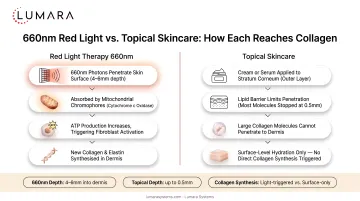
Multiple controlled trials document red light therapy's effects on collagen density, skin texture, and fine line appearance with consistent use. The mechanism - photobiomodulation-driven fibroblast activation - works at the dermis level, complementing topical approaches.
What distinguishes red light therapy from topicals: it works photochemically at the cellular level, bypassing the skin barrier penetration challenges that limit many ingredients.
Daily sessions of 5-20 minutes make it practically sustainable. Device quality determines whether the mechanism works: verified 660nm wavelength and adequate irradiance are the critical specs.
Vitamin C
Dual function: antioxidant against UV/pollution damage, and essential co-factor for collagen synthesis. L-ascorbic acid at 10-20% in stable formulations used morning is a strong complement to the collagen-building effects of retinoids and red light therapy.
Professional Procedures
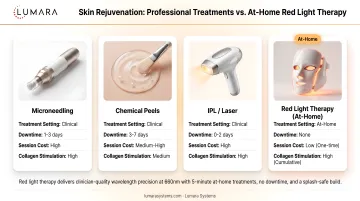
Microneedling: Creates controlled micro-injuries triggering robust collagen response. Produces faster, more dramatic collagen remodeling than light therapy alone. Requires downtime and professional expertise.
Chemical peels: Resurface the epidermis to trigger repair. Effect strength varies by peel depth (superficial to deep). Downtime varies accordingly.
IPL/Laser: Address specific concerns (pigmentation, vascular features, deeper resurfacing) with more targeted effects than topicals or light therapy.
Red light therapy works as a complement to all of these - supporting ongoing collagen maintenance and anti-inflammatory environment between professional treatments.
Building the Long-Term Routine
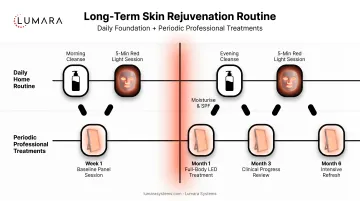
Daily foundation (every day, indefinitely):
- Morning: vitamin C serum + SPF
- Evening: red light therapy + retinoid + moisturizer
Enhancement (periodic):
- Chemical exfoliant 2-3x/week
- Professional treatments as appropriate (microneedling, peel, IPL) based on specific concerns
- For product pairing guidance, see best products for skin rejuvenation
Post-procedure:
- After peels, microneedling, or other professional treatments, resume red light therapy only once the skin barrier has recovered and the treating professional has cleared it
- Continue as foundation between professional treatments
The compounding principle: none of these approaches alone produces dramatic results. Consistently layered over months and years, they address aging from multiple angles simultaneously.
What to Look for in a Red Light Therapy Device
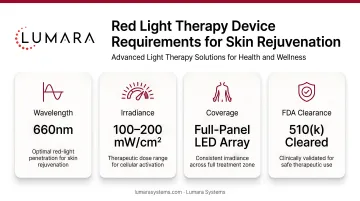
For skin rejuvenation, the device must deliver consistent, accurate 660nm output across the full face:
- Wavelength verification: Third-party tested 660nm output, not just labeled
- Irradiance: Minimum 20-30 mW/cm² at the treatment surface
- Full-face coverage: Even LED distribution from forehead to chin
- FDA clearance: Regulatory quality signal
- Session practicality: 5-20 minutes that fits daily use
Lumara's VISO LED Mask is built around all of these: 660nm triple-tested, 470 micro-LEDs at 30 mW/cm², 10" x 7" full-face coverage, FDA cleared.
Frequently Asked Questions
What is the most effective skin rejuvenation treatment?
There is no single best treatment - the most effective approach combines daily SPF, consistent retinoid use, regular red light therapy for collagen support, and targeted professional procedures for specific concerns.
How long does skin rejuvenation take?
Some users notice early improvements in skin radiance and overall appearance within 1–2 weeks, and visible changes may begin after just a few treatments. More noticeable tone, texture, and firmness improvements usually depend on consistent use and the device's wavelength, power, and treatment routine. Long-term compounding occurs over months and years.
Is red light therapy worth it for skin rejuvenation?
For consistent daily use with a quality device, yes. The collagen-stimulation mechanism is well-documented and the at-home accessibility makes consistent use practical in a way that professional treatments cannot match for frequency.
Can I combine red light therapy with retinoids?
Yes - and it is a recommended combination. Red light therapy in the evening on clean skin, then retinoid afterward. They support collagen from different angles.
Consistency Compounds Over Time
The most effective skin rejuvenation is not the most aggressive single treatment - it is the consistent layering of complementary approaches over time. Red light therapy's role is to provide a consistent dermal-support layer that can complement the rest of a well-built skin rejuvenation routine.
Lumara's VISO LED Mask - 660nm, triple-tested wavelength, 470 micro-LEDs, FDA cleared, full-face coverage - is built for exactly this daily foundation role.