
Introduction
The skin rejuvenation category is one of the most overcrowded in consumer wellness. Thousands of products claim to reverse, repair, or renew aging skin - and most of the difference between them comes down to marketing rather than mechanism.
This guide cuts through that. It covers the ingredient categories and device formats that have actual clinical evidence behind them, explains the mechanistic logic for each, and shows how red light therapy fits into a well-structured routine alongside skincare products.
Key Takeaways
- The core evidence-backed anti-aging ingredients are retinoids, vitamin C (L-ascorbic acid), peptides, and broad-spectrum SPF - these are where consistent routines should start
- Red light therapy at 660nm supports collagen production and cellular renewal through a different pathway than topicals - it is additive to a topical routine, not a replacement
- Ingredient priorities shift with age: prevention in your 30s, targeted repair in your 40s-50s, barrier support in your 60s+
- Product quality matters more than brand: verified active ingredient concentrations, appropriate packaging, and clinically supported formulations outperform expensive but underdosed products
- Device quality matters for red light therapy: wavelength verification, irradiance, full-face coverage, and FDA clearance are the specs that determine whether a device contributes
The Evidence-Backed Ingredient Categories
Retinoids
Retinoids (retinol, retinal, tretinoin) have the strongest evidence base in anti-aging skincare. They accelerate cell turnover, stimulate fibroblast activity for collagen production, and reduce hyperpigmentation.
OTC retinol converts to retinoic acid in skin - slower but accessible without a prescription. Prescription tretinoin is the most potent form - faster results but requires medical guidance and a tolerance-building period.
Start at low concentration (0.025-0.05%) used 2-3 nights per week, always followed by SPF the next morning. Expect 12+ weeks before meaningful visible improvement.
Vitamin C (L-Ascorbic Acid)
Vitamin C serves two complementary roles: neutralizing free radicals from UV and pollution damage (antioxidant protection), and acting as a collagen co-factor necessary for collagen synthesis. It is most effective in L-ascorbic acid form at 10-20% concentration, at pH below 3.5, in opaque packaging.
Formulas combining L-ascorbic acid with vitamin E and ferulic acid offer enhanced stability and have published data showing significantly improved photoprotection versus vitamin C alone.
Peptides
Peptides are amino acid chains that signal skin to perform specific functions. Signal peptides stimulate collagen production; carrier peptides deliver trace elements to support skin matrix; neurotransmitter-inhibiting peptides reduce muscle contraction to soften expression lines.
Peptides work best paired with hydrating ingredients. Look for specific named peptides on labels (hexapeptide, palmitoyl tripeptide) rather than vague "peptide complex" claims without disclosed concentrations.
SPF
Daily broad-spectrum SPF is the most impactful single anti-aging product available. UV exposure is the primary driver of extrinsic skin aging. Consistent SPF use prevents new damage while other treatments work on existing damage.
Physical sunscreens (zinc oxide, titanium dioxide) are generally better tolerated by sensitive or reactive skin. Mineral formulas with DNA repair enzyme technology (photolyase) offer protection beyond simple UV blocking.
Where Red Light Therapy Fits
Red light therapy at 660nm adds a different layer to a skincare routine - one that topicals cannot replicate.
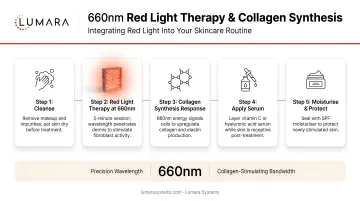
Topicals work by delivering active ingredients to skin cells. They are limited by skin barrier penetration, formulation stability, and bioavailability. Red light therapy works at the cellular level through photobiomodulation: 660nm wavelengths are absorbed by mitochondria in skin cells, supporting cellular energy and stimulating fibroblast activity directly.
The most studied outcome at 660nm is collagen synthesis. Research has shown increases in type-1 procollagen production and reductions in MMP-1 (a collagen-degrading enzyme) with consistent red light therapy use. These are the same markers that retinoids and vitamin C work toward through different pathways.
Used consistently, the two approaches are additive: topicals addressing surface renewal and ingredient delivery; red light therapy supporting deeper cellular collagen activity.
What to Look for in a Red Light Therapy Device
The mechanism only works if the device delivers accurate 660nm light at therapeutic irradiance to the full face consistently. Key specs:
- Wavelength verification: Triple-tested or independently verified 660nm output, not just stated on a spec sheet
- Irradiance: 30 mW/cm² is the benchmark for a session that delivers meaningful dose within 5-20 minutes
- Full-face LED coverage: Consistent coverage including forehead, cheeks, chin, and perioral area
- FDA clearance: Quality signal indicating the device has gone through regulatory review
Lumara's VISO LED Mask is built around these criteria: 660nm triple-verified, 470 micro-LEDs at 30 mW/cm², 10" x 7" full-face coverage, FDA cleared. For more on using a red light mask alongside retinol, see our dedicated guide.
Age-Specific Priorities
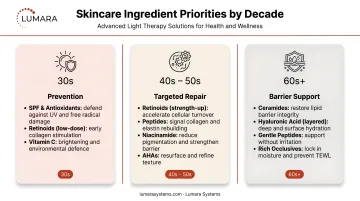
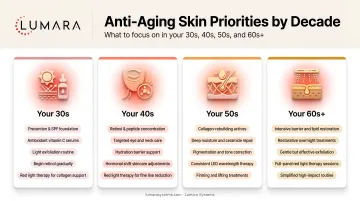
30s - Prevention first:
- Daily SPF and morning vitamin C serum form the foundation
- Introduce low-concentration retinol at night (0.025-0.05%) to build collagen before significant loss occurs
- Lightweight hyaluronic acid hydration
40s-50s - Targeted repair:
- Increase retinol concentration or consider prescription tretinoin
- Add glycolic acid or AHAs for texture and tone
- Incorporate peptides and richer moisturizers
- Add red light therapy to support deeper collagen activity alongside topicals
60s+ - Barrier repair and intensive support:
- Shift toward ceramide-rich moisturizers and growth factors
- Maintain gentle retinoids with increased emphasis on hydration
- Red light therapy remains relevant for collagen support at this stage
- Do not neglect neck and hands
Building the Routine
Morning:
- Gentle cleanser
- Vitamin C serum
- Moisturizer (hyaluronic acid or lightweight formula)
- Broad-spectrum SPF 30+
Evening:
- Red light therapy on clean, product-free skin (5-20 minutes)
- Retinoid or peptide serum
- Moisturizer with ceramides
Key principles:
- Apply products thinnest to thickest
- Vitamin C morning, retinoid evening - different pH requirements, different timings
- Consistency over months is the active ingredient - not any single product
Frequently Asked Questions
What skin rejuvenation products do dermatologists recommend? Retinoids, vitamin C (L-ascorbic acid), broad-spectrum SPF, peptides, and niacinamide form the core evidence-backed anti-aging stack. Daily sunscreen is consistently cited as the single highest-impact intervention.
Where does red light therapy fit in a skincare routine? Red light therapy is applied before serums and moisturizers, on clean dry skin. It is not a replacement for topicals - it adds a cellular stimulation layer that topicals cannot provide.
How long before skin rejuvenation products show results? Most topical actives require consistent use before visible improvement. With a properly powered red light system, some users may notice early improvements in radiance and overall skin appearance within 1-2 weeks, while deeper tone, texture, and collagen-related improvements build with consistent use.
What is the difference between red light therapy and skincare products? Topicals deliver active ingredients to skin cells. Red light therapy delivers photonic energy to support mitochondrial activity and cellular collagen synthesis. They address the same goal (skin quality improvement) through different mechanisms and are additive when used together.
Consistency Compounds
The most effective skin rejuvenation routines are not the most complicated. They are built on a small number of well-supported ingredients used consistently over months.
Red light therapy compounds that foundation at the cellular level - specifically at 660nm, which is where the collagen synthesis evidence is concentrated. Lumara's VISO LED Mask - 470 micro-LEDs, triple-verified 660nm, 30 mW/cm², FDA cleared - is designed for exactly that daily routine.