
Introduction
Red light therapy and skincare products are a natural pairing - but the sequencing and product selection matter. The wrong products before a session can block light penetration; the right products after leverage the cellular activity that photobiomodulation drives.
This guide covers what to apply before and after sessions, which ingredients complement red light therapy best, and what to avoid.
Key Takeaways
- Apply red light therapy to clean, product-free skin for maximum light penetration
- The best time to apply active serums is after red light therapy, not before
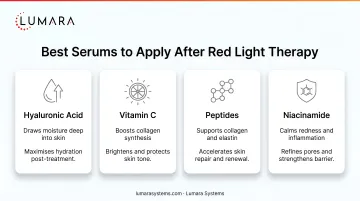
- Ingredients that complement red light therapy: hyaluronic acid, vitamin C, peptides, niacinamide
- Avoid thick physical sunscreens, heavy oils, and photosensitizing ingredients immediately before sessions
- Red light therapy and retinoids pair well - apply retinoids after sessions in the evening routine
Before Your Session: Start Clean
The most important rule for red light therapy is clean skin. Any product on the skin - moisturizer, SPF, foundation, serum - can partially block or scatter the light before it reaches tissue.
This is not about every molecule being blocked. It is about maximizing the consistent dose delivery that makes photobiomodulation effective. Clean skin ensures every session delivers the intended dose.
Before your session:
- Remove all makeup
- Cleanse with a gentle cleanser
- Pat dry
- No products applied before the session
One exception: water-based serums that have been fully absorbed (20+ minutes prior) and left no residue are generally fine. The concern is products still present on the skin surface during treatment.
After Your Session: The Best Products to Apply
The post-session window is when active ingredient application is most effective. Red light therapy increases local cellular activity and circulation in treated tissue - this enhanced cellular environment may support better absorption and utilization of topical actives. The mitochondrial response to photobiomodulation is the mechanism behind this cellular activation.
Hyaluronic Acid
Hyaluronic acid draws moisture into skin and supports barrier hydration. Applied to slightly damp skin immediately after a session, it locks in hydration while skin is in an elevated recovery state. Compatible with all skin types and non-irritating.
Vitamin C (L-Ascorbic Acid)
Vitamin C serves two roles: antioxidant protection and collagen synthesis co-factor. Used after red light therapy, it complements the photobiomodulation-driven collagen synthesis. Best formulations: 10-20% L-ascorbic acid in stable formulas.
Note: Some users prefer applying vitamin C in the morning and red light therapy in the evening to avoid any theoretical interaction concerns with unstable formulas. Both approaches are valid.
Peptides
Peptide serums signal cells to produce specific proteins including collagen. Used after red light therapy, they add a second collagen-stimulation signal alongside the photobiomodulation effect. Generally non-irritating and compatible with all skin types.
Niacinamide
Niacinamide reduces inflammation, strengthens the skin barrier, and inhibits excess melanin transfer. Post-session application supports the anti-inflammatory benefits of red light therapy and is particularly useful for skin with redness, sensitivity, or uneven tone concerns.
Retinoids and Red Light Therapy
Retinoids (retinol, tretinoin) are excellent complements to red light therapy - they address surface cell turnover while red light therapy supports deeper dermal collagen. But they require timing attention.
The recommended protocol:
- Evening: Red light therapy on clean skin (5-20 minutes)
- After: Apply retinoid as normal
- Do not apply retinoid before the session
Applying retinoid before red light therapy is not dangerous, but retinoids increase skin sensitivity and can create more photosensitivity at the surface. The cleaner the skin before the session, the more consistent the dose delivery.
What to Avoid Before Sessions
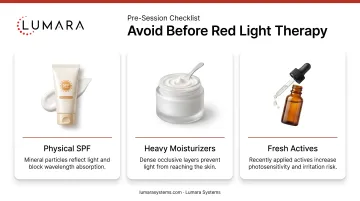
Heavy occlusive moisturizers and physical sunscreens (zinc oxide, titanium dioxide): Physical blockers reflect or scatter light at the skin surface. If applied before a session, they reduce the light reaching tissue.
AHAs and BHAs immediately before: Chemical exfoliants thin the stratum corneum and increase surface sensitivity. While not blocking light per se, using them immediately before a session adds unnecessary cumulative stress to the skin. For guidance on combining red light therapy with other acne treatments, see the related guide.
Fresh prescription topicals (retinoids, benzoyl peroxide, antibiotics): Apply these after sessions, not immediately before.
Building the Full Routine
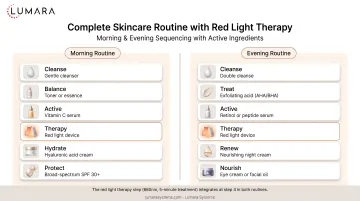
Morning routine (example):
- Cleanse
- Red light therapy session (optional morning timing)
- Vitamin C serum
- Hyaluronic acid
- Moisturizer
- SPF 30+
Evening routine (recommended):
- Double cleanse (remove all makeup and SPF)
- Red light therapy session on clean skin
- Hyaluronic acid or niacinamide serum
- Retinoid (if using)
- Moisturizer
For users with sensitive skin, peptides and niacinamide are gentler post-session options than vitamin C or retinoids while building tolerance.
Frequently Asked Questions
Should I apply serum before or after red light therapy?
After. Apply red light therapy to completely clean, product-free skin. Serums and actives should be applied after the session, not before.
Can I use vitamin C with red light therapy?
Yes - vitamin C and red light therapy both support collagen synthesis through different mechanisms, making them complementary. Apply vitamin C after sessions or in the morning if doing evening light therapy. For more on red light therapy wavelength and skin effects, see the dedicated guide.
Can I use red light therapy with retinoids?
Yes. The recommended protocol is red light therapy first on clean skin, then retinoid application afterward. Both support collagen - light therapy through photobiomodulation, retinoids through cell turnover.
What happens if I use red light therapy with products on my skin?
Products on the skin can scatter or block some of the light before it reaches tissue. The effect on results depends on the product type - heavy physical SPF blocks more than a thin serum. For optimal results, start sessions with clean skin.
Clean Skin In, Actives Out
Red light therapy is most effective when started on clean skin. The products that complement it best - vitamin C, peptides, hyaluronic acid, niacinamide, retinoids - go on after the session.
Lumara's VISO LED Mask - 660nm, triple-tested, 470 micro-LEDs, FDA cleared - is built for the daily clean-skin facial routine that makes this combination work. For a comparison of device formats, see red light panel vs mask.