Introduction
Both red light therapy and heating pads are used for pain relief and muscle recovery. They can feel similar during use - warmth, relaxation, reduced tension - but they work through fundamentally different mechanisms. Understanding that difference is what determines which one is the right tool for a given goal.
This guide covers how each works, what the research shows, where the practical differences show up, and how to choose between them.
Key Takeaways
- Heating pads work through surface heat: they increase local temperature, dilate blood vessels, and provide temporary pain relief through thermal response
- Red light therapy works through photobiomodulation: specific wavelengths interact with cellular structures to support repair, reduce inflammation, and produce cumulative effects
- Heating pads are better suited to acute muscle tension and immediate comfort; red light therapy is better suited to chronic inflammation, tissue repair, and sustained outcomes
- The two approaches are complementary and can be used together in the same routine
- Device quality matters significantly for red light therapy: wavelength accuracy, output, and whether the device includes near-infrared and far-infrared alongside red light determines what it can actually do
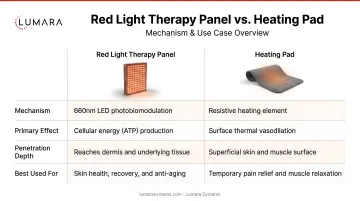
Quick Comparison
| Feature | Heating Pad | Red Light Therapy |
|---|---|---|
| Mechanism | Thermal response: vasodilation, muscle relaxation | Photobiomodulation: cellular energy, anti-inflammatory signaling |
| Tissue depth | Surface to 1-2cm (standard); 2-4cm (far infrared) | Red light can penetrate approximately 5–10 mm into the skin, depending on wavelength, power, exposure time, and tissue type; near-infrared wavelengths are generally used when deeper tissue support is the goal |
| Duration of effect | Temporary - fades within hours of use | Cumulative - builds with consistent sessions over weeks |
| Best suited for | Acute soreness, muscle tension, immediate comfort | Chronic inflammation, tissue repair, recovery routines |
| Session format | 15-30 minutes, on/off cycle | 5-30 minutes depending on device type |
| Primary limitation | No cellular effect; burns risk with prolonged contact | Requires consistent routine; device quality varies significantly |
How Heating Pads Work
A heating pad raises local tissue temperature. The thermal response produces several short-term effects: blood vessels dilate, increasing circulation to the area; muscle tension reduces as the tissue warms; pain signals are partly interrupted by the thermal sensation.
Standard electric heating pads produce surface heat that reaches approximately 1-2cm into tissue. Far-infrared heating pads use longer infrared wavelengths that penetrate slightly deeper - up to 3-4cm - and can produce similar effects with somewhat less surface heat, though the primary mechanism remains thermal.
Heating pads are effective for what they do. The limitation is that the effects are time-limited: once the heat is removed, circulation returns to baseline within hours. There is no cumulative tissue-level change from repeated heating pad use.
They are genuinely useful for:
- Acute muscle soreness after activity
- Menstrual cramps
- Stiffness from inactivity or postural tension
- Quick, accessible comfort between other recovery approaches
How Red Light Therapy Works
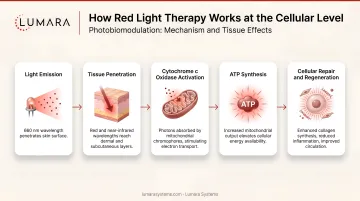
Red light therapy uses specific wavelengths - typically 660nm for red light, 830-850nm for near-infrared - to interact with cellular structures in tissue. Unlike heat, which acts through temperature change, red light acts through photochemical responses in cells.
The primary mechanism involves absorption by mitochondria, which supports cellular energy production and anti-inflammatory signaling. This has downstream effects on:
- Reduction in pro-inflammatory cytokines (including TNF-alpha)
- Support for tissue repair at the cellular level
- Improved local circulation through nitric oxide release
- Faster clearance of inflammatory mediators
The key difference from heating pads is that these effects are cumulative. A single session produces a transient response; consistent sessions over weeks produce lasting changes in tissue condition. Research on photobiomodulation for chronic musculoskeletal conditions consistently shows results building over 4-8 week protocols, not single sessions.
The Practical Differences
Duration of Effect
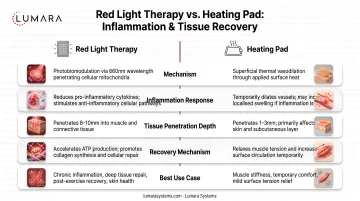
A heating pad's benefit fades within a few hours of use. Red light therapy's benefit from a consistent protocol builds and persists - users on 4-week protocols for conditions like fibromyalgia and chronic back pain show sustained improvements that outlast the treatment period.
This makes them suited to different goals: immediate comfort versus progressive improvement.
Tissue Depth
Red light can penetrate approximately 5–10 mm into the skin, depending on wavelength, power, exposure time, and tissue type. Near-infrared wavelengths at 830-850nm are generally used when deeper tissue support is the goal - reaching into muscle and joint tissue. Far-infrared heat from a far-IR pad reaches 2-4cm through a primarily thermal mechanism.
For superficial muscle and joint conditions, red light and near-infrared cover the relevant tissue depth. For conditions where deeper thermal effect is the goal, far-infrared pads have a depth advantage.
Inflammation vs. Comfort
A heating pad does not reduce inflammation at the cellular level. It temporarily relieves pain associated with tension and provides comfort, but the underlying inflammatory state is unchanged. Red light therapy has documented anti-inflammatory effects at the cellular level, making it more appropriate as a tool for chronic inflammatory conditions rather than purely acute comfort management.
When to Use Each
Use a Heating Pad When:
- You need immediate comfort from acute muscle tension or soreness
- Cost and simplicity are priorities
- The goal is temporary relief during activity or sleep
Use Red Light Therapy When:
- You are managing a chronic inflammatory condition (joint pain, musculoskeletal conditions, slow-healing tissue)
- You want cumulative, sustained results rather than temporary relief
- You are supporting a recovery routine alongside exercise, physical therapy, or other interventions
- Skin-level benefits (appearance support, wound healing) are also relevant
Using Both Together
The two approaches are complementary. Many users incorporate heating pads for immediate pre-session comfort or post-exercise tension relief, and red light therapy for their core recovery protocol. They work through different mechanisms and do not interfere with each other.
Where Lumara Fits
For users looking for a red light therapy option in the body recovery and pain management category, Lumara's Pad is the most directly relevant product - a flexible, multi-wavelength light therapy pad designed for body-contact use across back, stomach, knees, shoulders, and other large body areas.
The Lumara Pad uses red, near-infrared, and far-infrared wavelengths combined - offering photobiomodulation effects alongside thermal-adjacent far-infrared output. It is available in multiple sizes (from 11 x 11" up to 20 x 30") to match the treatment area. Treatment guidance is 20-30 minutes.
For users who prefer a panel format - positioned at a distance rather than placed directly on the body - Lumara's Illuminate V2 (660nm, 1,800 LEDs, 1,200 cm², 5 minutes) is the panel-based alternative for targeted body and facial use.
Frequently Asked Questions
Is red light therapy the same as a heating pad?
No. A heating pad produces warmth through thermal energy transfer. Red light therapy produces photochemical responses in cells through specific wavelengths of light. They feel similar during use but work through different mechanisms and produce different effects - heating pads for temporary thermal relief, red light therapy for cumulative cellular-level changes.
Do far-infrared heating pads work the same as far-infrared light therapy?
Far-infrared heating pads use FIR emission to warm tissue slightly more deeply than standard pads, but the primary mechanism is still thermal. Far-infrared light therapy devices used in photobiomodulation protocols deliver FIR at specific wavelengths for targeted tissue effects. The products overlap in name but differ in mechanism.
Can I use a heating pad and red light therapy together?
Yes. They work through different mechanisms and are compatible. Using a heating pad for pre-session muscle relaxation followed by a red light therapy session is a common combined approach.
How often should I use red light therapy for recovery?
Most evidence-supported protocols use 3-5 sessions per week. For body recovery applications, sessions of 10-20 minutes per area (or 5 minutes for panel formats like Illuminate V2) are typical. Consistency over 4-8 weeks is what produces sustained results.
Is red light therapy worth it compared to a heating pad?
Depends on your goal. For immediate, temporary relief from acute soreness, a heating pad is simpler and less expensive. For managing chronic inflammatory conditions, supporting tissue repair, or adding a cumulative recovery tool to a routine, red light therapy offers effects a heating pad cannot provide. The comparison is not which is better overall - it is which is the right tool for your specific goal.
Two Different Tools for Different Goals
A heating pad is useful, accessible, and effective for immediate comfort. Red light therapy is a different category of tool - one built around cumulative cellular effects that a heating pad cannot replicate.
For users who want to go beyond surface heat and build a recovery routine around light therapy, Lumara's Pad offers red, near-infrared, and far-infrared wavelengths in a flexible format built for body-contact use.