Introduction
Near-infrared (NIR) and far-infrared (FIR) are both invisible wavelengths beyond the visible red spectrum, and both are marketed for wellness and recovery applications. But they work through fundamentally different mechanisms, penetrate tissue to different depths, and are best suited to different applications.
Understanding the distinction matters for device selection: NIR devices are photobiomodulation tools; FIR devices are primarily heat therapy tools. They overlap in some applications but are not interchangeable.
Key Takeaways
- Near-infrared (700-1100nm) works through photobiomodulation - cellular mechanisms driven by light energy absorption, not heat
- Far-infrared (1100nm+) works primarily through heat - tissue warming, vasodilation, and systemic heat stress response
- NIR generally penetrates deeper than visible red light, reaching muscle and joint tissue through photochemical interaction - penetration varies by wavelength, power, exposure time, and tissue type
- FIR produces surface and moderate tissue warming through thermal radiation
- The most comprehensive body recovery approach combines red + NIR + FIR - each addressing a different aspect of recovery
- Lumara's Pad combines all three wavelength types in a flexible body-contact format
Near-Infrared: Photobiomodulation at Depth
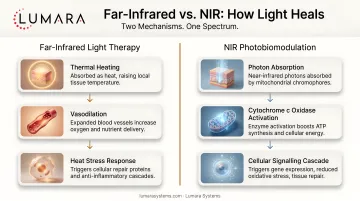
Near-infrared light at 700-1100nm (most commonly 830-850nm in therapeutic devices) is absorbed by cytochrome c oxidase in mitochondria - the same cellular target as red light therapy at 660nm, but at greater tissue depth.
At 830-850nm, NIR:
- Generally penetrates deeper than visible red light - reaching into muscle belly, joint capsule, and tendon tissue
- Drives cellular energy (ATP) production in deeper tissue structures
- Reduces pro-inflammatory cytokines at the cellular level in deeper tissue
- Supports muscle recovery and tissue repair at depths that 660nm cannot reliably reach
This is why NIR is the more relevant wavelength for:
- Post-exercise muscle recovery (DOMS reduction)
- Joint and tendon support
- Deep tissue inflammation
- Applications where the target tissue is below the skin and superficial dermis
NIR therapy at consumer device irradiance levels produces minimal heat. The mechanism is photochemical, not thermal.
Far-Infrared: Heat as Therapy
Far-infrared at 1100nm+ does not produce the same photobiomodulation response as NIR or red light. At this wavelength, the primary mechanism is thermal:
- FIR heats tissue from within through infrared radiation absorption
- This raises local and core tissue temperature
- Triggers vasodilation (blood vessel widening)
- Increases blood flow and circulation to heated tissue
- At full-body exposure (infrared sauna), induces sweating and a systemic heat stress response
FIR is the wavelength responsible for the warmth experienced during infrared sauna use. The therapeutic claims center on cardiovascular conditioning effects, muscle relaxation through vasodilation, and sweating and heat-based relaxation.
FIR does not drive the collagen synthesis, cellular energy production, or anti-inflammatory cytokine reduction that NIR photobiomodulation produces. Describing FIR sauna as photobiomodulation is technically inaccurate.
Side-by-Side Comparison
| Factor | Near-Infrared (700-1100nm) | Far-Infrared (1100nm+) |
|---|---|---|
| Primary mechanism | Photobiomodulation (cellular energy, anti-inflammatory) | Thermal (heat, vasodilation) |
| Tissue penetration | Generally deeper than visible red light; reaches muscle and joint tissue | Surface/shallow thermal warming |
| Heat produced | Minimal (at consumer device levels) | Significant - the intended effect |
| Best for | Muscle recovery, joint support, deep tissue anti-inflammatory | Whole-body relaxation, cardiovascular conditioning, sauna-style warming |
| Device type | LED panels, pads with NIR LEDs | Infrared saunas, FIR heating pads |
| Can they be combined? | Yes - NIR + FIR covers photobiomodulation AND heat benefits |
When Each Makes More Sense
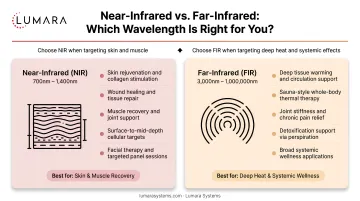
Choose near-infrared when:
- The goal is cellular recovery from muscle or joint stress
- You need anti-inflammatory effects at tissue depth
- Skin-adjacent applications where heat is not the primary goal
- Combined with red light (660nm) for surface + deep tissue coverage
Choose far-infrared when:
- The goal is systemic warming and muscle relaxation - a different outcome from a heating pad
- Cardiovascular conditioning through heat stress
- Sauna-style recovery and sweating
- Whole-body thermal therapy
Use both (red + NIR + FIR) when:
- Comprehensive body recovery is the goal
- You want surface photobiomodulation (red), deep tissue photobiomodulation (NIR), and thermal relaxation (FIR) in the same session
- Broader systemic wellness support alongside targeted cellular effects
Lumara Pad: Red + NIR + FIR in One Device
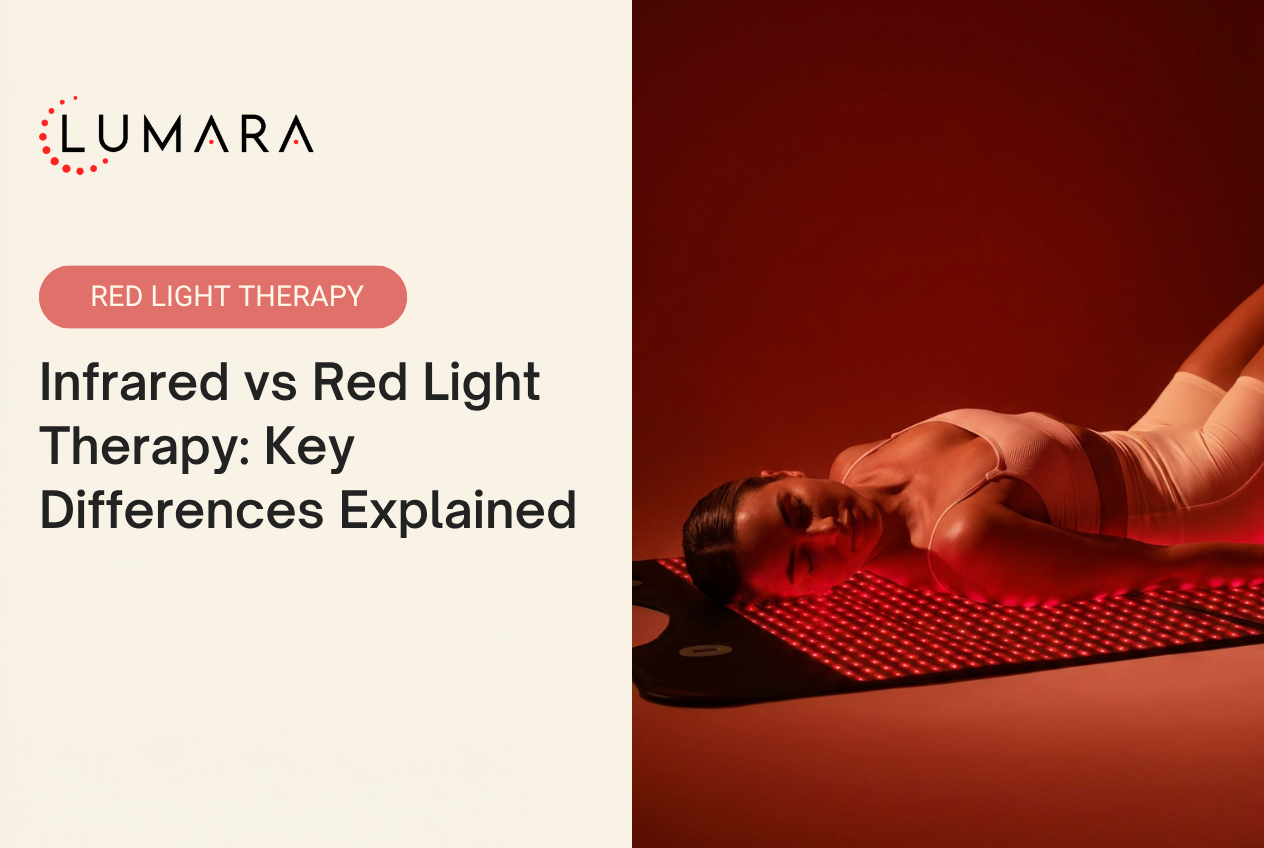
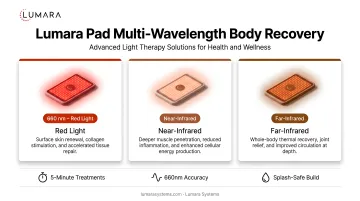
Lumara's Pad is the product in Lumara's lineup that covers all three wavelength ranges in a single flexible device. Available in multiple sizes (11x11" through 20x30"), it is designed for direct body-contact use across the back, stomach, knees, shoulders, and other areas.
The combination of red, near-infrared, and far-infrared in a flexible body pad means:
- 635nm red light: surface-level red light support
- 830nm near-infrared: deeper tissue photobiomodulation for muscle and joint support - applied directly to bare skin for best results
- 940nm near-infrared: thermal warmth and circulation support
Treatment guidance is 20-30 minutes per session - longer than panels because the pad format and multi-wavelength delivery benefit from extended contact.
Frequently Asked Questions
What is the difference between near-infrared and far-infrared light therapy?
Near-infrared (700-1100nm) works through photobiomodulation - cellular mechanisms in mitochondria that produce anti-inflammatory and repair effects. Far-infrared (1100nm+) works primarily through heat - warming tissue, dilating blood vessels, and creating a thermal response. Different mechanisms, different applications.
Which is better for muscle recovery - near-infrared or far-infrared?
Near-infrared has a more specific evidence base for cellular muscle recovery (DOMS reduction, cellular energy support). Far-infrared contributes through improved circulation and thermal muscle relaxation. The most comprehensive recovery approach uses both.
Is near-infrared the same as infrared sauna?
No. Infrared saunas use far-infrared to produce a heat response. Near-infrared therapy panels use shorter NIR wavelengths (830-850nm) for photobiomodulation at tissue depth. Different wavelengths, different mechanisms.
What is the best wavelength for deep tissue recovery?
Near-infrared at 830-850nm is the most studied wavelength for deep tissue photobiomodulation, generally penetrating deeper than visible red light to reach muscle and joint tissue. Actual penetration varies by wavelength, power, exposure time, and tissue type. For the deepest applications, NIR is the more relevant choice over red light (660nm) alone.
Can I use near-infrared and far-infrared together?
Yes. Combining NIR and FIR (alongside red light) covers photobiomodulation effects and thermal/circulatory effects simultaneously. Lumara's Pad includes all three in a single device.
The Right Wavelength for the Right Depth
Near-infrared and far-infrared serve different purposes in recovery and wellness. NIR drives cellular photobiomodulation at depth; FIR provides therapeutic warmth and circulation support. For comprehensive body recovery, both contribute something the other cannot.
Lumara's Pad - red, near-infrared, and far-infrared wavelengths, flexible format, multiple sizes, 3-year warranty - is built for users who want all three in a single body-contact device.