Introduction
Infrared sauna and red light therapy are two of the more popular at-home wellness tools in recovery and skin health circles. Both involve light and heat. Both are often described as beneficial for circulation, recovery, and skin wellness. But they work through different mechanisms - and understanding that difference is what makes combining them meaningful rather than redundant.
This guide covers what each does, how combining them works, the correct protocol sequence, and where Lumara's Illuminate V2 fits.
Key Takeaways
- Infrared sauna (far-infrared) works primarily through heat: vasodilation, core temperature increase, sweating, and a systemic heat stress response
- Red light therapy (660nm red or 830-850nm near-infrared) works through photobiomodulation: cellular mechanisms independent of significant heat
- The two are complementary: sauna creates a warm, vasodilated tissue environment; red light therapy drives cellular photobiomodulation that benefits from that environment
- Correct order: red light therapy before sauna, or red light during the pre-heating phase, not after when skin is heated and tissue is maximally vasodilated
- Lumara's Illuminate V2 is splash-safe and fits naturally into a pre-sauna red light routine
What Infrared Sauna Does
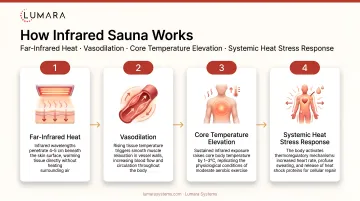
Infrared saunas use far-infrared wavelengths (1100nm+) to heat the body from within rather than heating the air as traditional saunas do. The mechanism is primarily thermal:
- Raises core body temperature by 1-3°C
- Induces significant vasodilation, increasing blood flow throughout the body
- Stimulates sweating and associated detoxification responses
- Creates a heat stress response with documented cardiovascular conditioning effects
- Promotes muscle relaxation through thermally induced vasodilation
Infrared sauna is a heat therapy. The wellness claims around it center on the cardiovascular and metabolic responses to sustained elevated body temperature - not photobiomodulation.
What Red Light Therapy Does Differently
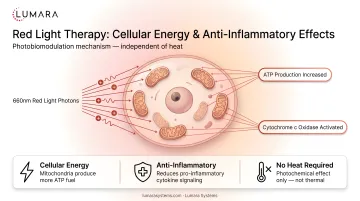
Red light therapy at 660nm and near-infrared at 830-850nm work through photobiomodulation - not heat. The mechanism involves photons absorbed by mitochondria in cells, which:
- Supports ATP (cellular energy) production
- Reduces pro-inflammatory cytokine levels
- Stimulates fibroblast activity and collagen synthesis (relevant at 660nm for skin)
- Supports muscle recovery and tissue repair
At consumer device irradiance levels, red light therapy produces minimal tissue heating. The therapeutic effect is photochemical, not thermal. This is the fundamental distinction.
Why Combining Them Can Add Value
The two mechanisms are genuinely complementary:
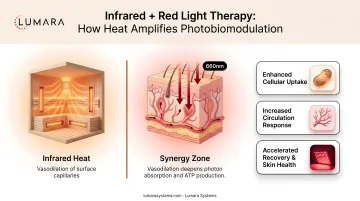
Infrared sauna creates: A warm, vasodilated tissue environment with elevated blood flow, relaxed muscle tissue, and an open, warmed skin surface.
Red light therapy delivers: Photobiomodulation that drives cellular energy, collagen production, and anti-inflammatory effects.
The vasodilated, blood-flow-enhanced tissue environment created by sauna heat may improve the distribution and utilization of the cellular energy produced by photobiomodulation. Skin in a warm, vasodilated state absorbs light differently than cold, constricted skin.
Additionally, the two target different aspects of recovery: sauna for whole-body cardiovascular and metabolic response; red light therapy for localized cellular repair and skin quality.
The Correct Protocol Order
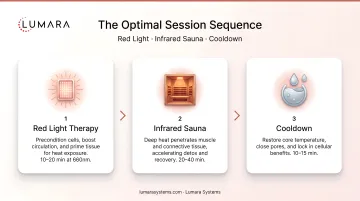
Red light therapy before sauna is the standard recommendation for combining both in the same session.
The rationale: red light therapy on pre-warmed but not overheated skin allows the photobiomodulation mechanism to work in a comfortable, normal tissue environment. Applying red light therapy after a full sauna session means exposing skin that is maximally heated, highly vasodilated, and physiologically stressed - conditions that may reduce the precision of photobiomodulation and increase skin sensitivity.
Practical protocol:
- Pre-heat the sauna (if applicable) while preparing
- Apply red light therapy for 5-10 minutes (Illuminate V2 is 5 minutes) before entering the sauna or during the initial low-temperature phase
- Complete the sauna session (typically 15-30 minutes)
- Cool down and hydrate
For skin-focused applications (collagen, face), apply red light therapy before the sauna to clean, dry skin and allow the photobiomodulation benefit to be delivered before the heat stress begins.
Why the Illuminate V2 Works for This Application
Lumara's Illuminate V2 is the relevant Lumara product for sauna-adjacent red light use. Key reasons:
Splash-safe build: Sauna environments involve humidity, moisture, and occasional water contact. Illuminate V2's splash-safe construction handles this environment safely.
5-minute sessions: A 5-minute treatment window fits naturally into a pre-sauna or early-session protocol without disrupting the overall session flow.
660nm wavelength, 1,800 LEDs, 1,200 cm²: Broad coverage for body and facial use in a single session before the sauna.
Sauna-adjacent format: The panel format can be positioned before a sauna session or in a sauna-adjacent setup, making it practical for a pre-sauna red light routine.
| Spec | Detail |
|---|---|
| Wavelength | 660nm red light |
| LEDs | 1,800 |
| Coverage area | 1,200 cm² |
| Session time | 5 minutes |
| Build | Splash-safe |
| FDA cleared | Yes |
| Made in | USA |
Frequently Asked Questions
Can you use red light therapy in an infrared sauna?
Yes. Red light therapy and infrared sauna use different mechanisms and are compatible. The recommended order is red light therapy before or at the start of the sauna session, not after.
Does infrared sauna count as red light therapy?
No. Infrared sauna uses far-infrared wavelengths that work primarily through heat. Red light therapy uses 660nm or 830-850nm wavelengths that work through photobiomodulation - a cellular mechanism independent of significant heat.
What order should I do red light therapy and infrared sauna?
Red light therapy first, then sauna. This allows photobiomodulation to work in a normal tissue environment before heat stress changes the skin's physiological state.
How long should I use red light therapy before a sauna?
5-15 minutes is the practical range. Lumara's Illuminate V2 runs a complete 5-minute session, which fits naturally before entering the sauna.
Can Lumara's Illuminate V2 be used before an infrared sauna session?
Yes. Illuminate V2 can fit into a pre-sauna routine. Use it before sauna exposure or in a sauna-adjacent setup unless Lumara explicitly confirms in-sauna use for your specific setup.
Different Tools, Better Together
Infrared sauna and red light therapy address different aspects of recovery and wellness. Combined with the right protocol, they are more valuable together than either alone.
Lumara's Illuminate V2 - 660nm, splash-safe, 5-minute sessions, FDA cleared - is the sauna-compatible red light format built for this application.