Introduction
Red light therapy tends to feel straightforward until the moment you try to choose the right device for skin. What begins as a simple search for help with fine lines, firmness, or overall skin support quickly turns into a list of technical decisions: red light alone or mixed wavelengths, mask or panel, visible red or red plus near-infrared. Once those choices start stacking up, the wavelength stops feeling like a minor spec and starts feeling like the detail that defines the treatment.
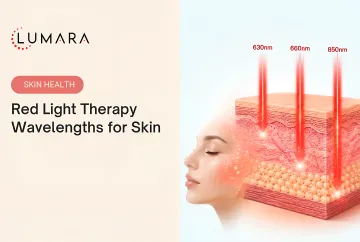
For skin-focused light therapy, that shift matters. Different wavelengths exist across the broader category, but they are not all serving the same purpose. When the treatment is built specifically around pure red light for facial skin, 660nm stands out because it is repeatedly associated with collagen-focused routines, visible skin support, and a more targeted treatment approach. That makes it one of the clearest places to start when comparing red-light devices for skin.
Key Takeaways
- For skin-focused red light therapy, 660nm is one of the most relevant wavelengths because it is closely associated with facial routines centered on collagen support, visible skin tone, and overall skin appearance.
- Other wavelengths do exist across the broader light-therapy category, but they are not all used for the same purpose.
- Wavelength is important, but it is not the only thing that matters. Coverage, device format, and session design also shape how effective a treatment feels in real use.
- A red-only device can create a more focused treatment experience because the product is built around one clear wavelength and one clear role.
- Lumara’s dedicated red-light skin devices — the VISO LED Mask and Illuminate Red Panel — are both built around 660nm only, while its broader systems use additional wavelengths for different goals.
What Wavelength Actually Means in Red Light Therapy for Skin
In red light therapy, wavelength refers to the specific part of the light spectrum a device emits, measured in nanometers (nm). For skin-focused devices, that number matters because it helps define what kind of light is being used and what kind of treatment the device is designed to support.
That does not mean every wavelength is interchangeable. Different wavelengths are used across different kinds of light-therapy systems. Some are used in blue-light devices, some in green-light devices, some in multi-wavelength clinical stations, and some in red-plus-near-infrared systems.
Lumara’s own broader lineup reflects that: the PRO is a multi-wavelength clinical system, and its Pad combines 635nm, 830nm, and 940nm for deeper body-focused recovery. But when Lumara builds products specifically for pure red-light skin treatment, the wavelength it centers is 660nm.
In Practical Terms, Wavelength Helps Answer Three Questions:
| What wavelength tells you | What it does not tell you on its own |
|---|---|
| What kind of light the device uses | How evenly the light is delivered |
| Whether the device is focused or multi-wavelength | How practical the session will feel |
| How the product is being positioned | Whether the treatment experience will feel consistent |
Wavelength is where the evaluation begins. After that, the more useful question becomes how well the device is built around it.
Why 660nm Stands Out for Skin-focused Red Light Therapy
Different wavelengths exist across the broader light-therapy category, but they are not all used for the same purpose. When the focus narrows to pure red-light treatment for skin, 660nm stands out because it supports a more specific treatment direction. It is commonly associated with facial routines centered on:
- collagen support
- visible skin tone
- and overall skin appearance
That focused role is part of what makes 660nm so useful in practice. Rather than asking one device to balance multiple kinds of light in the same format, a 660nm design can stay centered on visible red-light skin treatment.
Why 660nm is Used so Often for Skin-focused Treatment
- It is closely associated with visible red-light facial routines
- It supports a more targeted, skin-first treatment approach
- It gives the device a clearer treatment identity
- It is easier to build a dedicated facial mask or panel around one focused wavelength
| Design approach | What it emphasizes |
|---|---|
| Single-wavelength red-light design | Focused skin treatment, clearer device role, simpler treatment logic |
| Multi-wavelength design | Broader treatment scope across multiple light types |
Why Wavelength Alone Still is Not Enough
Even when the wavelength is clear, it is still only part of the picture. A strong skin device is not defined by wavelength alone, but by how well the whole design supports that wavelength in real use.
| What matters beyond wavelength | Why it matters |
|---|---|
| Coverage | Affects how evenly the treatment area is exposed |
| Session design | Affects how easy the routine is to maintain |
| Device format | Shapes how the wavelength is experienced in actual use |
Mask vs Panel: Which Format Makes More Sense?
If the goal is facial skin support, the choice between a mask and a panel is less about which one is “better” and more about which one fits the treatment style.
A mask makes more sense when the priority is:
- facial skin support
- hands-free use
- repeatable placement
- a routine that fits easily into daily or near-daily skincare
A panel makes more sense when the priority is:
- broader treatment flexibility
- larger treatment zones
- a more open setup
- faster, more output-focused sessions
How Lumara Applies 660nm in Real Skin Devices
Lumara’s strongest red-light skin examples are its two red-only products: the VISO LED Mask and the Illuminate Red Panel.
VISO LED Mask
The VISO is built around 660nm only and uses 470 micro-LEDs. It is a dedicated facial red-light device with full-face coverage, verified wavelength accuracy, and a format designed for regular at-home use. VISO leaves out near-infrared in the mask format, a choice tied to comfort and eye-safe use without bulky goggles.
Illuminate Red Panel
The Illuminate Red Panel follows the same wavelength logic in a different format. It is also built around 660nm red light, but in a panel format that offers broader coverage and a more professional treatment setup. Lumara positions it as a faster, higher-output option, with 5-minute treatment guidance and tight LED spacing to support a more even, efficient session.
| Lumara device | Wavelength focus | Main treatment style |
|---|---|---|
| VISO LED Mask | 660nm only | Face-first, routine-friendly red-light skincare |
| Illuminate Red Panel | 660nm only | Broader, higher-output red-light treatment |
What Matters Most
When people ask about the best red light therapy wavelength for skin, they are usually trying to solve a practical decision: which spec actually matters, and which one is just there to make the product sound advanced.
The honest answer is that other wavelengths do exist, and some belong in broader light-therapy systems. But for pure red-light skin treatment, 660nm stands out because it supports a more focused, skin-specific treatment approach.
Lumara centers it in both its red-only facial mask and its red-only panel. That is the clearest way to read the category: start with the wavelength, then look at how intentionally the device is built around it. In Lumara’s case, that answer is unusually consistent — and that consistency is part of what makes 660nm so compelling for skin-focused red light therapy.
FAQs
What is the best red light therapy wavelength for skin?
For pure red-light skin treatment, 660nm stands out as one of the strongest wavelengths to focus on. It is widely associated with facial routines centered on collagen support, visible skin tone, and overall skin appearance.
Why does 660nm get so much attention in red light therapy for skin?
660nm gets attention because it supports a more focused red-light treatment approach for skin. It is commonly used in facial devices designed around visible red-light skincare rather than broader multi-wavelength therapy.
Are other wavelengths used in light therapy?
Yes. Other wavelengths are used across the broader light-therapy category, including blue, green, near-infrared, and mixed-wavelength systems. They are not all serving the same purpose, which is why the treatment goal matters when comparing devices.
Is wavelength the only thing that matters in a red light therapy device?
No. Wavelength is an important starting point, but it does not explain the full treatment experience on its own. Coverage, device format, and session design also matter because they shape how the light is delivered and how easy the device is to use consistently.
Why would someone choose a red-only device instead of a multi-wavelength device?
A red-only device can feel more focused because it is built around one clear wavelength and one clear treatment role. For skin-focused red-light routines, that can make the device easier to understand and easier to fit into a regular skincare routine.
What is the difference between a red light mask and a red light panel?
A mask is usually better suited to face-first routines because it offers repeatable placement and hands-free use. A panel offers more flexibility and can work well for broader treatment setups. The better choice depends on the treatment area and how you want the routine to fit into daily use.