Introduction
Red light therapy has evolved from a clinical exclusive to a living room staple. What once required dermatology appointments and wellness clinic visits now sits on bathroom counters worldwide. This democratization of photobiomodulation technology means consumers face a real decision: invest in professional clinic sessions or bring the same core technology home.
That choice shapes your results, safety profile, and long-term costs more than most people expect. Clinic sessions deliver higher-intensity light with professional oversight but lock you into recurring fees. Home devices require upfront investment but enable the daily consistency that research shows drives meaningful outcomes.
TLDR
- Clinic sessions deliver higher irradiance (100–200 mW/cm²) for faster per-session results, but cost $75–$110+ per visit with no device ownership
- Home devices allow daily use at lower upfront cost — results build cumulatively over 8–16 weeks, so frequency matters
- The real performance gap is power output and coverage area, not wavelength — both settings use the same 660nm red and 810–850nm near-infrared spectrum
- Both settings are safe when protocols are followed — home use requires user discipline and consistent eye protection
- Many users benefit from an intensive clinic phase followed by home maintenance, or consistent home use from day one
Home vs. Clinic Red Light Therapy: Quick Comparison
Here's how the two options compare across the factors that matter most to most buyers.
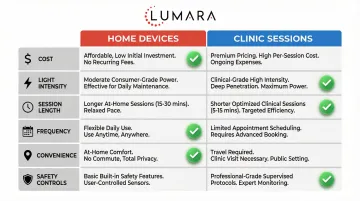
| Factor | Home Devices | Clinic Sessions |
|---|---|---|
| Cost | $150–$2,000+ one-time; pennies per session in electricity | $25–$200 per session (Thervo), typically $75–$110 |
| Light Intensity | 10–30 mW/cm² (masks); up to 100 mW/cm² (premium panels) | 100–200 mW/cm² (full-body clinical systems) |
| Session Length | 10–20 minutes per area | 5–15 minutes treatment time; 30–60 minutes total with prep and travel |
| Frequency | Daily or 3–5× weekly on-demand | Weekly or bi-weekly scheduled appointments |
| Convenience | Immediate access, no scheduling | Requires booking, travel, appointment windows |
| Safety Controls | User-managed; requires eye protection and adherence to instructions | Professional setup, calibrated equipment, staff oversight |

What Is Home Red Light Therapy?
Home red light therapy uses LED panels, masks, or handheld devices emitting red (630–670nm) and near-infrared (700–1100nm) wavelengths to trigger photobiomodulation—the biological process where light energy influences cellular function. Specifically, these wavelengths are absorbed by cytochrome c oxidase in mitochondria, boosting ATP production and activating tissue repair pathways.
The critical advantage of home therapy is consistency. Photobiomodulation results accumulate over weeks, not days. Having a device at home eliminates scheduling friction and enables the 3–5× weekly sessions that research links to measurable outcomes. Clinic visits typically allow only one or two sessions per week, meaning home users accumulate more total light energy over any given month.
That frequency advantage only holds if the device itself is accurate. Wavelength precision matters — therapeutic effects peak at specific nanometer ranges, and devices targeting 660nm hit the optimal absorption window for skin and tissue. Not all home devices hit that mark. Lumara Systems' panels are built to 660nm accuracy with 5-minute treatment sessions and a splash-safe design, practical for bathroom routines where skin and scalp care naturally fits.
Look for FDA clearance or equivalent certification when evaluating home devices. FDA 510(k) clearance means the device is "substantially equivalent" to legally marketed devices in safety and effectiveness. While not the same as full premarket approval requiring clinical trials, clearance indicates the FDA considers the device low-risk and technologically sound for consumer use.
Use Cases of Home Red Light Therapy
Primary home applications include:
- Daily skincare maintenance – collagen stimulation, fine line reduction, improved skin texture
- Acne management – at-home LED devices combining blue and red light significantly reduce inflammatory and non-inflammatory lesions over 4–12 weeks
- Post-workout muscle recovery – reducing inflammation and supporting circulation
- Scalp and hair growth routines – 16-week studies show helmet devices increase hair density by 41.90 hairs/cm² with every-other-day use
- General wellness rituals – stress reduction and relaxation support
Research confirms home devices work when used consistently. A randomized, double-blind study of a 630nm/850nm LED mask showed significant improvements in crow's feet and skin elasticity after 16 weeks of use (9 minutes per session, 5× weekly).
What Is Clinic Red Light Therapy?
Clinic red light therapy delivers professional photobiomodulation in dermatology offices, med spas, physical therapy clinics, and wellness centers using high-power, large-format LED systems. Professional equipment is engineered for greater irradiance and body-area coverage, enabling faster delivery of target light doses than most consumer devices.
That hardware advantage is only part of the picture. The clinical environment adds layers of control that home devices can't replicate:
- Trained professionals select wavelengths, distance, and duration based on your skin type and goals
- Regularly calibrated equipment ensures accurate, consistent dosing across every session
- Sanitized, controlled settings eliminate the environmental variables that affect home use
- Personalized protocols adapt over time — fixed consumer settings cannot do this
Clinic settings offer the clearest advantages in three scenarios:
- Post-procedure recovery — skin sensitized by chemical peels, microneedling, or laser treatments benefits from supervised, calibrated dosing
- Intensive aesthetic programs — early-phase protocols targeting visible changes in skin tone or texture, tracked by a professional
- Musculoskeletal rehabilitation — supervised treatment for acute or chronic pain in physical therapy or chiropractic settings
Use Cases of Clinic Red Light Therapy
Clinics are the better choice in these specific situations:
- LED photobiomodulation significantly reduces post-treatment redness and swelling following laser resurfacing or IPL — making it a natural clinical add-on
- Structured anti-aging programs benefit from defined visit series with professional progress tracking
- Rehabilitation settings use supervised red light treatment for both acute injuries and chronic musculoskeletal pain
Clinical-grade devices typically deliver higher intensities than consumer alternatives, with full-body panels outputting 100–200 mW/cm² compared to 10–30 mW/cm² for premium home masks.
Performance, Safety & Cost: A Head-to-Head Breakdown
Performance
Clinic systems win on raw power and coverage speed. Professional full-body panels deliver 100–200 mW/cm², allowing deep tissue penetration and shorter session times. Home masks typically deliver 10–30 mW/cm², effective primarily for superficial skin concerns.
Home devices win on cumulative dose over time. Because photobiomodulation follows a dose-over-time model (Dose = Irradiance × Time), a home device used 5× weekly for 10 weeks delivers more total light energy than a clinic visited once weekly. Studies show home device outcomes become measurable after 8–16 weeks of consistent use—timelines that require the frequency only home access enables.
Wavelength precision narrows the gap significantly. Both well-specified home devices and clinic systems target the same therapeutic bands: red ~630–700nm and near-infrared ~700–1100nm. The primary mechanism—absorption by cytochrome c oxidase—is identical. The real differentiator is irradiance and coverage area, not the wavelength technology itself. Well-engineered home panels delivering precise 660nm light access the same biological pathways as clinical equipment.

Safety
Red light therapy carries a low risk profile when used correctly. LED photobiomodulation is non-thermal and does not contain cancer-causing UV rays. In both settings, direct eye exposure to LEDs must be avoided—high-irradiance devices can cause retinal damage.
Key contraindications apply equally at home and in clinic:
- Photosensitizing medications – tetracyclines, ciprofloxacin, naproxen, hydrochlorothiazide, and other drugs increase light sensitivity and risk of phototoxic reactions
- Light-sensitive medical conditions – lupus erythematosus and porphyria can trigger severe rashes or systemic flare-ups with visible light exposure
- Active cancer sites – FDA guidance warns against using non-thermal lasers or LEDs over cancerous lesions, as effects on tumor growth are not fully understood
Clinics offer oversight, calibrated dosing, and staff to catch positioning or timing errors. Home users must self-regulate, which increases overexposure risk if instructions aren't followed. For home use in bathrooms or humid spaces, look for devices with splash-safe construction to reduce moisture-related hazards.
Cost
Clinic pricing breakdown:
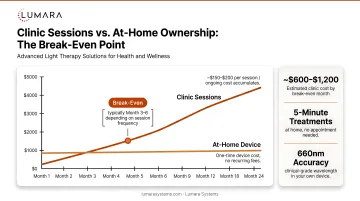
Professional sessions range from $25 to $200 per visit, with standard treatments averaging $75–$110. Consistent clinic use adds up quickly:
- 1× weekly = $300–$440/month
- 3× weekly = $900–$1,320/month
Home device investment:
Devices range from $150 (handheld wands) to $2,000+ (full-body panels). The break-even point is approximately 10–20 clinic sessions depending on device price.
Long-term economics favor home use. A home device continues delivering sessions for years with minimal ongoing cost (electricity only). For users with long-term wellness goals—ongoing anti-aging support, hair growth, or recovery routines—home devices become significantly more cost-effective after the initial break-even period.

Taken together, Performance, Safety, and Cost each tell the same story: clinics provide more power per session, but home devices offer more control, more frequency, and lower long-term expense—with the same safety requirements applying in both settings.
Which Option Is Right for You?
Weigh these decision factors:
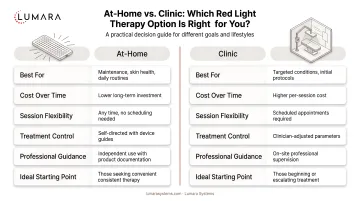
- Treatment goals – whether you need intensive short-term results or ongoing daily maintenance
- Budget structure – whether a single upfront purchase or recurring session fees fits your finances better
- Lifestyle – your schedule flexibility, proximity to a clinic, and ability to stay consistent
- Professional oversight – whether your condition benefits from supervised customization or self-directed use
Choose clinic sessions if you:
- Are undergoing specific, time-bounded treatment (post-procedure recovery, structured anti-aging series)
- Have complex skin or health conditions benefiting from professional customization
- Want expert progress tracking and protocol adjustments
- Need accountability and professional supervision
Choose a home device if you:
- Value daily flexibility and on-demand access
- Are pursuing long-term wellness goals requiring months of consistent use
- Can commit to a consistent daily routine
- Want to maximize cumulative light dose over time
For home users, device quality determines whether you see real results. Look for panels with accurate wavelengths (660nm is clinically supported for skin and cellular applications), short treatment times that fit a daily routine, and water-resistant builds that hold up to regular use. Lumara Systems designs its panels around exactly these criteria — making it practical to build the consistent habits that produce long-term results.
Conclusion
Neither home nor clinic red light therapy is universally superior—the best option fits your goals, budget, and routine closely enough that you'll actually use it consistently. For many users, clinics deliver a strong initial boost while home devices sustain results over months and years.
Photobiomodulation works when you deliver the right wavelengths consistently over time. Regardless of which setting you choose, the fundamentals don't change: follow recommended distances and session times, protect your eyes, and allow 8–16 weeks for results to build. The technology is sound. What separates people who see results from those who don't is simply showing up to sessions regularly — so choose the option that fits your life.
Frequently Asked Questions
Is red light therapy better at home or clinic?
Neither is strictly better—clinics offer higher power and professional guidance for faster early results, while home devices enable the daily consistency that drives long-term outcomes. The choice depends on budget, goals, and lifestyle, and many users benefit from combining both approaches.
How much should I pay for red light therapy?
Clinic sessions typically run $75–$110+ per session, though prices vary from $25–$200 depending on location, while home devices range from $150 to over $2,000 as a one-time cost. At consistent use, home devices break even within 10–20 clinic sessions and become more economical over time.
Can red light therapy help muscle atrophy?
While red and near-infrared light shows promise in supporting circulation and reducing inflammation in muscle tissue, evidence specifically for muscle atrophy is still limited and inconclusive. Consult a healthcare provider for this use case, as red light therapy is not a substitute for medical treatment.
Can red light therapy help autoimmune conditions?
Some research suggests photobiomodulation may help modulate inflammatory pathways, but evidence across autoimmune conditions remains limited and inconsistent. Anyone with an autoimmune condition should consult their physician before beginning red light therapy.
Are home red light therapy devices safe to use without professional supervision?
Quality home devices—particularly those with FDA 510(k) clearance—are designed to be safe for unsupervised use when instructions are followed. Follow key practices: wear eye protection, maintain correct distance, don't exceed recommended session times, and check for photosensitizing medications beforehand.
How often should I use red light therapy at home?
Most home device protocols suggest 3–5 sessions per week, with 10–20 minutes per targeted area. Results typically become noticeable after 8–12 weeks of consistent use. Follow your specific device's guidelines rather than applying a universal rule, as optimal frequency varies by device power and treatment goals.