Introduction
Planet Fitness offers red light therapy booths as part of its Black Card membership - a 22-minute standing session in an enclosed booth. For members who already pay for Black Card access, it seems like a free addition to the routine.
But the question most serious users end up asking is: does gym-based red light therapy deliver enough to be meaningful, or is owning a device the smarter long-term investment?
This guide breaks down what you are actually getting at Planet Fitness, the real long-term cost picture, and why device quality matters for results.
Key Takeaways
- Planet Fitness red light therapy is available as part of the Black Card membership (approximately $24.99/month)
- Sessions use stand-up booths with multiple LED arrays; the specific wavelength and irradiance of Planet Fitness booths is not publicly disclosed
- The cost advantage of gym-based red light therapy diminishes significantly over 12-24 months versus owning a quality device
- Gym access requires travel, scheduling, and availability - which affects how consistently you actually use the sessions
- Owning a verified-wavelength, FDA-cleared device gives you controlled, consistent sessions on your schedule
What Planet Fitness Red Light Therapy Is
Planet Fitness offers red light therapy as part of its Black Card membership tier. The booths are stand-up enclosed units with LED arrays intended to deliver red light to the full body during a 22-minute session.
What is publicly disclosed:
- 22-minute session limit
- Available to Black Card members (~$24.99/month includes multiple perks)
- Not every Planet Fitness location has the same booth model or maintenance protocol
What is not publicly disclosed:
- Exact wavelengths delivered by the booth LEDs
- Irradiance at the user's position within the booth
- Calibration and maintenance frequency of the LED arrays
This lack of specification transparency is the core limitation of gym-based light therapy. You are using the device without knowing whether it is delivering therapeutic wavelengths at therapeutic irradiance.
The Real Cost Comparison
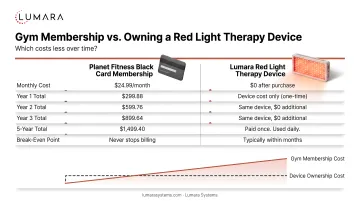
Gym-Based (Planet Fitness Black Card)
| Cost | Amount |
|---|---|
| Monthly membership | ~$24.99/month |
| Annual cost | ~$300/year |
| 3-year cost | ~$900 |
| Sessions per month | Limited by travel + availability |
| Wavelength/irradiance | Unknown |
Owning a Device (Lumara Illuminate V2)
| Cost | Amount |
|---|---|
| Device purchase | ~$1,000-$1,500 (one-time) |
| Annual operating cost | Near zero (electricity) |
| 3-year cost | Device cost only |
| Sessions | Unlimited, on your schedule |
| Wavelength/irradiance | Verified 660nm, documented specs |
The math: Over several years, the cost gap narrows. Depending on local membership fees, annual fees, taxes, and the device price, ownership can become comparable to or more cost-effective for users who plan to use red light therapy consistently long term. And unlike gym sessions, you are getting verified wavelength output and consistent conditions every time.
Why Consistency Matters More Than Access
Red light therapy results build cumulatively. Research on red light therapy generally depends on repeated, consistent sessions over time, whether the goal is skin appearance, recovery support, or routine wellness use. Most protocols call for 3-5 sessions per week over weeks and months.
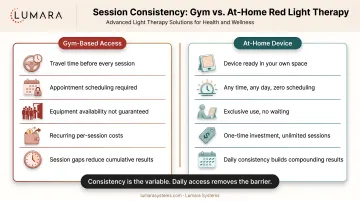
The practical question is not whether gym-based sessions work in principle - it is whether you will actually do 3-5 sessions per week when doing so requires a gym trip.
For most users:
- Gym trips happen 2-4x per week at best
- Red light booth access depends on availability and wait times
- Sessions may be skipped when the gym trip is skipped
- Travel time adds friction that accumulates over months
An at-home device removes that friction. Sessions happen because the device is there.
The Specification Question
For users who take light therapy seriously, the specification uncertainty of gym booths is a real limitation.
Therapeutic photobiomodulation requires:
- Correct wavelength (630-670nm for red, 810-850nm for NIR)
- Sufficient irradiance at the user's position
- Consistent output (calibrated, maintained equipment)
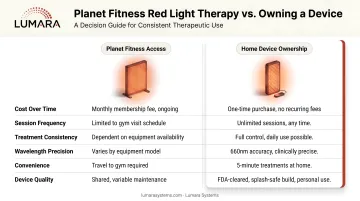
Planet Fitness booths are not marketed as medical devices with verified specifications. They are membership perks. The LED arrays in these booths vary by model, age, and maintenance status.
Lumara's Illuminate V2 provides documented specifications: 660nm wavelength verified through triple testing, 1,800 LEDs, 6,000 joules in 5 minutes, FDA cleared, 3-year warranty. You know what you are getting every session.
When Gym-Based Makes Sense vs When Owning Makes Sense
Gym-based (Planet Fitness) makes sense when:
- You are already a Black Card member and want to trial light therapy before committing to a device
- Your gym trips are already consistent and adding a booth session fits naturally
- You want exposure to light therapy without upfront device investment
Owning a device makes sense when:
- You are committed to consistent 3-5x/week sessions for months
- You want to know your wavelength and irradiance are therapeutic
- You want to use the device at home, at any time, without travel
- You are looking at 12+ months of use (the cost math favors ownership)
- You need specific facial or body-targeted sessions that a standing booth cannot provide - explore mat vs panel formats to find the right fit
Frequently Asked Questions
Does Planet Fitness red light therapy work?
Planet Fitness booths use LED light therapy technology. Whether they deliver therapeutic wavelengths at therapeutic irradiance is not publicly documented. Users report general wellness effects; specific therapeutic outcomes require consistent, verified-wavelength exposure.
What are the specs of Planet Fitness red light therapy booths?
Planet Fitness does not publicly disclose the specific wavelengths, irradiance, or LED specifications of their booths. The booths are marketed as a membership perk rather than a medical device.
Is Planet Fitness red light therapy worth it?
As part of a Black Card membership for an existing member, the booths add value at no extra cost. As a primary red light therapy strategy, the lack of specification transparency and session consistency limitations make ownership of a verified device more effective for most users. For users also considering infrared sauna alternatives, see the comparison of red light therapy and infrared sauna.
How much does Planet Fitness red light therapy cost?
Planet Fitness Black Card membership is approximately $24.99/month, which includes booth access alongside other perks. Dedicated gym-only light therapy would cost more if you were not already a Black Card member for other reasons.
How does Planet Fitness compare to owning a Lumara panel?
Planet Fitness provides accessible, no-additional-cost booth sessions for Black Card members. Lumara's Illuminate V2 provides verified 660nm wavelength, documented irradiance, FDA clearance, unlimited home sessions, and a 3-year warranty. Over 2-3 years, the ownership cost is comparable or lower than gym membership while providing significantly more session control.
Own Your Results
Planet Fitness red light therapy is a reasonable introductory experience for members who already have Black Card access. For anyone serious about consistent, verified-wavelength light therapy - the kind that produces the results documented in research - owning a quality device is the better long-term investment.
Lumara's Illuminate V2 - 660nm, 1,800 LEDs, 5-minute sessions, verified wavelength, FDA cleared - is built for exactly that.