
This guide unpacks the definition, science, clinical applications, and practical access points for PBMT. You'll learn how light interacts with mitochondria, which conditions respond best to treatment, how PBMT compares to consumer red light devices, and what to consider when choosing between clinical sessions and at-home panels.
TLDR:
- PBMT uses red (630–700nm) and near-infrared (800–1100nm) light to stimulate cellular repair through mitochondrial activation
- The therapy boosts ATP production, reduces inflammation, improves circulation, and accelerates tissue healing
- Clinical evidence supports its use for knee osteoarthritis, chronic pain, post-surgical recovery, and wound healing
- At-home LED panels operating at therapeutic wavelengths make PBMT-style treatment accessible outside clinical settings
What Is Photobiomodulation Therapy?
Photobiomodulation Therapy is a non-invasive, non-thermal process in which light energy at specific wavelengths, intensities, and durations is absorbed by cells to trigger biological responses that support healing, reduce pain, and modulate inflammation.
The formal definition established by Anders et al. (2015) describes it as "a form of light therapy that uses non-ionizing forms of light sources, including lasers, LEDs, and broadband light, in the visible and infrared spectrum."
The Name Change That Caused Confusion
PBMT was formerly called Low-Level Laser Therapy (LLLT) or Low-Level Light Therapy. The terminology shift to "photobiomodulation" was formally adopted in 2014 by the North American Association for Light Therapy and World Association for Laser Therapy to better reflect the mechanism—light modulating biological processes—and to acknowledge that non-coherent LEDs work just as effectively as lasers. That's why you'll encounter both terms in clinical literature depending on when a study was published.
Parameters That Define a Therapeutic Dose
Three variables determine whether light therapy produces clinical effects:
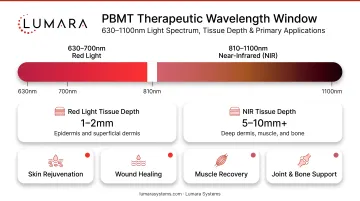
Wavelength: The accepted therapeutic window spans 600–1100nm. Red light (630–700nm) penetrates superficial tissue, while near-infrared (800–1100nm) reaches deeper structures like joints and deep muscle.
Irradiance (Power Density): Measured in mW/cm², this determines how much light energy reaches the tissue per unit area. Too little produces no effect; too much can negate benefits.
Treatment Duration: Combined with irradiance, this dictates total energy delivered (measured in Joules). All three parameters must fall within a therapeutic window for clinical effects to occur.
What PBMT Is NOT
PBMT doesn't cut, burn, or damage tissue — it has nothing in common with surgical lasers or UV light, which damages DNA. Therapeutic effects come from photochemical processes inside the cell, not from heat transfer. This distinction matters: it's why PBMT can be applied daily without the recovery periods associated with ablative or thermal treatments.
PBMT devices span a wide range — from clinical-grade lasers used in physical therapy and orthopedic settings to FDA-cleared consumer LED panels built for home use.
How Does PBMT Work at the Cellular Level?
The primary target of PBMT is cytochrome c oxidase (CCO), an enzyme in the mitochondrial respiratory chain. When cells experience stress or inflammation, CCO activity drops, reducing energy production. Light at the correct wavelength reactivates it.
The Cellular Cascade
Here's the sequence:
- Light absorption by CCO → Photons at 600–1100nm photodissociate inhibitory nitric oxide from the enzyme
- Increased ATP production → Restored electron transport boosts adenosine triphosphate synthesis
- More cellular energy → Cells gain resources for repair and recovery
- Reduced oxidative stress → A transient reactive oxygen species burst activates transcription factors
- Optimized mitochondrial function → The cell operates more efficiently

This mechanism is supported by extensive research on mitochondrial redox signaling.
Downstream Effects That Translate Into Results
These cellular changes produce measurable effects throughout the body:
- Nitric oxide release expands blood vessels, improves local circulation, and reduces inflammation at the treatment site
- Pain modulation occurs through endogenous opioid pathways and peripheral receptor activity, contributing to measurable relief
- Cytokine regulation lowers pro-inflammatory markers (IL-6, TNF-α) and modulates NF-κB signaling — helping regulate, not eliminate, the inflammatory response
- Collagen synthesis accelerates via TGF-β/SMAD signaling, enhancing procollagen expression and fibroblast proliferation for wound healing and tissue repair
The Arndt-Schulz Law: Why Dosing Precision Matters
These downstream effects don't scale linearly with more light — PBMT follows the Arndt-Schulz Law, meaning it exhibits a biphasic dose response. Low doses activate physiological processes; moderate doses peak the response; excessive doses inhibit the very pathways you're trying to stimulate.
Staying within the therapeutic window is non-negotiable. Underdosing produces no meaningful effect, while overdosing can suppress cellular activity.
How that window looks in practice depends on the condition. Acute pain typically responds to more frequent, targeted sessions, while chronic conditions often benefit from lower doses sustained over longer treatment periods.
What Conditions Can PBMT Treat?
Musculoskeletal Pain and Inflammation
Clinical evidence supports PBMT for multiple musculoskeletal conditions. A meta-analysis of 22 randomized controlled trials demonstrated significant pain reduction in knee osteoarthritis—14.23mm on the VAS scale at the end of therapy. For chronic low back pain, studies show short-term pain reduction when doses reach ≥3 J/point. Neck pain responds particularly well to high-intensity laser therapy, with pooled results showing a 14.1mm reduction in pain intensity.
PBMT works by reducing local inflammation, improving microcirculation, and accelerating cellular repair in damaged cartilage, tendons, and ligaments—the same pathways that explain its effectiveness across multiple tissue types.
Post-Surgical and Injury Recovery
Orthopedic and sports medicine specialists use PBMT to accelerate tissue repair after surgery or acute injury. A randomized controlled trial on total knee arthroplasty patients showed significantly higher range of motion (116.8° vs 92.3°) and lower opiate consumption (48.3 vs 60.3mg) at one month post-surgery.
Clinicians report faster returns to normal activity, particularly for elderly patients seeking alternatives to pain medication.
Additional Clinically Supported Applications
TMJ/Temporomandibular Disorders: A meta-analysis of 17 studies showed significant pain reduction (14.05mm) and improved functional jaw opening.
Oral Mucositis: The MASCC/ISOO guidelines strongly recommend PBMT (e.g., 632.8nm at 3.0 J/cm²) for preventing severe oral mucositis in patients receiving radiotherapy or hematopoietic stem cell transplantation.
Neuropathic Pain: Randomized trials on diabetic peripheral neuropathy show significant improvements in pain scores and neuron-specific biomarkers at 3.1 J/cm².
Wound Healing: A meta-analysis on diabetic foot ulcers documented a 22.96% reduction in ulcer size compared to control groups.

Soft Tissue Injuries: Tendonitis, plantar fasciitis, and muscle strains respond to PBMT through the same inflammatory modulation and collagen synthesis pathways.
These established applications share a common evidence base. Researchers are now applying that same framework to less-explored areas where results are promising but not yet definitive.
Emerging Research Areas
Evidence is developing for cognitive performance enhancement, androgenic alopecia treatment, and skin rejuvenation. A 2024 randomized controlled trial on adults with mild cognitive impairment using transcranial photobiomodulation showed significant improvements in Montreal Cognitive Assessment scores and increased serum BDNF levels. While promising, these applications require more research before being considered standard practice.
Is PBMT the Same as Red Light Therapy?
PBMT and red light therapy overlap significantly but are not identical terms.
Red light therapy typically refers specifically to visible red wavelengths (around 630–700nm) used in consumer devices marketed for wellness or cosmetic purposes. Photobiomodulation therapy is the precise scientific term—indexed in the MeSH medical database—encompassing both red and near-infrared wavelengths across lasers, LEDs, and broadband light sources used for clinical outcomes.
The Wavelength Distinction
Consumer red light panels operating at 660nm fall squarely within the therapeutic window defined by PBMT research. A well-designed panel delivering verified wavelength, adequate irradiance, and appropriate treatment duration can produce photobiomodulation effects.
Not all "red light" products meet clinical dosing standards, though. Many lack wavelength verification, deliver insufficient power density, or fail to specify treatment protocols.
The Device-Type Distinction
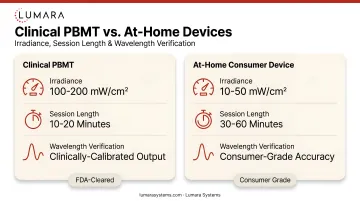
Clinical PBMT devices—class IV lasers, MLS laser systems—deliver higher irradiance (often >500mW) and penetrate deeper tissue than most consumer LED panels. The right device depends on what you're treating:
- Superficial applications (skin repair, surface muscle recovery, minor pain relief): consumer LED panels are generally effective
- Deep tissue applications (joint conditions, nerve pathologies, chronic musculoskeletal issues): clinical-grade equipment with higher penetration depth is typically required

Lumara Systems' Illuminate panels sit in the middle of this spectrum: calibrated to 660nm at 30mW/cm², they meet the dosing requirements for superficial applications while completing a full therapeutic session in 5 minutes—practical for consistent at-home use.
PBMT Safety: Side Effects and Who Should Avoid It
PBMT has a strong safety record when used as directed. It is non-thermal, non-ionizing, and does not damage tissue at therapeutic doses. Most users report no discomfort during treatment — some describe only a mild warming sensation.
Known Side Effects
Side effects are typically mild and temporary:
- Brief redness or warmth at the treatment site
- Eye sensitivity if proper eye protection is not used
- In rare cases, temporary fatigue or soreness in the treated area
These reactions are temporary, typically resolving within a few hours.
Contraindications and Precautions
Certain populations should take extra care or avoid PBMT in specific circumstances:
- Pregnancy: Avoid direct irradiation of the abdomen or pelvis; consult a healthcare provider before treating any area
- Active or suspected cancer: Do not apply directly over known tumors or metastatic sites; supportive use (for example, managing oral mucositis) happens only under medical supervision
- Photosensitizing medications: Skip PBMT if you're taking drugs that increase light sensitivity
- Photosensitive epilepsy: Avoid pulsed visible light modes if light-triggered seizures are a concern
- Implanted electronic devices: Avoid direct irradiation over pacemakers or similar devices as a precaution
Consult a healthcare provider before using PBMT for any chronic or serious condition to ensure it's appropriate for your specific situation.
How to Try PBMT: Clinical vs. At-Home Options
The Clinical Route
PBMT is offered by physical therapists, chiropractors, orthopedic specialists, sports medicine clinics, and some dental offices. Sessions typically last 5–20 minutes depending on the device power, treatment area, and condition being addressed. Protocols often recommend 2–4 sessions per week for 3–8 weeks, though this varies by chronicity and severity.
Multiple sessions are usually needed for lasting results. A clinician can calibrate dosing to the specific condition, tissue depth, and individual response, adjusting parameters as treatment progresses.
The At-Home Option
Consumer-grade red light therapy panels that operate at therapeutic wavelengths have made PBMT-style treatment accessible outside clinical settings. They're ideal for surface-level applications like muscle recovery, skin health, and minor pain relief.
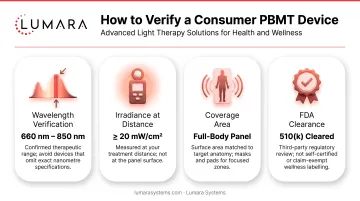
Evaluation criteria for at-home devices:
- Confirm wavelength accuracy through third-party testing, not manufacturer claims alone
- Check irradiance specs (mW/cm²) at the stated working distance
- Look for clear session duration and frequency protocols
- Verify safety certifications such as FDA clearance or IEC 62471 photobiological compliance
Lumara Systems, for example, produces FDA-cleared panels designed around these criteria — a useful reference point when comparing at-home options.
Practical Guidance for Beginners
Start with manufacturer or clinician-recommended session lengths. Maintain a consistent schedule — most benefits accumulate over repeated sessions, so early drop-off skews your results. Track how the target area responds over 2–4 weeks before evaluating outcomes.
If you're not seeing progress, consult a clinician who can adjust dosing parameters or confirm whether PBMT is appropriate for your specific condition.
Frequently Asked Questions
Is PBMT the same as red light therapy?
Red light therapy is a subset of PBMT. Both use therapeutic light wavelengths, but PBMT is the broader clinical term covering red and near-infrared light across device types from consumer panels to clinical lasers.
How does PBMT work?
PBMT stimulates cytochrome c oxidase in mitochondria, boosting ATP production. This triggers reduced inflammation, improved circulation, and accelerated tissue repair through nitric oxide release and collagen synthesis.
What is PBMT used for?
Primary applications include chronic pain, musculoskeletal injuries, post-surgical recovery, wound healing, and oral/dental conditions. Ongoing studies are also examining its use in traumatic brain injury recovery and acne treatment.
Who should not use PBMT?
Pregnant individuals should avoid abdominal treatment, people with active cancer should not treat over tumor sites, those on photosensitizing medications should avoid exposure, and anyone with light-triggered epilepsy should consult a doctor before use.
How much does PBMT cost?
Clinical sessions vary by provider, location, and device type, typically ranging from $50–$150 per session. At-home medical-grade consumer panels range from $1,799 to $2,295 as a one-time purchase.
What are the potential drawbacks or side effects of PBMT?
Side effects are generally mild — temporary redness, warmth, or eye sensitivity. The main risk is improper dosing: too little produces no effect, too much can cause irritation. Wear eye protection during treatment.