Introduction
You've just crushed a tough workout—legs are burning, shoulders ache, and you know the real pain hasn't even started yet. Over the next 48 to 72 hours, delayed onset muscle soreness (DOMS) sets in, making every movement a reminder of yesterday's effort. For many athletes and fitness enthusiasts, this cycle of soreness and forced rest becomes the biggest barrier to consistent training progress.
Red light therapy (RLT), also known as photobiomodulation, works by using specific wavelengths of light to stimulate cellular energy production in muscle tissue, helping reduce inflammation and accelerate repair. Research involving professional volleyball players, rugby athletes, and resistance training participants has documented measurable improvements in recovery speed, muscle damage markers, and training capacity.
This guide covers everything you need to apply RLT to your recovery routine:
- How RLT works at the cellular level in muscle tissue
- Proven benefits for reducing soreness and limiting muscle damage
- When to use it — before workouts, after, or both
- Practical protocols for home use
- Safety considerations and who should avoid it
TLDR
- Red light therapy stimulates mitochondria in muscle cells using 630–660nm wavelengths, boosting ATP production by 200–350%
- Clinical trials show it reduces DOMS and lowers creatine kinase levels by up to 50%
- Use it before workouts to prime muscles or immediately after to speed recovery — timing is flexible
- Effective sessions can be as short as 5 minutes with high-output devices
- Generally safe when used correctly, but requires eye protection and medical clearance for certain conditions
How Red Light Therapy Works for Muscle Recovery
The Cellular Mechanism (Photobiomodulation)
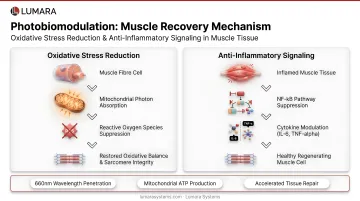
When red or near-infrared light penetrates your skin and reaches muscle tissue, it's absorbed by cytochrome c oxidase—a critical enzyme in the mitochondrial respiratory chain. This absorption triggers a cascade of cellular events that fundamentally change how your muscles produce and use energy.
Photons from the red light hit cytochrome c oxidase and cause nitric oxide (NO) to dissociate from the enzyme's binding site. This removes a brake on the mitochondrial respiratory chain, allowing electron transport to accelerate.
The result is a significant increase in mitochondrial membrane potential and ATP synthesis that jumps by 200% to 350% over baseline levels, with peak effects occurring 3 to 6 hours after light exposure.
ATP (adenosine triphosphate) is the primary fuel molecule your muscles use during contraction and recovery. More ATP means faster tissue repair, quicker clearance of metabolic waste, and enhanced cellular recovery between training sessions.
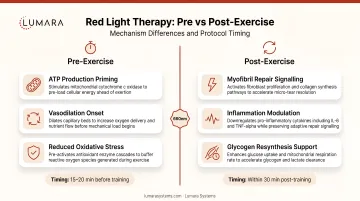
RLT also modulates oxidative stress through a process called mitohormesis. Intense exercise generates reactive oxygen species (ROS) that damage cell structures and contribute to fatigue. Pre-conditioning muscles with RLT induces a controlled, transient release of mitochondrial ROS that acts as a signaling mechanism. This activates your cells' natural antioxidant defense systems, preparing them to better handle the oxidative stress from your upcoming workout.

Why Wavelength Matters for Muscles
Not all red light is created equal for muscle recovery. The wavelength you choose determines how deeply the light penetrates and which tissue layers receive therapeutic doses.
Red light (630–660nm) characteristics:
- Penetrates 2–3mm into tissue
- Highly effective for superficial muscle groups (biceps, forearms, calves)
- Most extensively studied wavelength range for skeletal muscle recovery
- Strongly absorbed by skin and surface tissue layers
Near-infrared light (800–850nm) characteristics:
- Penetrates deeper, reaching muscles several millimeters below the surface
- Better suited for larger or deeper muscle groups (quads, hamstrings, back)
- Falls within an optical window with less tissue attenuation
- Shows significantly less absorption through skin, fat, and muscle layers — confirmed in optical tissue studies
The 660nm wavelength is among the most clinically validated for skeletal muscle recovery. A controlled trial comparing 660nm and 830nm wavelengths on biceps brachii fatigue found both increased peak force output (12.14% for 660nm; 14.49% for 830nm) with no significant difference for this superficial muscle group. Precision at these wavelengths is critical — even small deviations reduce mitochondrial stimulation efficiency.
Proven Benefits of Red Light Therapy for Muscle Recovery
Reduction of DOMS (Delayed Onset Muscle Soreness)
Multiple controlled trials document significant reductions in muscle soreness when RLT is applied around exercise. In a randomized controlled trial by Douris et al., participants received 8 J/cm² of dual-wavelength photobiomodulation (660nm and 880nm) to the biceps for five days following DOMS-inducing exercise. The treatment group showed statistically significant decreases in Visual Analog Scale pain scores at 48 hours compared to both control (p=0.01) and sham (p=0.03) groups.
Another trial using 630nm LED therapy applied immediately after eccentric elbow flexor exercise found that muscle soreness, strength loss, and range of motion impairments were significantly reduced for up to 96 hours post-exercise compared to placebo.
A 2025 systematic review and meta-analysis analyzing 14 studies confirmed these findings, reporting statistically significant reductions in VAS scores at 72 hours (SMD = -0.55) and 96 hours (SMD = -0.56) post-exercise—a moderate effect size that translates to noticeably less pain during the critical recovery window.
Reduction of Muscle Damage Biomarkers
Creatine kinase (CK) and C-reactive protein (CRP) are blood markers that spike when muscle tissue is damaged and inflammation increases. RLT consistently blunts these post-exercise elevations.
For creatine kinase, research by Felismino et al. applied 808nm laser therapy to the biceps between sets of eccentric exercise. At 72 hours post-exercise, the CK spike was dramatically attenuated in the laser group compared to placebo—357% increase vs. 841% increase (p < 0.05). That's less than half the muscle damage response.
CRP tells a similar story. A study by Leal-Junior et al. showed that pre-exercise laser therapy (810nm, 60 J total) significantly reduced post-exercise CRP levels. Just 5 minutes after exercise, the active treatment group measured 1.3 ± 4.0 mg/dL, while the placebo group spiked to 92.0 ± 115.1 mg/dL (p = 0.047).

Endurance and Fatigue Resistance
Pre-conditioning muscles with RLT before exercise delays the onset of fatigue and increases work capacity. The Leal-Junior crossover trial had athletes receive 810nm laser therapy (60 J total) to the biceps 3 minutes before an exhaustion protocol. Results showed:
- 14.5% increase in repetitions performed (39.6 ± 4.3 vs. 34.6 ± 5.6; p = 0.037)
- 8.0% increase in time before exhaustion (p = 0.034)
These improvements occurred in trained athletes during maximal effort tests, confirming that RLT can enhance performance even in conditioned individuals. That acute performance boost also sets the stage for longer-term structural gains with consistent training.
Support for Muscle Hypertrophy
When combined with consistent resistance training, RLT supports muscle growth and structural adaptation. A randomized controlled trial by Baroni et al. followed 30 healthy males through an 8-week isokinetic eccentric training program for knee extensors. Participants receiving pre-exercise laser therapy (810nm, 240 J total) achieved:
- 15.4% increase in muscle thickness (vs. 9.4% in training-only group)
- 32.2% gain in eccentric peak torque (vs. 20.0% in control group)
These findings align with preclinical work. Ferraresi et al. showed that mice combining progressive strength training with LED therapy (630nm and 850nm) produced significantly greater muscle performance, ATP synthesis, and cytochrome c oxidase activity compared to training alone—pointing to enhanced mitochondrial output as the underlying driver.
Recovery Between Sessions for Athletes
For competitive athletes training multiple times per week, the ability to control cumulative muscle damage between sessions directly affects training quality. Consistent RLT use makes a measurable difference.
A field trial with professional volleyball players applied LED therapy (630nm and 850nm) to lower limbs 40–60 minutes before official matches. The dose-response breakdown at 24 hours post-match was clear:
- 105 J group: +59% CK spike (p = 0.001) — no protective effect
- Placebo group: +53% CK spike (p = 0.012)
- 210 J group: +10% CK increase (p > 0.05) — spike effectively prevented
- 315 J group: +31% CK increase (p > 0.05) — spike effectively prevented

Properly dosed RLT provided protective benefits that extended through high-intensity competition and into the recovery window, allowing athletes to sustain higher training loads with less systemic breakdown between sessions.
Before vs. After Workout: When Should You Use Red Light Therapy?
Using Red Light Therapy Before Exercise (Pre-Conditioning)
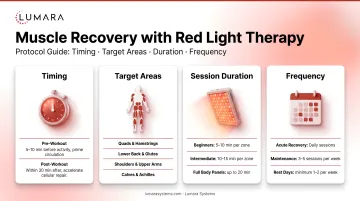
Applying RLT to target muscle groups 3–5 minutes immediately before a workout primes mitochondria for the upcoming stress. This pre-conditioning temporarily boosts ATP availability and reduces the extent of exercise-induced muscle damage during your session. The protective effects can persist for 3–6 hours after light exposure, aligning with your body's peak mitochondrial response.
The immediate pre-conditioning approach works particularly well for:
- Endurance-focused sessions where delaying fatigue is critical
- High-volume training days with multiple sets to failure
- Athletes looking to increase work capacity during the session itself
Extended pre-conditioning protocol:An alternative approach used with elite athletes involves applying RLT 40–60 minutes before activity rather than immediately before. Research with volleyball players using this extended window showed protection lasting 72–96 hours, with measurable reductions in muscle damage markers even days after competition. This protocol leverages the delayed ATP synthesis peak and may be preferable for major competitions or particularly intense training sessions.
Using Red Light Therapy After Exercise (Post-Recovery)
Applying RLT directly after training accelerates your body's natural inflammatory resolution process. Post-workout application helps speed muscle adaptation, supports tissue repair, and can help "lock in" training gains including muscle growth and improved energy metabolism.
Consistency matters here. The post-exercise approach works best across multi-day or multi-week programs, not as a one-time treatment. Regular post-workout RLT helps prevent acute inflammation from becoming chronic — particularly relevant if you're training frequently with minimal rest days.
Post-workout RLT works well for:
- Recovery-focused days when reducing soreness is the priority
- Training programs with short recovery windows between sessions
- Individuals prone to excessive inflammation or prolonged DOMS
Can You Do Both?
You can combine both pre- and post-workout RLT to capture the distinct benefits of each window. Pre-conditioning enhances acute performance and provides a protective effect during exercise, while post-workout application accelerates the recovery and adaptation phase.
That said, aim for at least a 6-hour gap between sessions to align with the natural mitochondrial response cycle and avoid diminishing returns from over-exposure. Research indicates that photobiomodulation is effective from 5 minutes up to 6 hours before exercise, with effects lasting up to 54 hours post-treatment. Applying therapy 24 hours before exercise, by contrast, showed diminished efficacy.

Your training intensity and recovery needs should ultimately guide how you structure both windows within a single day.
How to Use Red Light Therapy for Muscle Recovery at Home
Step-by-Step Protocol
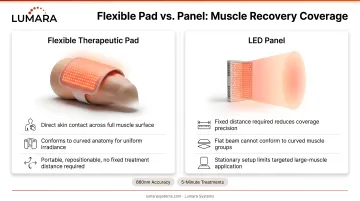
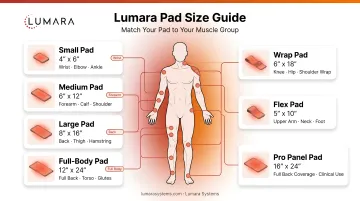
Device placement:Position your RLT panel or device 6–12 inches from the target muscle group with skin directly exposed (remove clothing from the treatment area).
Distance dramatically affects irradiance — the energy delivered to tissue — due to the inverse square law. Doubling your distance from 5cm to 10cm drops light intensity to roughly one-quarter of its original value, so follow your device's distance guidelines closely to achieve a therapeutic dose.
Session duration and frequency:For home panels, sessions of 5–20 minutes per muscle group, 3–5 times per week, represent the recommended range based on clinical protocols. High-output, precision-wavelength devices can cut that down to 5 minutes per session — Lumara Systems' panels, for instance, deliver therapeutic doses in 5-minute protocols, which makes sticking to a routine far more practical for busy training schedules.
Calculate your target dose based on your device's power output:
- Target fluence: 1–4 Joules/cm² per treatment point (WALT guidelines)
- Irradiance: Check your device specifications (measured in mW/cm²)
- Treatment time: Divide target dose by irradiance to determine minutes needed
Consistency over intensity:Once you have your dose dialed in, consistency matters more than any single session. RLT works cumulatively — irregular use produces minimal results, while a steady routine over 4–8 weeks is when most users report meaningful changes in soreness and recovery speed. Like progressive overload in training, small consistent exposures compound into significant adaptations over time.

Setting Realistic Expectations
Initial improvements in soreness and fatigue may appear within the first 2–4 weeks of consistent use. You might notice you're less sore 48 hours after tough workouts, or that you're recovering faster between training days.
Structural benefits — improved muscle endurance, faster recovery turnaround, enhanced training capacity — build over 6–12 weeks of regular application. These reflect measurable changes in mitochondrial density, cytochrome c oxidase activity, and cellular energy metabolism.
What RLT cannot do:
- Repair structural injuries like ligament tears, muscle ruptures, or fractures
- Reverse advanced osteoarthritis or degenerative joint disease
- Replace fundamental recovery practices: adequate sleep, proper nutrition, progressive training design
Red light therapy works best as a complement to sound recovery fundamentals, not as a replacement for them. If you're sleeping 5 hours per night and eating inadequate protein, no amount of photobiomodulation will fully compensate.
Safety, Risks, and Who Should Be Cautious
At therapeutic light levels, RLT is considered low-risk and non-thermal — it does not burn or damage skin under normal use conditions. Unlike UV tanning beds, red light therapy operates in the visible red and near-infrared range (600–1100nm) with no UV radiation, so there is no cancer risk from light exposure itself.
FDA-cleared photobiomodulation devices are regulated as Class II medical devices and must meet specific safety and performance standards.
Key precautions:
- Wear eye protection during every session — direct retinal exposure to high-intensity red or near-infrared light can cause eye damage, even though these wavelengths don't feel hot.
- Avoid use near cancerous lesions: FDA guidance recommends against applying RLT over or near tumors, as safety testing in these populations is inconclusive.
- Check your medications: Certain antibiotics (tetracyclines, fluoroquinolones), amiodarone, and retinoids increase skin sensitivity to light. Clinical guidance advises caution — these drugs can trigger exaggerated tissue responses.
- Consult your doctor with autoimmune conditions: People with lupus, Hashimoto's thyroiditis, or similar conditions should get physician clearance first, since RLT's immune-modulating effects haven't been well-studied in these groups.
- Stick to recommended doses: At significantly elevated irradiance, skin redness and blistering can occur. Case reports of thermal injuries from high-intensity light exposure typically involve equipment misuse, not proper therapeutic application.
Frequently Asked Questions
Does red light therapy actually work for muscle recovery?
Yes, multiple peer-reviewed studies and systematic reviews demonstrate that RLT reduces DOMS, lowers creatine kinase levels by up to 50%, and improves endurance performance by 8–14.5%. Research on optimal protocols is ongoing, but professional sports teams and sports medicine practitioners increasingly incorporate it into recovery programs.
How long should I use red light therapy for muscle recovery?
Typical sessions last 5–20 minutes per targeted muscle group, depending on your device's power output. High-output panels with precise wavelengths can deliver effective treatments in as little as 5 minutes. Frequency should be 3–5 sessions per week for optimal cumulative effects.
How long does it take to see results from red light therapy for muscle recovery?
Some users notice reduced soreness within the first 1–2 weeks of consistent use. Most meaningful benefits—faster recovery, improved endurance, reduced injury risk—develop over 4–8 weeks, while structural adaptations like mitochondrial function and hypertrophy support may take up to 12 weeks to fully emerge.
What wavelength or color of light is best for pain relief and muscle recovery?
Red light in the 630–660nm range is the most extensively studied for surface muscle tissue and pain relief. Near-infrared (800–850nm) penetrates deeper for larger or deeper muscle groups, and many protocols combine both — though 660nm is widely cited as the therapeutic sweet spot for skeletal muscle recovery.
What are the risks or downsides of red light therapy?
Main risks include potential eye damage from direct exposure (use protective goggles), skin irritation at excessively high doses, interactions with photosensitizing medications, and the financial investment in quality equipment. At recommended therapeutic doses, serious side effects are rare. The primary downside is cost and the time commitment required for consistent application.
Is red light therapy safe for people with medical conditions or older adults?
RLT is generally considered safe for older adults and most populations. Those with autoimmune conditions (lupus, Hashimoto's), photosensitizing medications, active cancer, or uncontrolled high blood pressure should consult a physician before starting to confirm the therapy suits their health status.