Introduction
Red light therapy is safe for daily facial use. That statement has one non-negotiable condition attached to it: proper eye protection in every session.
The question most buyers ask is whether red light therapy harms eyes at all. The more useful question is what the actual risk mechanism is, when protection is required, what counts as real protection, and why the eye inserts most quality masks include are not just a formality.
This guide covers all of that - clearly and practically - so you can run a consistent facial routine without confusion about what is actually required.
Key Takeaways
- Closed eyelids alone are not sufficient protection during close-range facial LED mask sessions
- The retina has no pain receptors, meaning cumulative exposure does not signal discomfort before damage accumulates
- Consumer 660nm red light is non-UV and non-ionising; the risk is cumulative direct retinal exposure over repeated sessions, not a single-incident burn
- Proper protection means light-blocking eye inserts or phototherapy goggles - not fashion sunglasses, thin fabric, or improvised covers
- For body panel sessions positioned away from the face, eye protection is typically not a concern
- A well-designed facial mask includes eye inserts as standard equipment, not an optional add-on
What Actually Makes Red Light Eye-Safe or Risky
Red light at 660nm is non-UV and non-ionising. It does not cause the same type of damage that ultraviolet or high-intensity laser light can cause. That is the good news - and it is also why some users assume no protection is needed.
The actual risk is different: cumulative direct retinal exposure.
The retina is the most light-sensitive tissue in the body. Unlike skin, the retina has essentially no pain receptors. That means overexposure does not signal discomfort while it is happening. Repeated direct LED illumination, close to the face, over weeks and months of daily use, accumulates retinal exposure without feedback.
That is why "my eyes feel fine" is not a reliable safety indicator during red light therapy sessions.
For a single, brief session at a reasonable distance, the risk is low. For a daily facial routine where a mask sits close to the eye area for 5 to 20 minutes per session, day after day, correct protection is what makes that routine genuinely safe.
Why Closed Eyes Are Not Enough
This is the most common misconception: that closing your eyes during a session provides adequate protection.
Closed eyelids reduce light transmission, but they do not block it adequately. Eyelids are thin tissue. Red and near-infrared wavelengths at close-range LED mask irradiance transmit through closed eyelids to a meaningful degree. The eyes open or closed question is covered in more detail in its own guide, but the short answer for facial mask use is: closed alone is not enough.
Light-blocking eye inserts work differently. They are opaque or highly light-blocking forms that physically prevent light from reaching the retina regardless of wavelength or irradiance level. That is a different category of protection from closed eyelids, and it is what the clinical literature and device guidance recommend for close-range LED facial mask use.
What Protection Actually Works
Light-blocking eye inserts are the correct protection for facial LED mask sessions. A well-designed mask includes these as standard equipment.
Lumara's VISO LED Mask includes eye inserts designed specifically for its 660nm output and illumination intensity. They are part of the product, not an afterthought. Every session requires them.
Phototherapy goggles are the appropriate protection for panel sessions where the face or head is positioned within the light field.
What not to use:
- Fashion sunglasses - designed for UV and ambient glare, not close-range LED irradiance
- Thin fabric or hand covering - transmits enough light to be inadequate
- Generic sleep masks - not rated for phototherapy irradiance levels
- Any insert not specifically designed for the device's wavelength and intensity
The practical rule is straightforward: if the insert or goggle did not come with the device or is not rated for phototherapy use, do not rely on it.
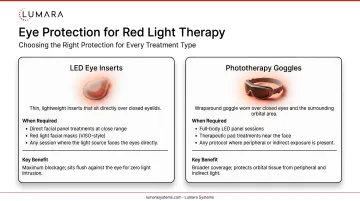
When Eye Protection Is and Is Not Required
Not every session requires the same level of attention to eye protection. Here is where to focus it:
Always required:
- Facial LED mask sessions at any duration
- Panel sessions where the face or head is within the illuminated field
- Any periorbital or jaw-area application
Typically not required:
- Body panel sessions positioned clearly away from the face - back, legs, stomach, knees, shoulders
- Pad sessions on body areas with no proximity to the eyes
The practical rule: if the device is near your face or head during the session, use proper eye protection. If the device is treating a body area at a distance from your face, standard session caution applies without specific eye protection requirements.
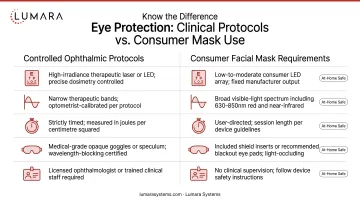
The Distinction Between Consumer Facial Use and Ophthalmic Research
Some published research explores low-level red light therapy for beneficial effects on retinal health, including studies on dry eye conditions and visual acuity. This research area is real and worth knowing about - and the photobiomodulation mechanism that drives it, involving mitochondrial function in retinal cells, is well-documented.
However, that context is meaningfully different from consumer facial mask use.
Ophthalmic photobiomodulation research uses controlled, brief exposures under ophthalmologist supervision with specific devices and protocols. A consumer facial LED mask used in an unprotected daily home routine is a completely different situation.
Do not use a consumer facial mask as a therapeutic ophthalmic device. Do not skip eye inserts on the basis that some research shows red light may have positive retinal effects. The protective protocol exists for good reason - use it.
How a Well-Designed Mask Handles This
Eye safety during facial red light therapy is partly a product design question.
A well-engineered mask includes:
- Eye inserts or goggles as standard equipment
- A fit design that holds the mask securely against the face without requiring the user to manually manage eye coverage
- Clear instructions on insert placement and session protocol
- Consistent output that does not vary in ways that affect dosing unpredictably
Lumara's VISO LED Mask is built around this standard. The mask delivers 660nm red light across 470 micro-LEDs with full-face coverage and even illumination. Eye inserts are included and required for every session. The 5- to 20-minute session format is designed for consistent daily use when the mask is used as directed.
The point is not that the VISO is uniquely special for having eye inserts - any serious facial red light mask should include them. The point is that eye safety is not a separate consideration from device quality. It is part of what a well-designed device is built around.
What to Do if You Have Already Skipped Protection
If you have been using a facial LED mask without eye protection and are concerned, the practical guidance is:
- Stop using the mask without eye inserts immediately.
- Use the inserts provided with your device for all future sessions.
- If you have any visual disturbance, unusual sensitivity to light, or other eye symptoms, consult an eye care professional. Red light at consumer device intensity is unlikely to cause acute injury from brief unprotected use, but persistent symptoms should be assessed professionally.
- Do not attempt to compensate for missed protection by skipping sessions. Resume using the device correctly.
The cumulative nature of the risk means that correct protocol going forward is the most useful corrective step.
Frequently Asked Questions
Is red light therapy bad for your eyes?
With proper light-blocking eye inserts used in every session, facial red light therapy is considered safe for daily use. Without protection, repeated close-range LED exposure can accumulate retinal exposure over time. The retina has no pain receptors, so damage does not signal discomfort before it accumulates. Eye inserts eliminate this risk when used correctly.
Can I just close my eyes instead of using eye inserts?
Closed eyelids reduce but do not adequately block red light at close-range LED mask intensity. The eyelid is thin tissue and transmits a meaningful amount of light. Light-blocking inserts designed for the device's output are the correct solution.
What eye protection works for red light therapy?
Use the light-blocking eye inserts provided with your mask. These are designed for the specific wavelength and irradiance of the device. For panel sessions near the face, phototherapy goggles are appropriate. Do not use fashion sunglasses, thin fabric, or improvised covers as substitutes.
Do I need eye protection for body panel sessions?
Not typically. For panel sessions treating body areas - back, shoulders, knees, legs, stomach - positioned away from the face, eye protection is not a standard requirement. The concern is specific to devices positioned near the eye area during use.
Is near-infrared more dangerous to eyes than red light?
Near-infrared at 810-850nm has deeper tissue penetration than 660nm red light, and the same principle applies: eye protection is required for any close-range application near the face. Body-area use away from the face carries different considerations. Follow device-specific guidance.
Does Lumara VISO include eye protection?
Yes. The VISO LED Mask includes eye inserts as standard equipment. They are required for every session and are part of the device's complete kit alongside the controller, charging cord, wall plug, and travel bag.
Conclusion
Red light therapy is safe for consistent daily facial use. That safety is not complicated or expensive to maintain. It requires one thing: using the right eye protection in every session.
Closed eyes are not enough. Fashion sunglasses are not enough. The inserts designed for the device are what work - and any facial mask worth using includes them.
If you are looking for a 660nm facial red light mask built for daily routine consistency, with eye inserts included and a full-face illumination design, explore Lumara's VISO LED Mask.