Introduction
Red light therapy blankets are full-body or large-area wearable light therapy products that wrap around the body. They appeal to users who want whole-body coverage in a single session without standing in front of a panel or lying on a mat.
The format is compelling in concept. In practice, blankets vary enormously in wavelength accuracy, irradiance, and actual therapeutic value. This guide covers what blankets are, where they fall short, and when a purpose-built multi-wavelength pad is the more intelligent choice.
Key Takeaways
- Red light therapy blankets wrap around the body and are designed for full-body or large-area coverage in a single session
- Many blankets on the market use far-infrared heating as their primary mechanism rather than photobiomodulation (red/NIR LED therapy)
- Blankets that are primarily far-infrared heating products are heat therapy, not photobiomodulation - the mechanisms and evidence bases are different
- LED-based blankets face a practical challenge: achieving consistent LED-to-skin contact across a flexible, draped format is difficult
- For users who want multi-wavelength coverage over the full body or large areas, a flexible pad in appropriate sizes provides more consistent direct contact than a blanket format
- Lumara's Pad (available up to 20x30") provides 635nm red light plus 830nm and 940nm infrared wavelengths in a flexible body-contact format with 20-30 minute session guidance
What Red Light Therapy Blankets Actually Are
The term "red light therapy blanket" covers several different product types:
Far-infrared heating blankets: These produce warmth through far-infrared emission. The primary mechanism is thermal - they heat the body from within, producing vasodilation, sweating, and a heat stress response. This is a different mechanism from photobiomodulation (LED red/NIR light therapy). Many products marketed as "red light therapy blankets" are actually far-infrared heating products.
LED light therapy blankets: These embed LED arrays within a flexible blanket material and aim to deliver red or near-infrared photobiomodulation. The challenge is maintaining consistent LED-to-skin contact when the blanket material can drape, fold, and shift during a session.
Combined/hybrid blankets: Some products combine both far-infrared heating and LED arrays, attempting to deliver both thermal and photobiomodulation effects simultaneously.
Understanding which category a product falls into is the first step in evaluating it.
The Spec Challenges with Blanket Formats
Wavelength Verification
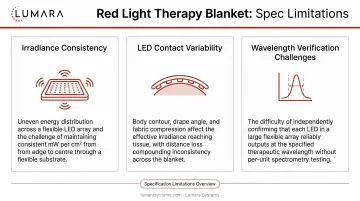
Flexible blanket products are less commonly subject to third-party wavelength verification than panel or pad devices. The LED bins used in wearable formats sometimes prioritize flexibility and cost over wavelength precision. Ask whether any blanket product has independently verified wavelength output.
Irradiance and LED Contact
Irradiance (the therapeutic dose per unit area) depends on consistent LED-to-tissue proximity. A blanket that drapes loosely over the body will have significant variation in LED distance across different body areas during a session. Areas where the blanket makes direct contact will receive more light; areas where it drapes away receive less.
This variability makes dose delivery less predictable than a flat pad placed directly against the skin.
Session Duration
Far-infrared blankets typically require 30-45 minute sessions to produce meaningful heat responses. LED photobiomodulation blankets require sufficient session time to deliver therapeutic doses despite variable contact. Session times of 20-45 minutes are common.
When a Flexible Pad Is the Better Choice
For users who want multi-wavelength coverage of large body areas, a flexible pad placed directly against the body provides:
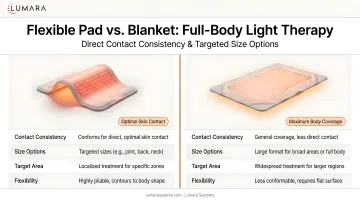
Consistent direct contact: No draping or shifting - the pad maintains consistent LED-to-tissue proximity across the treatment surface.
Verified wavelength output: Purpose-built pads from quality manufacturers have documented wavelength specifications.
Targeted application: You can apply the pad precisely to the back, stomach, legs, or other specific areas rather than attempting whole-body coverage in one setup.
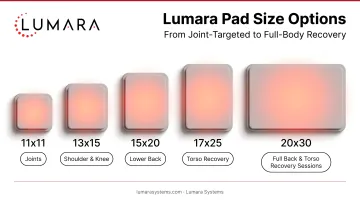
Multiple size options: Rather than one blanket-size format, pads come in sizes that match the actual treatment area - from 11x11" for targeted joints to 20x30" for full back and torso coverage.
Lumara's Pad is available in five sizes (11x11", 8x17", 11x24", 12x30", and 20x30"), uses 635nm red light plus 830nm and 940nm infrared wavelengths, and is designed for direct body-contact use with 20-30 minute session guidance.
What to Look for If You Are Considering a Blanket
If you want a blanket format specifically:
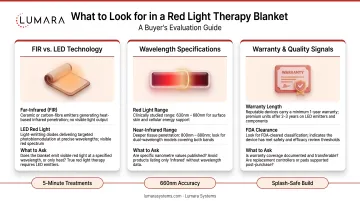
Distinguish far-infrared from photobiomodulation: If the product is primarily a far-infrared heating device, understand that you are buying heat therapy - not LED photobiomodulation. Both have legitimate uses, but they are different mechanisms with different evidence bases.
Ask about LED specifications: For LED-based blankets, ask about wavelength verification (is it independently tested?), LED count, and how the product maintains consistent LED contact during use.
Check session guidance: Vague session guidance ("use as desired") suggests the manufacturer has not calibrated the product for specific therapeutic dose delivery.
Evaluate warranty and return policy: Blanket formats with flexible circuits are more prone to wear. A 2-3 year warranty from a credible manufacturer is the minimum acceptable standard.
Lumara's Approach: Flexible Pads, Not Blankets
Lumara does not make a blanket format. Lumara's Pad is the closest product in the lineup to the use case that blankets are designed for - large-area body coverage - but through a flexible pad format that addresses the contact consistency problem that blankets face.
The 20x30" pad covers the full back and torso in a lying session. The 12x30" covers the lower back and legs. Smaller sizes (11x11" and 8x17") target specific joints and areas. All sizes use the same red, near-infrared, and far-infrared wavelength combination with 20-30 minute session guidance and a 3-year warranty.
Frequently Asked Questions
Do red light therapy blankets work?
Far-infrared blankets produce real heat-based effects (vasodilation, relaxation, sweating). LED photobiomodulation blankets can work if they maintain consistent LED-to-tissue contact, use verified wavelengths, and are used for appropriate session durations. Results depend heavily on the specific product quality.
What is the difference between a red light therapy blanket and a pad?
A blanket wraps around the body; a pad is placed directly against a specific area. Pads typically maintain more consistent LED-to-skin contact because they are flat and direct-contact. Blankets offer whole-body coverage convenience but face contact consistency challenges.
Are far-infrared blankets the same as red light therapy?
No. Far-infrared blankets work through heat. Red light therapy uses LED photons in the red range, commonly around 630-670nm, and near-infrared/infrared wavelengths that may extend into ranges such as 830-940nm depending on the device. Different mechanisms, different evidence bases.
What size pad do I need for full-body coverage?
The 20x30" Lumara Pad covers the full back and torso. For lower back and legs, 12x30" is practical. For targeted joint or extremity sessions, 11x11" or 8x17" sizes are more manageable.
Purpose-Built Format Makes the Difference
Blankets solve a real problem - wanting large-area coverage without complex setup. Flexible pads solve the same problem while maintaining the consistent direct contact that makes photobiomodulation effective.
Lumara's Pad - 635nm red light plus 830nm and 940nm infrared wavelengths, five sizes, 20-30 minute sessions, 3-year warranty - is built for body-area recovery without the contact consistency compromises of blanket formats.