Introduction
The red light therapy device market has expanded rapidly, leaving consumers to navigate a growing range of product formats — mats, panels, pads, and more — each marketed with overlapping claims. The global red light therapy market is projected to reach $1.13 billion by 2033, driven largely by at-home device adoption. Yet many users struggle with a fundamental question: which device format actually delivers results for their specific needs?
That question usually comes down to two formats: mats and panels. Both use the same photobiomodulation science, but the delivery method changes everything — from session length to treatment coverage.
Panels project high-intensity light from a distance. Mats press LEDs directly against the skin. These differences shape who each format suits and what results you can realistically expect.
What follows is a side-by-side comparison of both formats — how they work, where each excels, and how to choose based on your goals, space, and budget.
TLDR
- Mats lie flat against the skin for maximum photon absorption: ideal for relaxation, general wellness, and targeted body zones
- Panels emit high-intensity light from a distance, making them better suited for full-body coverage and deeper tissue applications
- Panels deliver higher irradiance (mW/cm²), but mats offset this with near-zero reflection loss from direct skin contact
- Key decision factors: health goal, available space, budget, session length, and portability needs
- Neither format is universally superior — the right choice depends on how and why you use red light therapy
Red Light Therapy Mat vs Panel: Quick Comparison
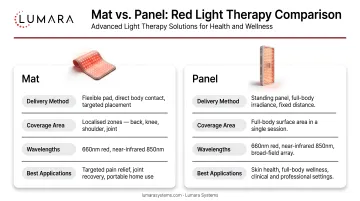
| Feature | Red Light Therapy Mat | Red Light Therapy Panel |
|---|---|---|
| Light Delivery | Contact therapy (direct skin application) | Distance-based (6-12 inches from body) |
| Treatment Coverage | Localized or full-body zones while lying down | Broad multi-zone or full-body standing sessions |
| Portability | High (rollable, travel-friendly) | Low (rigid, requires dedicated space) |
| Irradiance Level | Lower raw output (compensated by contact delivery) | Higher output (60-170 mW/cm² at 6 inches) |
| Price Range | £200-£900 | £220-£2,200+ |
| Ease of Use | Passive (use while resting) | Active (requires positioning) |
| Maintenance | Requires sanitisation after each use | Minimal (no skin contact) |
| Ideal User | Relaxation-focused, budget-conscious, localized treatment | Results-driven, multi-zone treatment, clinical-grade needs |

Both devices use the same core science — photobiomodulation (PBM) at red (630–660nm) and near-infrared (800–850nm) wavelengths. Cytochrome c oxidase in mitochondria absorbs these wavelengths, boosting cellular energy production (ATP). How that light is delivered — at contact distance versus a foot away — determines which device actually fits your treatment goals.
What Is a Red Light Therapy Mat?
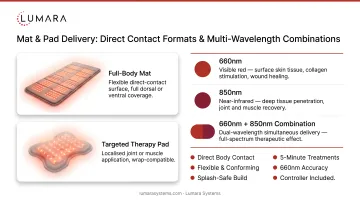
A red light therapy mat is a flexible, padded device embedded with LED lights, designed to be laid on or wrapped around specific body parts for direct-contact light therapy. "Mats" and "pads" are often used interchangeably, though mats typically refer to larger, full-body formats.
The core advantage is direct contact: pressing LEDs against the skin eliminates the light loss that distance-based panels experience. Fresnel reflection at the air-skin interface accounts for only about 4-7%, so nearly all emitted photons reach tissue.
Panels, by contrast, lose intensity over distance through the inverse-square law — not reflection. This is why mats can deliver effective doses even at lower raw irradiance.
Use Cases of Red Light Therapy Mats
Common home-use scenarios include:
- Lying on the mat for lower back pain relief
- Wrapping it around a knee or shoulder for localized joint recovery
- Using it during rest or meditation for general wellness and sleep support
These use cases make mats well-suited for targeted recovery sessions and passive daily routines. Here's how they stack up overall:
Key Pros:
- Typically priced between $250 to $1,000 (approximately £200–£900), with accessible entry-level options
- Rolls up for easy storage and travel — no mounting or assembly required
- Designed for passive use: run a session while resting, reading, or meditating
- Direct contact maximizes photon absorption by eliminating intensity loss over distance
Key Cons:
- Lower raw irradiance than most panel systems
- Repeated folding causes mechanical wear on LEDs and connections over time
- Requires surface sanitization after each use due to direct skin contact
- Less practical for treating the front and back of the body in a single session
What Is a Red Light Therapy Panel?
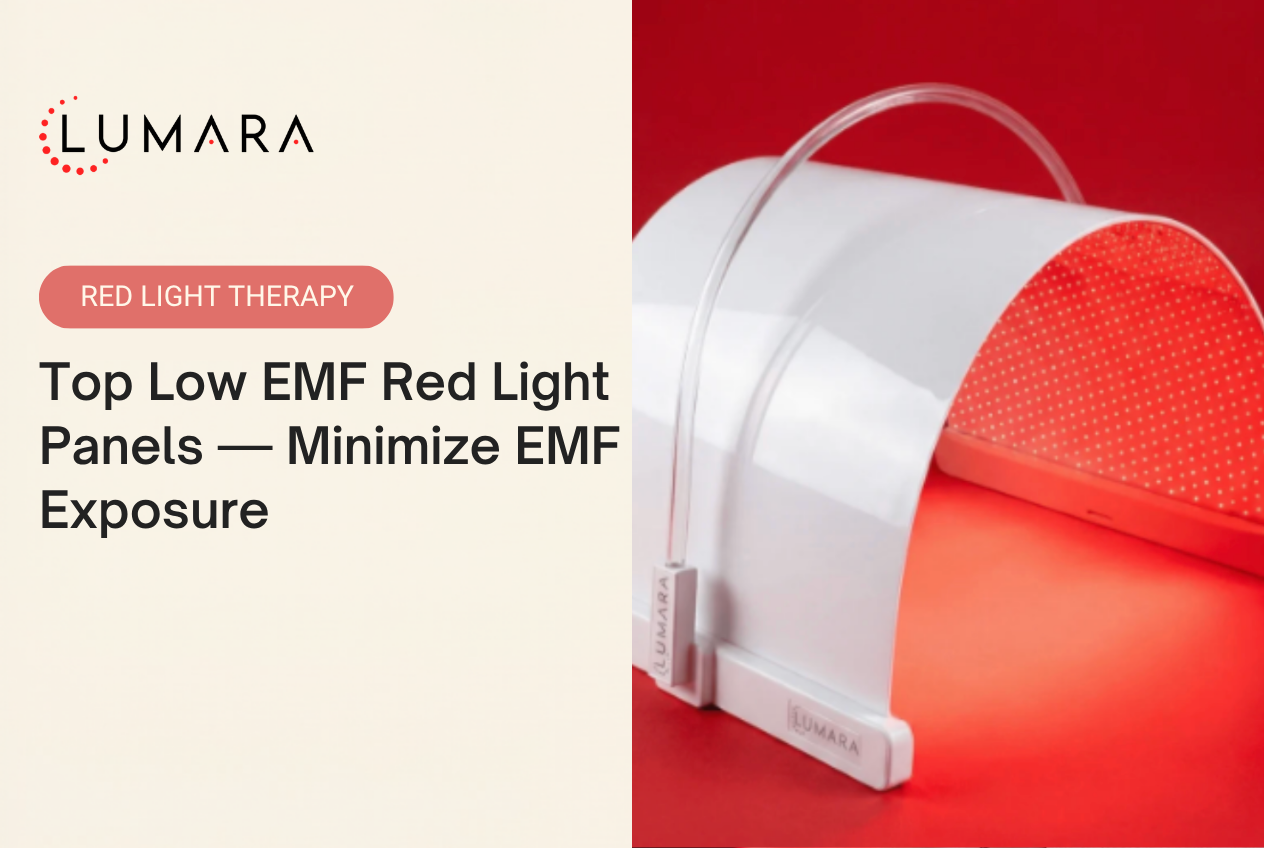
A red light therapy panel is a rigid, high-powered LED device designed to stand or hang at a set distance from the body (typically 6–12 inches), projecting concentrated light across a broad area. Panels range from compact, single-zone devices to large full-body units.
Panels are engineered for high mW/cm² output, enabling shorter treatment sessions. That output comes with a catch: the inverse-square law means doubling your distance from the panel can reduce intensity by up to 75%, so placement directly affects results.

Quality panels operate at specific clinically studied wavelengths. For example, 660nm is optimal for red light skin applications, while 850nm targets near-infrared deep tissue penetration. Lumara Systems' panels, for instance, target exactly 660nm — a wavelength precision that allows effective sessions in as little as 5 minutes.
Use Cases of Red Light Therapy Panels
Primary scenarios include:
- Standing in front of a panel for full-body skin and recovery sessions
- Athletes using panels post-training for muscle recovery
- Clinical or professional wellness settings where consistent high-irradiance delivery is needed
Key Pros:
- Higher irradiance: Faster, deeper treatment in shorter sessions
- Treats larger or multiple body zones simultaneously
- Longer device lifespan: Rigid construction with LED lifespans of 50,000–100,000 hours
- Lower maintenance: No skin-contact sanitization required
Key Cons:
- Higher upfront cost: Home-use panels range from $250 to $2,500+
- Requires dedicated space and proper mounting or stand
- Not easily portable
- "Active" positioning needed to ensure the target area is correctly illuminated
Mat vs Panel: Which One Is Right for You?
Decision Variables
Assess these three core factors:
- Primary health goal: Skin rejuvenation, pain relief, muscle recovery, or general wellness
- Lifestyle fit: Available space, session time, and whether you prefer passive or active therapy
- Budget: Both upfront device cost and ongoing energy use (panels draw 300-1500W; mats use 50-150W)
Goal-Based Recommendations
| Wellness Goal | Best Device | Rationale |
|---|---|---|
| Chronic back pain | Mat or Panel | Evidence is mixed for chronic low back pain; mats offer comfort, panels offer higher irradiance |
| Post-workout recovery | Panel or Mat | Meta-analyses show PBMT reduces DOMS and improves strength recovery; both effective |
| Skin rejuvenation | Panel | RCTs confirm red/NIR LEDs reduce wrinkles; distance delivery provides uniform facial coverage |
| Sleep quality | Mat | NIR light improves subjective sleep duration; systemic contact therapy aligns with evening routines |
| Joint pain (knee OA) | Panel or Mat | PBMT offers symptomatic relief for OA; high irradiance or direct contact both reach synovial tissue |

Situational Recommendations
Choose a mat if you:
- Prioritize passive, relaxation-friendly sessions
- Need portability for travel
- Want budget-friendly entry into red light therapy
- Focus on localized joint or muscle treatment
Choose a panel if you:
- Want faster results with shorter sessions
- Need high-irradiance full-body coverage
- Cover multiple body zones without repositioning
- Have dedicated space for a standing or mounted device
Combination Use Case
Mats and panels work well together. Some users run a panel for front-body sessions and a mat for the back or recovery work — getting comprehensive coverage while keeping contact therapy available for specific zones.
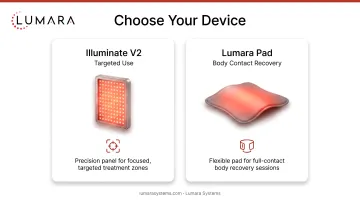
If speed and precision matter most to you, Lumara Systems' 660nm panels are built around 5-minute treatment protocols and a splash-safe design — a practical option for home users who want accurate wavelength delivery without a professional setup.
Conclusion
The core distinction comes down to how you use it. Mats deliver light through direct skin contact — ideal for relaxation, recovery, and lower price points. Panels operate at a distance, offering higher irradiance, faster sessions, and broader body coverage in one pass.
A quick decision guide:
- Choose a mat if you prioritize affordability, portability, or want to integrate therapy into rest and sleep routines
- Choose a panel if you need faster treatment times, higher power output, or consistent full-body coverage without repositioning
Your lifestyle determines which format you'll actually stick with — and consistency is what produces results.
The science of red light therapy is consistent across both formats — both deliver red and NIR photons that stimulate the same photobiological targets. Matching the delivery method to how you live and move is what determines whether you use it daily or let it collect dust.
Frequently Asked Questions
What is the difference between a red light mat and a red light panel?
Mats use direct skin contact (contact therapy) for localized or full-body treatment while lying down, whereas panels emit high-intensity light from a distance for broader or faster coverage. Both use the same photobiomodulation wavelengths but differ in delivery method and ideal use case.
How do I choose between red light therapy mats, panels, pads, wraps, and masks?
Each format targets a different coverage zone:
- Masks — face and targeted facial skin
- Wraps/pads — localized joints or small body areas
- Mats — broad body zones during rest or recovery
- Panels — high-intensity full-body or multi-zone sessions
Choose based on your target area and preferred session style.
What is the most effective red light therapy device?
It depends on your goal. Panels deliver higher irradiance for faster deep-tissue results, while mats maximize photon absorption through direct skin contact. Both are highly effective when matched to the right application and used consistently.
Do red light therapy mats, pads, and blankets actually work?
Yes, these devices work on the same photobiomodulation principles as panels. Clinical studies support RLT for pain relief, skin improvement, and recovery. Results depend on wavelength accuracy, session duration, and consistency.
Does red light therapy work through a blanket?
No. Standard blankets block red light wavelengths and significantly reduce photon penetration. Red light therapy mats are designed to emit light at or against the skin directly, which is why contact delivery is built into the device design itself.
Can I use a red light therapy mat and panel together?
Yes, using both is a complementary approach — a panel can treat the front of the body while a mat handles the back or a specific zone. Total session exposure should stay within recommended guidelines of 2-10 J/cm² for most applications.