Introduction
Red light therapy devices and heat lamps both emit light that produces warmth. That surface similarity causes a lot of confusion - including the question of whether a standard heat lamp can substitute for a red light therapy device.
The answer is no, and the reason matters for anyone considering either option. This guide covers exactly how they differ, what each is actually designed to do, and which one fits which use case.
Key Takeaways
- Heat lamps produce broad-spectrum visible and infrared light with the primary effect being thermal (heat) at the tissue level
- Red light therapy devices deliver specific wavelengths (typically 660nm) chosen for their photobiomodulation effects - cellular responses independent of heat
- A heat lamp does not produce the photobiomodulation effects that red light therapy research is based on
- Red light therapy should not rely on heat as its primary mechanism. Some warmth can occur during use, but the therapeutic distinction is that red light therapy is built around wavelength-specific light delivery, not heat alone
- The two are not substitutable; they have different mechanisms, applications, and results
Quick Comparison
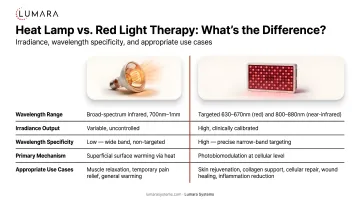
| Factor | Heat Lamp | Red Light Therapy Device |
|---|---|---|
| Light spectrum | Broad-spectrum infrared and visible light | Narrow-band specific wavelengths (typically 660nm) |
| Primary mechanism | Thermal: raises tissue temperature | Photobiomodulation: cellular responses to specific wavelengths |
| Tissue depth | Surface to 1-2cm | Red light can penetrate approximately 5–10 mm, depending on wavelength, power, exposure time, and tissue type; near-infrared wavelengths are generally used when deeper tissue support is the goal |
| Intended effect | Warmth, temporary pain relief, muscle relaxation | Cellular energy support, anti-inflammatory effect, skin wellness |
| Heat during use | Significant - that is the intended effect | Some warmth can occur, but the therapeutic distinction is wavelength-specific light delivery, not heat alone |
| Substitutable? | No | No |
How Heat Lamps Work
Heat lamps emit broad-spectrum light including visible red wavelengths and infrared, but their therapeutic effect comes from heating tissue - not from any specific wavelength interaction.
When tissue temperature rises from heat lamp exposure, blood vessels dilate (vasodilation), circulation increases temporarily, and muscle tension reduces. This provides genuine short-term pain relief and comfort for acute soreness and tension.
The limitation is that these effects are entirely thermal and temporary. Once the heat source is removed, tissue temperature returns to baseline and the circulatory effect dissipates. There is no cumulative cellular effect from heat lamp use - it works in the moment and does not persist.
Heat lamps are appropriate for:
- Temporary warmth and comfort
- Acute muscle tension relief
- Warming a body area before movement or stretching
- Situations where the goal is purely thermal comfort
They are not appropriate as a substitute for red light therapy when the goal is skin wellness, tissue repair, or anti-inflammatory effects at the cellular level.
How Red Light Therapy Devices Work
A red light therapy device at 660nm delivers a narrow band of light specifically chosen because that wavelength interacts with chromophores in cells - particularly in mitochondria - in ways that produce photochemical responses.
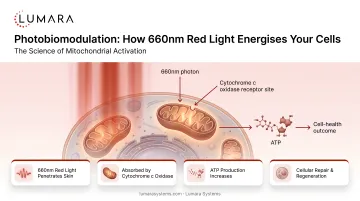
These responses include:
- Increased mitochondrial activity and cellular energy production
- Reduced pro-inflammatory cytokine signaling
- Support for collagen production in skin fibroblasts
- Improved local microcirculation through nitric oxide release
These effects occur at the wavelength level, not the temperature level. Red light therapy should not rely on heat as its primary mechanism. Some warmth can occur during use, but the therapeutic distinction is that red light therapy is built around wavelength-specific light delivery, not heat alone. A device that runs excessively hot may be losing energy as heat rather than delivering it as light.
The effects are also cumulative. A single session produces a transient cellular response; consistent sessions over weeks produce lasting changes in skin condition, inflammatory state, and tissue quality.
Why You Cannot Use a Heat Lamp as a Red Light Therapy Device
The core issue is that photobiomodulation is wavelength-specific. The cellular responses documented in red light therapy research occur at specific wavelengths - primarily 660nm for skin and soft tissue applications.
A heat lamp's broad-spectrum output includes some light in the red visible range, but:
- The wavelength is not controlled or verified
- The proportion of light at 660nm specifically is a small fraction of total output
- The primary energy delivery is thermal, not photochemical
- The irradiance at therapeutic wavelengths is far below what a dedicated red light therapy device delivers
Using a heat lamp "for red light therapy" is like using a general vitamin supplement instead of a specific nutrient that research shows works at a particular dose. The general product contains some of the relevant ingredient, but not in the right amount, at the right specificity, to produce the documented effect.
Which One Fits Which Goal
Use a heat lamp when:
- The goal is temporary warmth and physical comfort
- You need acute muscle or joint tension relief
- Budget is the primary constraint and thermal comfort is sufficient
Use a red light therapy device when:
- The goal is skin wellness (collagen, tone, fine line appearance)
- You are managing chronic inflammation or soft tissue conditions
- You want cumulative results that build over weeks of use
- Cellular-level tissue repair is the objective
Do not use a heat lamp when:
- You think you are getting the benefits of red light therapy research
- The goal is anything related to photobiomodulation-documented effects
- You are following a skin or recovery protocol based on RLT research
What to Look for in a Red Light Therapy Device
If the goal is photobiomodulation - not just warmth - the key specs are:
Wavelength verification: The device should specify exactly 660nm (or 850nm for near-infrared), not "red light" or a broad range. Third-party wavelength verification is more reliable than manufacturer claims alone.
Irradiance at treatment distance: The amount of light delivered to the skin surface needs to be sufficient for the intended dose. This is measured in mW/cm² and should be verified at the distance you will actually use the device.
Minimal heat output: Good thermal management in the device means more energy is delivered as light, not lost as heat. A device that runs hot is wasting output.
FDA clearance: Indicates the device has gone through regulatory review for its stated category.
Lumara's Illuminate V2 is built around these criteria: 660nm verified wavelength, 1,800 LEDs, splash-safe construction, FDA cleared, and Made in the USA.
Frequently Asked Questions
Is a heat lamp the same as red light therapy?
No. Heat lamps produce broad-spectrum light with thermal effects. Red light therapy devices deliver specific wavelengths (typically 660nm) chosen for photobiomodulation - cellular responses that occur independently of heat. They work through different mechanisms and produce different effects.
Can I use a heat lamp for red light therapy benefits?
No. Heat lamps do not deliver the wavelength precision or irradiance levels required for photobiomodulation effects. The benefits documented in red light therapy research require specific wavelengths at specific irradiance levels - not broad-spectrum thermal output.
Why does my red light therapy device feel warm?
Some warmth is normal from close-range light exposure. Red light therapy should not rely on heat as its primary mechanism - the therapeutic effect is wavelength-specific light delivery, not heat alone. A device that runs excessively hot may be losing energy as heat rather than delivering it effectively as light.
What wavelength should a red light therapy device use?
660nm is the most studied wavelength for skin and soft tissue photobiomodulation. Near-infrared at 830-850nm is used for deeper tissue applications. Any device claiming red light therapy benefits should specify exact wavelengths, not vague ranges.
Do heat lamps help with pain?
Yes, for temporary thermal pain relief. Heat lamps dilate blood vessels and reduce muscle tension through temperature, providing genuine short-term comfort for soreness and tension. This is a different mechanism from the anti-inflammatory cellular effects of red light therapy vs a heating pad.
Which is better for muscle recovery - heat lamp or red light therapy?
For immediate post-exercise comfort, a heat lamp provides faster temporary relief. For sustained recovery support and reduced inflammation over time, red light therapy (particularly near-infrared at 850nm) has more relevant evidence. Many users use both for different purposes.
Same Name, Different Science
Red light therapy and heat lamps share the color red and produce warmth. The comparison ends there. Photobiomodulation is a wavelength-specific cellular process; thermal therapy is a temperature-based tissue response. They are not substitutable, and confusing them leads to wasted money and missed results.
A device that delivers verified 660nm light at therapeutic irradiance is doing something fundamentally different from a heat lamp. Lumara's Illuminate V2 is built around that difference - 660nm verified wavelength, 1,800 LEDs, splash-safe construction, FDA cleared, and Made in the USA.