Introduction
"Infrared" and "red light" are often used interchangeably in consumer wellness marketing. They are not the same thing. Red light therapy and infrared therapy overlap in some wavelengths and mechanisms but diverge in penetration depth, mechanism emphasis, and ideal applications.
Getting this distinction right matters for device selection - you want to understand what you are buying and why.
Key Takeaways
- Red light (630-700nm) is visible light; near-infrared (700-1100nm) and far-infrared (1100nm+) are invisible
- All three interact with tissue, but through different mechanisms and at different depths
- Red light at 660nm is the most studied wavelength for skin and superficial soft tissue applications
- Near-infrared (830-850nm) penetrates deeper - relevant for muscle, joint, and deeper tissue applications
- Far-infrared (FIR) works primarily through heat and is the wavelength used in infrared saunas
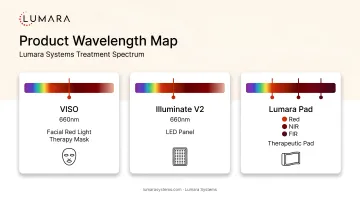
- Lumara's product range covers multiple wavelengths: 660nm red (VISO, Illuminate V2), 415nm blue (Illuminate Blue), 525nm green (Illuminate Green), and red/NIR/FIR (Lumara Pad)
The Visible Spectrum and What Lies Beyond
Light exists on a spectrum. What we call "red light" in therapeutic contexts is visible red light - typically 630-700nm. You can see it. It appears red.
Beyond 700nm, light transitions into near-infrared (NIR), which is invisible to the naked eye. Beyond approximately 1100nm is far-infrared (FIR), also invisible.
The therapeutic interest in these wavelengths comes from how differently tissue absorbs and responds to each:
| Wavelength range | Type | Visible? | Depth of tissue interaction |
|---|---|---|---|
| 630-700nm | Red light | Yes (appears red) | Approximately 5-10 mm, depending on wavelength, power, exposure time, and tissue type |
| 700-1100nm | Near-infrared | No | Generally deeper than visible red light; relevant for muscle, joint, tendon, and deeper soft-tissue applications |
| 1100nm+ | Far-infrared | No | Primarily thermal at tissue surface |
Red Light Therapy: Surface to Mid-Dermis
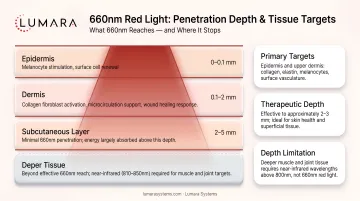
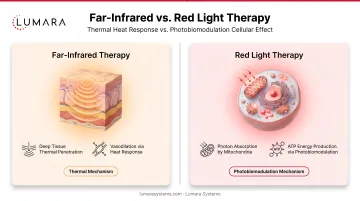
Red light therapy at 630-700nm (most commonly 660nm) is absorbed by chromophores in cells - particularly cytochrome c oxidase in mitochondria. This photochemical interaction is what drives the photobiomodulation (PBM) mechanism.
At 660nm, the primary tissue targets are:
- Epidermal cells and fibroblasts (collagen production, skin wellness)
- Superficial blood vessels (circulation support)
- Surface muscle and connective tissue
This is why 660nm red light is the most studied and cited wavelength for facial skincare, wound healing, and surface-level skin quality applications. The evidence base for 660nm is the deepest in the photobiomodulation research landscape.
The limitation is penetration depth. 660nm light is largely absorbed within the first approximately 5-10 mm of tissue, depending on wavelength, power, exposure time, and tissue type. For conditions involving structures below the dermis - deep muscle, joints, bone - red light alone is insufficient.
Near-Infrared: Deeper Tissue Applications
Near-infrared at 830-850nm generally penetrates deeper than visible red light, making it more relevant for muscle, joint, tendon, and deeper soft-tissue applications. The mechanism is the same - photobiomodulation via mitochondrial stimulation - but the target tissue is deeper.
This makes NIR the more relevant wavelength for:
- Muscle recovery after training
- Joint and tendon support
- Deeper chronic pain and inflammatory conditions
- Applications where the target tissue is below skin and superficial dermis
Many consumer "red light therapy" panels include both 660nm and 850nm LEDs - delivering both surface and deeper tissue photobiomodulation in the same session. Lumara's Pad includes red, near-infrared, and far-infrared for body-focused recovery routines.
Far-Infrared: The Heat Wavelength
Far-infrared works differently. FIR at 1100nm+ does not produce the same photochemical mitochondrial response as red or NIR light. Its primary mechanism is thermal - it heats tissue from within, which:
- Dilates blood vessels (vasodilation)
- Increases core body temperature
- Induces sweating
- Creates a systemic heat stress response
This is the mechanism behind infrared saunas. The therapeutic claims for FIR center on cardiovascular conditioning effects from heat stress, detoxification through sweating, and deep muscle relaxation from thermally induced vasodilation.
FIR is not the same mechanism as red light photobiomodulation. Describing infrared sauna use as "red light therapy" is technically inaccurate.
Which Wavelength for Which Goal
| Goal | Most relevant wavelength | Penetration needed |
|---|---|---|
| Facial skincare, collagen, skin tone | 660nm red light | Surface to upper dermis |
| Wound healing, surface inflammation | 660nm red light | Surface to dermis |
| Muscle recovery, DOMS reduction | 850nm near-infrared | Mid to deep muscle |
| Joint and tendon support | 850nm near-infrared | Deep soft tissue |
| Full-body heat, sweating, cardiovascular conditioning | Far-infrared | Thermal (whole body) |
| Multi-layer body recovery | Red + NIR + FIR combined | Surface through deep tissue |
How Lumara's Range Maps to This
Lumara's product lineup is built around wavelength specificity rather than multi-wavelength confusion:
VISO LED Mask: 660nm red light for facial skincare. Full-face coverage, 470 micro-LEDs, 30 mW/cm², FDA cleared. Purpose-built for the surface-level skin applications where 660nm has the strongest evidence.
Illuminate V2: 660nm red light in a panel format. 1,800 LEDs, 1,200 cm², 5-minute sessions. Broader coverage for facial and body surface applications.
Lumara Pad: Red, near-infrared, and far-infrared combined. Flexible body-contact format for larger body areas and recovery-focused routines where the multi-wavelength approach covers surface through deeper tissue.
Frequently Asked Questions
Is infrared the same as red light therapy?
No. Red light (630-700nm) and near-infrared (700-1100nm) are both used in photobiomodulation and work through similar cellular mechanisms at different depths. Far-infrared (1100nm+) works primarily through heat. Infrared sauna uses far-infrared heat; red light therapy uses visible or near-infrared photobiomodulation.
Which penetrates deeper - red light or near-infrared?
Red light can penetrate approximately 5-10 mm into the skin, depending on wavelength, power, exposure time, and tissue type. Near-infrared generally penetrates deeper than visible red light, which is why it is more often used for muscle, joint, tendon, and deeper soft-tissue applications.
Can I use both red and near-infrared at the same time?
Yes. Many devices combine both wavelengths for simultaneous surface and deeper tissue treatment. Lumara's Pad includes red, near-infrared, and far-infrared for comprehensive body-contact use.
What wavelength does an infrared sauna use?
Infrared saunas primarily use far-infrared wavelengths (1100nm+) to heat the body. This is different from the photobiomodulation mechanism of red light and near-infrared therapy panels.
Which is better for skin - red light or near-infrared?
For facial skincare and surface skin applications, 660nm red light has the stronger evidence base and more targeted depth profile. Near-infrared is better suited to deeper tissue applications. For skin specifically, 660nm is the more commonly used and better-studied wavelength.
Wavelength Shapes the Application
Infrared and red light therapy are related but not interchangeable. The wavelength determines the depth of interaction, and the depth determines which conditions are addressable.
For skin and surface applications, 660nm red light - the wavelength at the core of Lumara's VISO and Illuminate V2 - has the most relevant evidence. For body recovery across surface and deeper tissue, the red/NIR/FIR combination in Lumara's Pad covers more of the therapeutic picture.