Introduction
Cellulite affects the majority of women - it is a structural skin condition, not a weight problem or a hygiene issue. It appears when subcutaneous fat pushes through weakened connective tissue, creating the dimpled texture visible on thighs, buttocks, and abdomen.
Red light therapy is used as part of cellulite management routines, and there is a legitimate evidence basis for it. This guide covers what the research actually shows, how red light interacts with the tissue involved in cellulite, and which device format makes practical sense for this application.
Key Takeaways
- Red light therapy at 630-660nm has evidence for supporting collagen production, local circulation, and fat cell metabolism - all relevant to cellulite's structural drivers
- Results are visible in skin texture and firmness rather than fat removal - it reduces the appearance of cellulite, not the underlying fat itself
- Coverage area is the most important device spec for this application - small handhelds and facial masks are not practical for thighs, buttocks, and abdomen
- Consistent sessions 3-5x per week over With a properly powered red light system, some users may notice early changes in radiance or skin feel after just a few treatments, while deeper tone, texture, and collagen-related improvements build with consistent use. is the minimum commitment to assess results
- Lumara's Illuminate V2 - 660nm, 1,200 cm², 1,800 LEDs, 5-minute sessions - is the most relevant Lumara format for body coverage routines
How Red Light Therapy Applies to Cellulite
Cellulite is a structural problem. The dimpled texture occurs when fat deposits push through fibrous connective tissue (septae) under the skin. Factors that worsen it include thin or weakened skin, poor local circulation, and chronic low-grade inflammation in the tissue.
Red light therapy at 660nm addresses several of these factors:
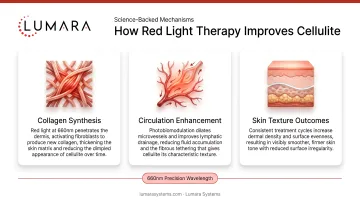
Collagen and skin matrix support: Multiple controlled studies show red light stimulates fibroblast activity and increases collagen synthesis in dermal tissue. Stronger, denser skin matrix means the skin resists the upward pressure of fat more effectively.
Circulation support: Photobiomodulation increases nitric oxide availability in tissue, supporting vasodilation and improved blood flow. Better circulation helps clear inflammatory mediators and supports tissue health in cellulite-prone areas.
Fat cell metabolism: Some research suggests red light at these wavelengths may support triglyceride release from adipocytes - contributing to localized changes in fat cell size without damaging the cells themselves.
What the Research Shows
A 2014 controlled trial using 611-650nm and 570-850nm wavelengths found significantly improved skin texture, reduced roughness, and increased collagen density after 30 sessions over 15 weeks in the treatment group.
A 2009 Journal of Investigative Dermatology study on 660nm LED therapy showed a 31% increase in type-1 procollagen and an 18% decrease in MMP-1 (a collagen-degrading enzyme) - both markers consistent with improved skin structural quality.
An RCT examining LLLT for body contouring found that light at 635-680nm produced measurable girth reduction versus control, with lab assays showing triglyceride release from adipocytes without cell damage.
The honest framing: red light therapy reduces the appearance of cellulite through skin quality improvement and tissue health - not through fat removal. Visible changes take weeks of consistent use, not single sessions.
Why Format Matters Most for This Application
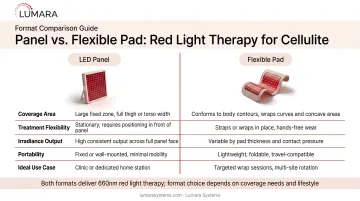
The most important spec for cellulite treatment is coverage area - not wavelength or LED count alone. Cellulite on the thighs, buttocks, and abdomen covers large surface areas. A small handheld device requires dozens of repositioning steps per session. A facial mask covers the wrong geometry entirely.
For practical at-home cellulite sessions, the device needs to cover a meaningful body area per session - ideally 500+ cm² - with consistent irradiance across the treatment surface. A panel versus a mask is not a minor distinction for this application - format determines whether the device can reach the target tissue at all.
Lumara Illuminate V2 - Best for Panel-Format Body Coverage
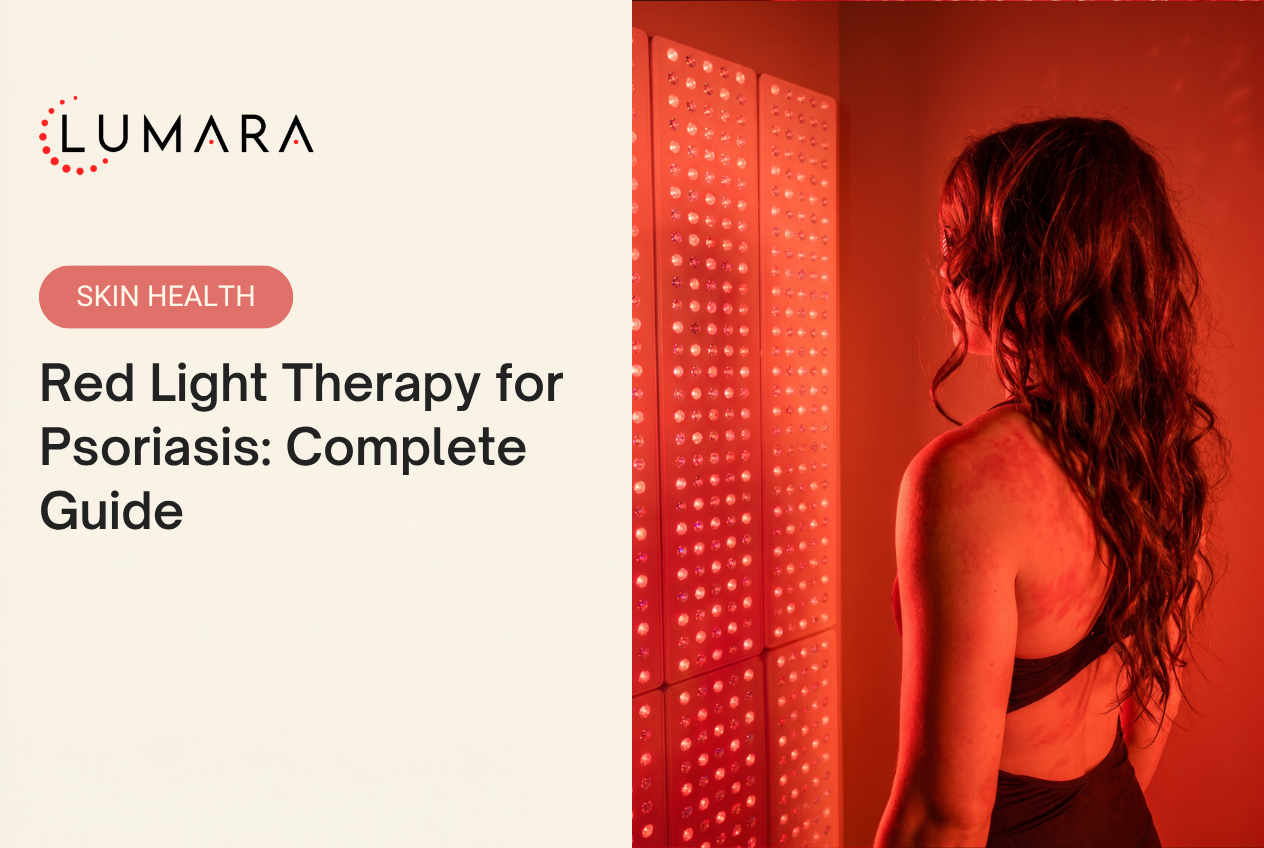
Lumara's Illuminate V2 is a 660nm red light panel with 1,800 LEDs across 1,200 cm², delivering 6,000 joules in 5 minutes. Its panel format positions efficiently against thigh, buttock, and abdominal surfaces, and the 5-minute session guidance makes it practical for consistent daily use.
| Spec | Detail |
|---|---|
| Wavelength | 660nm red light |
| LEDs | 1,800 |
| Coverage area | 1,200 cm² |
| Session time | 5 minutes |
| Energy delivery | 6,000 joules per session |
| Build | Splash-safe |
| FDA status | FDA cleared |
| Made in | USA |
| Warranty | 3 years |
For users wanting full-body coverage across all cellulite areas in a single setup, larger panel systems or multiple devices may be needed - the Illuminate V2 is best suited to targeted area treatment per session.
Flexible Pad Format - Alternative for Body-Contact Coverage
For users who prefer direct-contact coverage, a flexible pad can be positioned directly against the skin surface on the thigh or lower body. Lumara's Pad - available in multiple sizes up to 20 x 30", using red, near-infrared, and far-infrared wavelengths - is designed for direct body-contact use with 20-30 minute sessions. The flexible format conforms to body contours, which may improve LED-to-skin contact consistency on curved areas.
How to Build an Effective At-Home Protocol
Session prep:
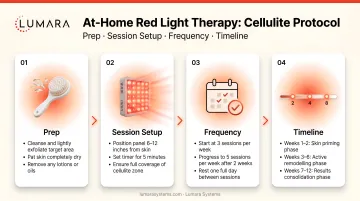
- Cleanse and dry the treatment area - remove all lotions, oils, and serums before treatment
- Bare skin with no product barrier is required for effective light penetration
Session setup:
- Position the panel 6-12 inches from the treatment area per manufacturer guidance
- For pad format, place directly against the skin surface
Frequency:
- 3-5 sessions per week minimum
- With a properly powered red light system, some users may notice early changes in radiance or skin feel after just a few treatments, while deeper tone, texture, and collagen-related improvements build with consistent use. of consistent use before assessing results
- Results build cumulatively - individual sessions do not produce visible change
Supporting practices:
- Dry brushing before sessions may support lymphatic drainage
- Regular exercise and adequate hydration support the same circulatory and tissue health outcomes that red light therapy targets
What Realistic Results Look Like
Most users who see meaningful improvement report changes in skin texture, firmness, and smoothness over With a properly powered red light system, some users may notice early changes in radiance or skin feel after just a few treatments, while deeper tone, texture, and collagen-related improvements build with consistent use. of consistent use. The improvement is in skin quality and appearance - not fat removal.
Cellulite appearance is affected by hydration, muscle tone, and skin thickness as well as light therapy. Results are most pronounced when red light therapy is used as part of a broader routine including exercise and adequate hydration, not as an isolated intervention.
Frequently Asked Questions
Does red light therapy reduce cellulite?
Red light therapy reduces the appearance of cellulite through improved collagen density, skin texture, and local circulation. It does not remove fat. Consistent use over With a properly powered red light system, some users may notice early changes in radiance or skin feel after just a few treatments, while deeper tone, texture, and collagen-related improvements build with consistent use. is required to assess results.
What wavelength is best for cellulite?
630-660nm is the most studied wavelength for collagen stimulation and skin quality improvement. Near-infrared (850nm) can complement by supporting deeper tissue circulation. Lumara's Illuminate V2 uses 660nm specifically.
How often should I use red light therapy for cellulite?
3-5 sessions per week is the most commonly referenced frequency. Consistency over months is the primary driver of results - not individual session length.
How long to see results?
Some users notice early improvements in skin radiance and overall appearance within 1–2 weeks, and visible changes may begin after just a few treatments. More noticeable tone, texture, and firmness improvements usually depend on consistent use and the device's wavelength, power, and treatment routine.
Can I use a face mask for cellulite treatment?
No. Face masks are shaped for facial coverage and cannot effectively cover the large body surface areas where cellulite occurs. A panel or flexible pad with adequate coverage area is required.
The Right Coverage Makes the Difference
Red light therapy for cellulite works - but only if the device can actually reach the treatment area consistently. A 5-minute facial mask used on the thighs is not a cellulite protocol. A panel or pad with meaningful body coverage used consistently for 3 months is.
Lumara's Illuminate V2 - 660nm, 1,800 LEDs, 1,200 cm², 5-minute sessions, FDA cleared - is built for exactly that format.