Introduction
Most people dealing with stretch marks have tried the creams. They moisturize, they smell good, and they change nothing — because they can't reach the dermis, the middle skin layer where the real damage lives. The torn collagen and elastin networks beneath the surface stay untouched.
Red light therapy — clinically called photobiomodulation — takes a different path. Red and near-infrared photons penetrate the dermis directly, triggering cellular repair processes that stimulate collagen and elastin production. It's not a surface treatment. Results still depend on how you use it, and there's real variability in outcomes.
This guide walks through how red light therapy works on stretch marks, what an effective at-home protocol actually looks like, and the most common mistakes that stall progress before it starts.
TLDR
- Red light therapy stimulates collagen and elastin production in the dermis — one of the few at-home treatments that improves stretch mark texture and color, not just surface hydration
- Wavelength matters: 660nm targets surface texture and newer marks, while 850nm near-infrared penetrates deeper for older, fibrotic ones
- Effective protocols require 10–20 minutes per session, 3–5 times weekly, sustained over 8–16+ weeks
- New (red or purple) stretch marks respond faster than old (white or silvery) ones; older marks improve too, just more gradually
- Device irradiance and wavelength accuracy matter more than size or price
Why Red Light Therapy Works on Stretch Marks
The Cellular Reality of Stretch Marks
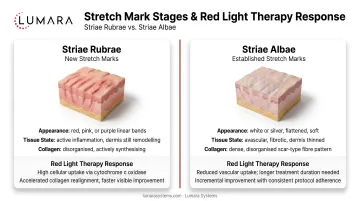
Stretch marks form when rapid skin stretching tears the dermis — the middle skin layer — disrupting the collagen-elastin latticework that gives skin its strength. The body patches the damage with disorganized "bridge" collagen. This is why stretch marks feel different from surrounding skin and resist normal regeneration.
The damage looks different depending on the mark's age:
- Striae rubra (new, red/purple marks) — excess thin elastic fibers, vasodilation, and active collagen disruption
- Striae alba (older, white marks) — epidermal atrophy, reduced blood flow, and dense scarred horizontal collagen lines
How Photobiomodulation Triggers Repair
Red light photons are absorbed by cytochrome c oxidase in the mitochondria — the cell's energy factories. This absorption triggers a surge in ATP production, giving skin cells the energy they need to repair, produce new tissue, and function like normal skin cells rather than continuing to replicate scar behavior.
Three Key Biological Effects
Red light therapy delivers three mechanisms relevant to stretch marks:
- Fibroblast activation — Increases collagen and elastin synthesis in the dermis, gradually replacing disordered scar tissue with more structured skin
- Anti-inflammatory action — Helps transition red or purple marks toward a more natural skin tone by reducing the inflammatory phase
- Improved circulation — Accelerates nutrient delivery and waste removal at the treatment site, supporting faster tissue turnover

Why Red Light Outperforms Topical Creams
Those three mechanisms explain why depth matters. Topical drugs have limited skin permeability, resulting in minimal improvement on mature white stretch marks. The American Academy of Dermatology notes that creams, lotions, and gels appear to have little to no effect on mature stretch marks.
Red light therapy reaches the mid and deep dermis and subcutaneous tissue, making it one of the few non-invasive home methods capable of supporting actual tissue remodeling where the structural damage occurred.
Step-by-Step: How to Use Red Light Therapy for Stretch Marks at Home
Step 1: Prepare Your Skin Before the Session
Start with clean, bare skin. Remove all lotions, oils, self-tanners, and occlusive products — even a thin film can scatter light and reduce absorption. Use a gentle, fragrance-free cleanser and pat dry.
Before your first session, also check for contraindications:
- Avoid treating over open wounds, active rashes, or freshly irritated skin
- If you take photosensitizing medications or have a condition like lupus, consult a healthcare provider first
Step 2: Set Up and Position Your Device
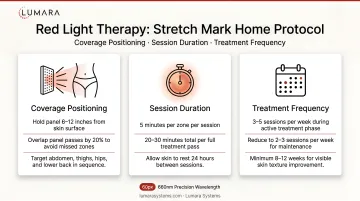
Position the device at the manufacturer's recommended distance — typically 6–12 inches for panels. Closer distances (2–6 inches) apply to higher-irradiance devices targeting deeper, older marks. Irradiance drops sharply with distance, so consistent positioning matters every session.
Coverage is equally important. The entire affected area must fall within the beam's zone. For large areas like the abdomen or thighs, use a wide panel or treat in sections — partial coverage produces uneven results.
With your device set up correctly, you're ready to run the session.
Step 3: Run the Session
Keep the device stationary for 10–20 minutes per area. Consistent, still exposure drives more even cellular activation than sweeping the light back and forth. High-irradiance panels — like Lumara's 660nm devices — can deliver a therapeutic dose faster due to higher power output, making shorter sessions viable once you've verified the device's irradiance specs.
Don't exceed 20 minutes per area. Going beyond this threshold can trigger the biphasic dose response (Arndt-Schulz Law), where too much light energy inhibits rather than stimulates cellular repair.
Step 4: Post-Session Care and Building a Consistent Routine
Apply a hyaluronic acid or vitamin C serum immediately after your session. Skin absorption is temporarily enhanced post-treatment, and vitamin C is a direct cofactor for collagen synthesis. One timing note: avoid retinoids right after a session. Use them at night and schedule your red light sessions in the morning or early evening instead.
For results, consistency is non-negotiable:
- 3–5 sessions per week for at least 8–16 weeks
- Skipping multiple weeks disrupts the cumulative collagen stimulus
- Most users report visible fading within 8–12 weeks of regular sessions — the skin's ~30-day cell turnover cycle means results build gradually, not overnight
Key Parameters That Affect Your Results
Four variables determine whether red light therapy actually remodels your stretch marks or just produces the sensation of doing something. Getting even one wrong leads to weeks of consistent effort with little visible change.
Wavelength
Not all wavelengths reach the same tissue depth — which matters because newer and older stretch marks live in different layers of the dermis.
- 660nm red light targets the superficial dermis, improving color and surface texture; most effective for newer, red stretch marks (striae rubra)
- 850nm near-infrared penetrates deeper into the dermis — reaching mid and deep layers where older, fibrotic marks (striae alba) reside; research confirms penetration depth of ~1.8mm vs. ~2.4mm respectively
- Single-wavelength devices (red only) treat the surface but miss deeper structural damage
- Dual-wavelength devices (660nm + 850nm) address both surface texture and dermal remodeling; combination therapy showed 36% improvement versus 26% for red light alone in clinical trials

Irradiance (mW/cm²)
Irradiance measures how much light energy actually reaches the skin per unit area. Treat too low, and session length becomes irrelevant — you never hit a therapeutic dose.
- Target 100+ mW/cm² at the skin surface for efficient dosing; use this formula to calculate your dose: Dosage (J/cm²) = [Irradiance (mW/cm²) × Time in seconds] / 1000
- For stretch marks, aim for the 10–20 J/cm² range per session
- Don't trust spec sheets alone — consumer devices with inflated claims often deliver a fraction of their stated output; look for independently tested irradiance data
Session Duration and Frequency
Collagen remodeling runs on the skin's natural cell turnover cycle — roughly 30 days. Session frequency needs to match that biology, not override it.
- 3–5 sessions per week is the evidence-supported range; daily use is safe but offers diminishing returns
- Cap each area at 20 minutes per session — beyond that, you're not adding stimulus, just time
- Space sessions 24–48 hours apart so the cellular repair cascade from each treatment can complete before the next
Distance from Device
Irradiance drops sharply with distance following the inverse square law — a device rated at 100 mW/cm² at 6 inches may deliver far less at 12 inches.
- Position the device at the **manufacturer's rated distance** for every session, not approximately
- Even small variations across sessions can push your actual dose below the therapeutic threshold
- Treat distance like a dosing variable — because it is one
New vs. Old Stretch Marks: What to Realistically Expect
Understanding the Biological Difference
Striae rubra (new stretch marks):
- Red or purple marks in the active inflammatory phase
- Fibroblasts are still responsive
- Tissue is still transitioning from injury to scar formation
Striae alba (old stretch marks):
- White or silvery marks that have become fibrotic
- Thinned skin with loss of pigment
- Multiple layers of scar tissue must turn over before healthier cells take hold
For New Stretch Marks
Begin treatment as early as possible — the active inflammatory phase is the window when fibroblasts are most receptive to red light therapy stimulation. The American Academy of Dermatology recommends using treatments on early stretch marks, as treatments seem to have little effect on mature stretch marks.
Expected timeline:
- Visible improvement in color and texture within 4–8 weeks of consistent treatment
- Faster response due to active inflammatory phase
- Better chance of influencing the trajectory of scar formation
For Old Stretch Marks
Older marks are harder to shift, but still respond. They need deeper penetration — 850nm near-infrared wavelengths are especially effective — along with longer treatment durations. Clinical trials treating striae alba with photobiomodulation showed moderate to near-total improvement after 8–12 sessions, with assessment at 1 month and 3 months after the last session.
Expected timeline:
- Meaningful results may take 4–6 months or more of consistent use
- Expect improved texture, better blending with surrounding skin, and reduced depth
- Complete erasure is unlikely — but older marks can look and feel significantly better
Common Mistakes When Using Red Light Therapy for Stretch Marks
Skipping sessions: Sporadic treatment — once a week or skipping weeks entirely — breaks the cumulative collagen synthesis stimulus your skin needs. Meaningful remodeling requires repeated, sustained stimulation over time.
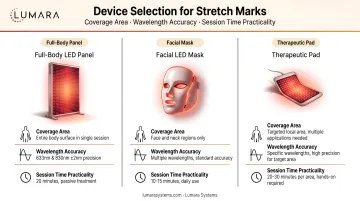
Using underpowered or single-wavelength devices: A device without verified irradiance output or accurate wavelength targeting will underperform regardless of session length — particularly if it lacks near-infrared coverage for deeper marks. When evaluating a device, check for:
- Confirmed mW/cm² irradiance specifications
- Verified wavelength output (not just claimed)
- Dual-wavelength capability for comprehensive treatment
Wrong skincare timing: Applying retinoids, AHAs, or occlusive creams before a session either increases photosensitivity or blocks light penetration. The correct routine: cleanse skin before your session, then apply supporting serums — hyaluronic acid or vitamin C — afterward.
Stopping too early: Most users see no visible change in the first 4 weeks — skin cell turnover takes roughly 30 days, and cumulative results lag behind. Those who quit at 4–6 weeks miss the window where early remodeling actually becomes visible.
Over-treating in a single session: Treating the same area for 30–45 minutes hoping to speed results can trigger the biphasic dose response and inhibit healing. More sessions per week beats longer individual sessions every time.

Frequently Asked Questions
How long should I use red light therapy for stretch marks at home?
Use 10–20 minutes per area per session (adjusted by device irradiance), 3–5 sessions per week for a minimum of 8–16 weeks. Older stretch marks may require ongoing use beyond 6 months for meaningful results.
Can red light therapy for stretch marks at home reduce or get rid of stretch marks?
Red light therapy can significantly reduce the appearance of stretch marks — improving texture, color blending, and skin firmness. Complete removal isn't realistic — most users see a noticeable reduction in texture and color contrast rather than full elimination.
What color or wavelength of light (red vs infrared) is best for treating stretch marks?
660nm red light targets surface texture and newer red marks, while 850nm near-infrared reaches deeper dermal layers for older stretch marks. Using both wavelengths together provides the most comprehensive approach.
Is LED or red light therapy safe for people with lupus?
People with lupus or other photosensitive conditions should consult their doctor before starting red light therapy. Photosensitivity is present in over 90% of lupus cases, and the American Academy of Dermatology warns that skin conditions making individuals sensitive to light can worsen when exposed to red light.
Is red light therapy more effective on new (red) stretch marks than older ones?
Yes — new red marks are in the active inflammatory phase, when fibroblasts respond most readily to red light stimulation. Treating early gives you the best window to influence collagen production before the scar fully matures.
How many sessions before seeing results from red light therapy on stretch marks?
Results build gradually over several months:
- 4–6 weeks: Early improvements in skin texture and softness
- 8–12 weeks: More visible changes in color and firmness
- 4–6 months: Most significant results, especially for older stretch marks