Red Light Therapy Clinical Trials in 2026: Latest Research

Introduction

Red light therapy—clinically known as photobiomodulation—has moved well past wellness trend territory. Over 1,800 interventional studies are now registered on ClinicalTrials.gov, with major institutions like the National Institute of Neurological Disorders and Stroke and the U.S. Department of Defense investing millions across neurology, ophthalmology, and metabolic health.

That institutional backing moves the conversation from anecdotal claims to evidence-based medicine. It also exposes a critical nuance: not all red light therapy works for all conditions, and evidence quality varies significantly by application and device.

This article breaks down the most significant 2025–2026 clinical trial findings across multiple conditions, translates what they mean for real-world use, and identifies where the science still has gaps—so you can make informed decisions rather than rely on hype.

Key Takeaways

  • ENLITE PD found light therapy safe for Parkinson's patients, but it didn't advance to Phase 3 for sleep outcomes
  • A JAMA Ophthalmology trial found 650nm light slowed myopia progression in children, with some transient retinal changes
  • DoD's $4.6M trial is testing photobiomodulation plus cognitive rehab for traumatic brain injury in veterans
  • Hair loss studies consistently support the 630–670nm range for follicle stimulation
  • No trial has proven red light therapy works universally—but current research is broader and more rigorous than ever

What the Surge in RLT Clinical Trials Means in 2026

The evolution from early photobiomodulation studies to today's research represents a fundamental shift in scientific rigor. Early studies were often small, uncontrolled, and lacked proper sham comparisons. Current trials feature randomized controlled designs with legitimate placebo controls, larger participant pools, multi-site coordination, and pre-registered endpoints—the gold standard for medical evidence.

Context shapes everything when interpreting results. A positive outcome in a 20-person pilot study carries far less weight than a 300-participant randomized trial with sham controls and independent oversight.

Institutional Investment Signals Legitimacy

The range of funding bodies now involved tells its own story. The National Institute of Neurological Disorders and Stroke awarded grant U01NS114001 for the ENLITE PD Parkinson's trial. The Department of Defense committed $4.6 million for traumatic brain injury research running through 2029. These aren't wellness companies funding marketing studies—these are federal agencies allocating taxpayer dollars to answer specific clinical questions.

FDA Clearance vs. Registration: A Critical Distinction

Consumers frequently encounter terms like "FDA registered" and "FDA cleared" when evaluating devices, but these designations mean very different things.

DesignationWhat It MeansWhat It Does NOT Mean
FDA Establishment RegistrationManufacturer has registered its facility and listed devices with the FDAFDA has reviewed, approved, or endorsed the device's safety or efficacy
FDA 510(k) ClearanceDevice demonstrated "substantial equivalence" in safety and effectiveness to an existing legally marketed device; requires evidence submission and FDA reviewBlanket approval for all uses or conditions

FDA establishment registration versus 510k clearance side-by-side comparison infographic

When a clinical trial tests a specific device-condition pairing—such as a 655nm laser comb for male pattern baldness—and that device receives 510(k) clearance, the FDA has reviewed evidence for that specific use case.

A general-purpose LED panel that is "FDA registered" has cleared no such bar. When evaluating any device, check whether clearance applies to your intended use, not just the manufacturing facility.

Parkinson's Disease and Sleep: Inside the ENLITE PD Trial

Sleep disruption affects more than 75% of people with Parkinson's disease, contributing to fatigue, cognitive impairment, and reduced quality of life. Unlike motor symptoms, sleep problems in Parkinson's often respond poorly to standard medications, making non-pharmacological interventions particularly valuable if they work.

The ENLITE PD trial tested whether light therapy could address this gap.

Trial Design Overview

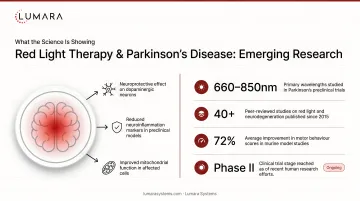
The NeuroNEXT NN110 ENLITE PD Phase 2 trial enrolled 150 participants in a 16-week randomized study with four arms:

  • Twice-daily bright white light therapy
  • Once-daily bright white light therapy
  • Once-weekly bright white light therapy
  • Twice-daily dim red light therapy (sham control)

The primary outcome was change in the Parkinson's Disease Sleep Scale-2 (PDSS-2), a validated measure of sleep quality. Researchers set a threshold improvement of ≥1.7 points for daily bright white light therapy compared to controls to justify advancing to Phase 3.

Notably, the trial used twice-daily dim red light as the sham control—a design choice that would prove significant.

Key Findings and What They Mean

The trial did not meet its pre-specified advancement criteria. Daily bright white light therapy did not produce a statistically meaningful enough improvement over controls to justify a larger Phase 3 trial.

The improvement simply wasn't large enough, or consistent enough, to meet the strict statistical threshold researchers set before the trial began. Many participants across all arms—including controls—reported some improvement in sleep scores.

While sleep was the primary endpoint, researchers also measured fatigue using the Parkinson's Disease Fatigue Scale (PFS-16). Twice-daily bright white light therapy showed the strongest improvement across all arms at −6.4 points—a promising signal even though it was a secondary outcome.

The twice-daily dim red light "sham" arm also produced a measurable fatigue improvement of −3.8 points. This points to a persistent design problem in photobiomodulation research: low-intensity red light isn't biologically inert, which makes constructing a true placebo genuinely difficult.

Light therapy was well-tolerated, with adherence rates ranging from 63% to 86%—strong compliance for a 16-week non-drug intervention. For a condition where many standard medications carry significant side effect burdens, that tolerability profile matters: it keeps the door open for larger trials and real-world use even as efficacy questions remain.

ENLITE PD trial four-arm design with fatigue improvement scores comparison chart

Myopia Control and Traumatic Brain Injury: Two Breakthrough Trials

RLRL Therapy for Myopia in Children (JAMA Ophthalmology)

Myopia is projected to affect nearly 50% of the world's population by 2050, making interventions that slow progression in childhood important. Axial elongation—the lengthening of the eyeball—drives myopia progression and increases long-term risk of retinal complications.

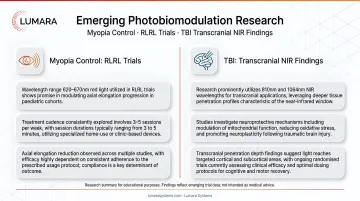
A 2024 randomized clinical trial published in JAMA Ophthalmology tested repeated low-level red light (RLRL) therapy in 336 children aged 6 to 12 years. Participants used a 650nm device for 3 minutes twice daily for one year.

Results: RLRL significantly slowed myopia progression. The mean change in spherical equivalent refraction was almost 1 diopter more myopic in controls compared to the treatment group, and axial length was approximately one-third of a millimeter greater in controls. This represents clinically meaningful slowing of progression.

Slowing axial elongation in childhood reduces the risk of sight-threatening complications in adulthood, including myopic macular degeneration, retinal detachment, glaucoma, and optic nerve damage.

The safety signal: A separate randomized trial involving 86 children using a 650nm desktop device twice daily for 6 months confirmed efficacy but identified an important safety consideration. In the treatment group, 3 eyes in 3 children (7%) showed transient dome-shaped hyperreflectivity between the retinal pigment epithelial layer and the foveal ellipsoid zone on optical coherence tomography (OCT).

These children had no visual symptoms and their vision remained normal. The hyperreflectivity resolved completely 0.5 to 3 months after stopping therapy. However, this finding underscores the importance of routine OCT monitoring during RLRL therapy to detect asymptomatic retinal changes early.

For parents and clinicians: RLRL therapy shows genuine promise for slowing myopia progression, but it requires medical supervision and regular OCT imaging—not DIY home treatment without ophthalmologic oversight.

DoD-Funded Photobiomodulation Trial for Traumatic Brain Injury

Persistent symptoms following mild traumatic brain injury (mTBI)—including cognitive difficulties, mood changes, and headaches—affect many service members, veterans, and first responders. Current treatments are limited, leaving a significant gap for affected populations.

The University of Utah and New York University received a $4.6 million Department of Defense grant for a 300-participant, multi-arm randomized controlled trial running through August 2029, combining photobiomodulation with computerized cognitive rehabilitation.

Treatment protocol: Participants use a specialized LED headset delivering near-infrared light to the scalp plus a nasal delivery clip, approximately 25 minutes per day, five to six days per week. The mechanism works on three levels:

  • Targets cytochrome c oxidase in mitochondria to support ATP production
  • Releases nitric oxide to improve cerebral circulation
  • Reduces neuroinflammation in affected tissue

Preliminary signals: Earlier pilot studies showed statistically significant improvements in fluid cognition, verbal learning and memory, attention, and executive function, alongside decreases in depression and anxiety symptoms. These are preliminary findings—not proven outcomes—but they were strong enough to justify this larger, more rigorous trial.

Photobiomodulation traumatic brain injury treatment mechanism three-level process flow

What makes this trial worth watching: the combination of PBM with cognitive rehabilitation, the 300-person sample size, and DoD funding together mean results—expected around 2029—could establish photobiomodulation as a standard-of-care option for mTBI, a population currently running out of alternatives.

Skin, Hair Loss, and Metabolic Conditions: Where the Evidence Stands

Hair Loss and the 630-670nm Wavelength Research

Low-level laser therapy (LLLT) for androgenetic alopecia has the strongest evidence base of any red light therapy application, with multiple FDA-cleared devices and consistent clinical trial results.

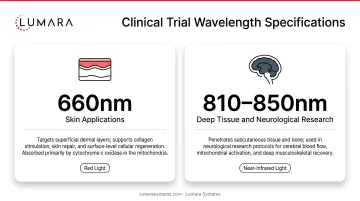
The mechanism is well-characterized: light in the 630-670nm range is absorbed by cytochrome c oxidase in hair follicle mitochondria, increasing ATP production, modulating reactive oxygen species, and releasing nitric oxide.

This cascade stimulates dormant (telogen) follicles to re-enter the active growth (anagen) phase and prolongs that phase in follicles already cycling.

Clinical evidence: Systematic reviews and meta-analyses of randomized controlled trials confirm that LLLT significantly increases terminal hair density and thickness over 16 to 26 weeks compared to sham devices. Results require consistent use—skipping sessions reduces effectiveness.

Trials that produced measurable results used specific wavelength bands, typically 655nm ±5nm. A consumer LED panel claiming "red light" without wavelength verification may or may not deliver therapeutic doses—device quality matters here. Lumara Systems' devices operate at precisely 660nm, placing them within the wavelength range studied in these trials.

Skin, Thyroid, and Metabolic Applications

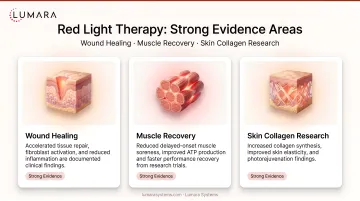
Skin rejuvenation has the broadest RCT support in this group. Red (630-660nm) and near-infrared (830nm) light improve skin roughness, hydration, and collagen density by stimulating fibroblast activity and reducing inflammation. Gene expression studies show red light activates pathways responsible for rebuilding and remodeling collagen.

For rosacea, the picture is more cautious. Red and near-infrared light reduce pro-inflammatory markers like TNF-α and IL-6 in experimental models, but comprehensive dermatological reviews place the strongest clinical evidence with vascular lasers—Pulsed Dye Lasers and Intense Pulsed Light—for erythema and telangiectasia. Some LED-based studies suggest benefit, but robust RCT evidence remains limited.

The remaining applications are earlier-stage. Here's where the research currently stands:

  • Thyroid (Hashimoto's): A 2013 placebo-controlled trial (n=43) found 830nm LLLT reduced levothyroxine requirements and improved thyroid echogenicity. Long-term follow-up showed the benefit was time-limited, indicating repeated treatments would be needed. Preliminary only—not a substitute for medical management.
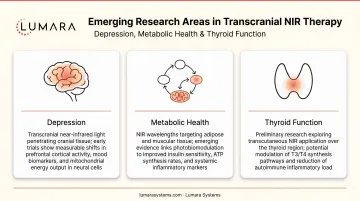
  • Blood glucose regulation: A 2024 experimental study found 15-minute 670nm exposure, taken 45 minutes before glucose consumption, reduced blood glucose elevation by 27.7% over two hours and cut maximum spiking by 7.5%. The proposed mechanism is increased mitochondrial ATP production driving higher systemic glucose demand. Replication in larger controlled trials is needed before any clinical application.

Red light therapy evidence strength comparison across skin hair thyroid and metabolic conditions

Safety Signals and What Clinical Trials Still Can't Tell Consumers

Overall Safety Profile

Across contemporary trials, red light therapy holds a strong safety record within established parameters. The ENLITE PD trial reported no serious adverse events, and the large JAMA Ophthalmology myopia trial (336 children) found no safety concerns in masked fundus photograph reviews. Hair loss trials show adverse events are typically mild and transient — temporary shedding or scalp itching.

However, the retinal hyperreflectivity observed in the smaller myopia trial (7% of treatment group) serves as an important reminder: dose, device quality, and medical supervision matter. Even when changes are transient and asymptomatic, they underscore that photobiomodulation is a biological intervention with real effects—not a risk-free wellness gadget.

Biphasic Dose Response: Why More Isn't Better

Photobiomodulation follows the Arndt-Schulz law, a biphasic dose response where low doses stimulate cellular repair, moderate doses produce optimal effects, but high doses inhibit function or cause tissue stress.

This means delivering higher fluences or extending treatment times beyond recommended parameters doesn't yield better results—it can negate therapeutic benefits or cause harm. The World Association for Photobiomodulation Therapy provides specific dosage recommendations, noting that therapeutic dose windows typically range within ±50% of given values, and doses outside these windows are inappropriate.

Biphasic dose response curve showing stimulation optimal and inhibition zones for photobiomodulation

This is why protocol design matters. Lumara Systems' 5-minute treatment protocol is built around appropriate dosing — calibrated to wavelength, power density, and treatment area — to stay within the therapeutic window. Longer sessions aren't necessarily better, and modifying protocols without guidance can push you outside the range where benefits occur.

What Trials Can't Tell You

Clinical trials test specific devices, wavelengths, protocols, and populations — so a positive result in one study doesn't automatically transfer to all red light therapy devices or all users.

Key limitations:

  • A trial using a 655nm laser comb doesn't validate a 630nm LED panel for the same use
  • Results in children with myopia don't predict outcomes in adults with macular degeneration
  • A study using 3-minute twice-daily sessions doesn't validate 20-minute once-weekly protocols
  • Strong evidence for hair loss doesn't carry over to metabolic conditions

Anyone managing a diagnosed medical condition should consult a healthcare provider before starting any light therapy regimen. The evidence base is growing — but it's condition-specific, device-specific, and protocol-specific.

Frequently Asked Questions

Is there clinical evidence that red light therapy works?

Yes, there is an expanding body of clinical evidence including randomized controlled trials for hair loss, myopia control, Parkinson's symptoms, and traumatic brain injury. However, the strength of evidence varies significantly by condition and device, and the field continues to produce new trial data with mixed results.

Does red light therapy work in 2025?

2025 saw significant trial publications and a major DoD-funded trial launch. Results are condition-specific: strong for hair loss and myopia control, promising but preliminary for TBI, and inconclusive for Parkinson's sleep symptoms.

Is red light therapy FDA cleared?

FDA clearance applies to specific device-condition pairings — certain LLLT hair loss devices like HairMax LaserComb and iRestore systems hold clearance, but most consumer devices do not. Note that "FDA registered" (manufacturing registration) is not the same as FDA clearance for efficacy.

Will red light therapy help Parkinson's?

The ENLITE PD trial showed light therapy had a safe profile and some fatigue improvements but did not meet criteria to advance to Phase 3 for sleep outcomes. The evidence for Parkinson's is still developing, and patients should discuss light therapy with their neurologist before use.

Will red light therapy help rosacea?

Red and near-infrared light therapy has shown anti-inflammatory effects in skin research, though strong RCT evidence for rosacea remains limited. The strongest clinical evidence for rosacea's erythema still lies with vascular lasers — consult a dermatologist before use.

Does red light therapy work on a 70-year-old woman?

Multiple trials have included older adults, and the ENLITE PD trial (mean age 67) showed good tolerability. Age alone is not a contraindication, though underlying conditions and medications should be reviewed with a physician first.