Introduction
People managing rosacea often reach a fork in the road: their dermatologist or aesthetician mentions Laser Genesis as an in-clinic option, while they are also reading about at-home red light therapy devices. These are genuinely different tools, and the confusion around them is understandable - they both use light, both appear in rosacea discussions, and neither is universally the right first step.
This guide explains what each approach actually does, where the evidence sits, how they can work together, and how to think about the decision based on your specific rosacea presentation and access to care.
Key Takeaways
- Laser Genesis is an Nd:YAG 1064nm clinical laser procedure primarily targeting visible blood vessels and telangiectasia - it requires a trained clinician and cannot be done at home
- Red light therapy at 660nm works through photobiomodulation and may help support calmer-looking skin and overall skin quality in rosacea-prone skin, as part of a consistent skincare routine
- These are not competing options - they target different aspects of rosacea and can be used complementarily
- At-home red light therapy may help support skin comfort and overall skin quality in rosacea-prone skin; Laser Genesis addresses structural vascular features that light therapy alone does not resolve
- For people with mild, rosacea-prone redness who are already under appropriate skincare or dermatology guidance, at-home red light therapy may be a practical supportive routine. Clinical procedures are more relevant when visible vessels or telangiectasia are the main concern.
Understanding Rosacea: Why One Tool Rarely Covers Everything
Rosacea is not a single, uniform condition. It presents across a spectrum that includes chronic facial redness, visible broken capillaries (telangiectasia), inflammatory papules and pustules, skin sensitivity, and sometimes thickening of skin tissue. Most people with rosacea have more than one of these features.
That complexity is why comparing "Laser Genesis vs red light therapy" as if one wins is a misleading frame. A more useful question is: what aspect of my rosacea presentation is driving the most visible concern, and which tool addresses that mechanism?
- If persistent visible red vessels or telangiectasia are the dominant concern: vascular-targeted procedures like Laser Genesis are the more direct intervention
- If chronic redness, skin reactivity, and inflammatory flares are the dominant concern: photobiomodulation addresses those mechanisms more directly
- If both are present - which is common: a combined approach addresses more of the picture
What Laser Genesis Actually Does
Laser Genesis uses an Nd:YAG 1064nm laser at low fluence to heat the upper dermis - a fundamentally different mechanism from the infrared and red light wavelengths used in photobiomodulation devices. The primary mechanism is photothermal: the laser energy is absorbed by hemoglobin in dilated blood vessels, which causes those vessels to coagulate and collapse. It also creates controlled thermal stimulation that supports collagen remodeling.
What Laser Genesis is best suited for:
- Visible telangiectasia - the fine red lines or broken capillaries that appear on the cheeks and nose
- Persistent diffuse redness driven by dilated vasculature
- Skin texture improvement as a secondary benefit
What Laser Genesis does not do:
- It does not reduce the underlying chronic inflammatory environment that causes rosacea to persist and flare
- It is not an ongoing maintenance tool - it is a course of treatment, typically 4 to 6 sessions spaced weeks apart
- It requires a trained clinician in a clinical setting - it cannot be replicated at home
For people whose primary rosacea feature is visible vessels or persistent structural redness, Laser Genesis has a more direct effect than any light therapy device. That is an honest assessment of how these tools compare mechanistically.
What Red Light Therapy at 660nm Does for Rosacea
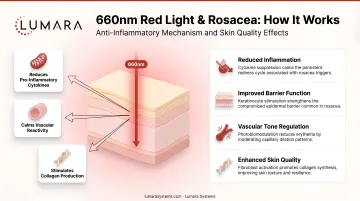
Red light therapy at 660nm works differently. Rather than targeting blood vessels thermally, 660nm light is absorbed at the cellular level, where it can reduce pro-inflammatory cytokines and support the skin's natural barrier and repair processes.
For rosacea, this is relevant because rosacea is a chronically inflammatory condition - the visible symptoms are driven by an ongoing inflammatory environment in the skin. Anti-inflammatory support does not eliminate structural telangiectasia, but it may help support calmer-looking skin in rosacea-prone skin.
What at-home 660nm red light therapy is suited for in a rosacea context:
- May help support overall skin comfort and quality in rosacea-prone skin
- Helping calm skin reactivity and sensitivity
- Supporting overall skin quality and barrier function in rosacea-prone skin
- Daily maintenance routines that do not require clinic access or scheduling
What it does not directly address:
- Structural telangiectasia already present - these require vascular-targeted procedures
- Acute rosacea flares driven by triggers: these require management through trigger avoidance and, where appropriate, medical care
The distinction matters: red light therapy is well-suited as an ongoing supportive tool. It is not a one-time corrective procedure. For a deeper look at how at-home and clinic-based approaches compare across access, cost, and outcomes, that comparison is covered separately.
The Practical Comparison
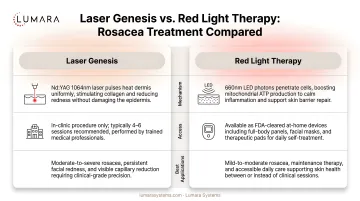
| Factor | Laser Genesis | Red Light Therapy 660nm |
|---|---|---|
| Mechanism | Photothermal vascular targeting | Photobiomodulation, anti-inflammatory |
| Primary target | Telangiectasia, dilated vessels | Chronic inflammation, skin reactivity |
| Access | Clinical procedure, trained operator | At-home consumer devices |
| Session format | 4-6 sessions, spaced weeks apart | Daily or 4-5x per week, ongoing |
| Ongoing maintenance | Not designed for frequent repeat use | Designed for consistent daily routine |
| Cost structure | Per-session clinic pricing | One-time device investment |
| Best suited for | Structural vascular features | Calmer-looking skin support and consistent skincare routines in rosacea-prone skin |
When Combining Both Makes the Most Sense
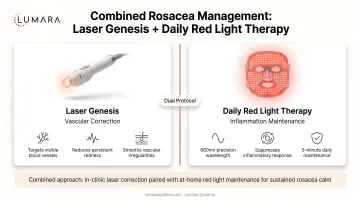
For many rosacea presentations, the most effective approach uses both tools in sequence or in parallel:
- Laser Genesis (or a similar vascular procedure like IPL) addresses the structural vascular features - the telangiectasia and visible vessels that at-home light therapy does not resolve
- At-home red light therapy may help support calmer-looking skin and a consistent skincare foundation, which can complement clinical procedures over time
The logic is straightforward: Laser Genesis can improve the visible structural features, but rosacea is a chronic condition that does not go away after a treatment course. A consistent daily at-home red light routine may help support skin quality and comfort without the need for repeated clinic visits.
After a clinical procedure series, at-home 660nm red light therapy is also gentler on sensitive post-procedure skin than treatments that involve heat, friction, or active ingredients - which matters for rosacea-prone skin that is easily triggered.
What Rosacea Patients Should Discuss With Their Dermatologist
Red light therapy is an adjunctive tool, not a dermatology substitute. If your rosacea is severe, involves papules and pustules, is progressing, or has not responded to basic management, dermatological care is the appropriate primary step.
For mild to moderate presentations where the main features are chronic redness, skin sensitivity, and general inflammatory activity, at-home red light therapy can be a practical and consistent daily tool - used alongside, not instead of, medical guidance where needed.
Questions worth asking a dermatologist before deciding between clinical procedures and at-home devices:
- Is my rosacea primarily vascular (vessels, telangiectasia) or primarily inflammatory?
- Would a clinical vascular procedure address my most visible concerns more directly than at-home devices?
- Is at-home light therapy an appropriate complement to my current management plan?
How a Well-Designed Device Fits This Routine
For rosacea-adjacent at-home use, device design matters. Wavelength accuracy is important - 660nm is the range studied for photobiomodulation in skin applications. Coverage matters because rosacea typically affects the full central face. Session practicality matters because the benefit of at-home light therapy is rooted in consistency, and a device that does not fit naturally into a daily routine will not get used consistently. When evaluating at-home panel versus mask form factors, the facial coverage and fit differences are worth understanding for rosacea-specific use.
Lumara's VISO LED Mask delivers 660nm red light across 470 micro-LEDs with full-face coverage and even illumination. The 5- to 20-minute session format and secure fit are designed around daily routine consistency - the kind of use pattern that matters for rosacea-prone skin routines. The wavelength is triple-tested and verified, and the device is FDA cleared as a Class II medical device.
For rosacea-adjacent skincare routines, VISO is a better fit than general-purpose panels that spread output across a larger area with less facial-specific design focus.
Frequently Asked Questions
Is Laser Genesis or red light therapy better for rosacea?
They address different aspects of rosacea, so the comparison is less useful than understanding what each does. Laser Genesis targets vascular features like telangiectasia and persistent redness from dilated vessels. Red light therapy at 660nm may help support calmer-looking skin and overall skin quality in rosacea-prone skin. It does not treat rosacea itself, resolve structural telangiectasia, or replace dermatological care. For most rosacea presentations, a combined approach addresses more of the picture than either alone.
Can red light therapy help rosacea?
Research suggests that 660nm red light therapy may help support reduction in inflammatory activity and skin reactivity in rosacea-prone skin, and may support overall skin quality. It does not resolve structural telangiectasia, which requires vascular-targeted procedures. As part of a consistent daily routine, it may be a practical supportive routine for rosacea-prone skin.
How often should I use red light therapy for rosacea?
Daily or 4 to 5 sessions per week. The anti-inflammatory benefit of photobiomodulation is cumulative and maintained through consistent use. Irregular sessions reduce the practical benefit.
Can I use red light therapy after Laser Genesis?
Discuss timing with the clinician who performed the procedure. Generally, red light therapy is gentle and compatible with post-procedure skin care routines once any immediate post-treatment sensitivity has resolved, but follow the specific guidance of your treating clinician.
Does red light therapy reduce facial redness?
Red light therapy at 660nm may help support reduction in chronic inflammatory redness over time through its anti-inflammatory effects. It is not a vascular-targeting procedure and does not directly collapse dilated vessels. For redness driven primarily by vascular dilation and telangiectasia, a clinical vascular procedure is a more direct intervention.
Is Laser Genesis painful?
Laser Genesis is generally described as a warm, tolerable sensation rather than painful. It is performed in a clinical setting with trained operators. Individual experience varies.
Conclusion
Laser Genesis and red light therapy are not substitutes for each other - they work through different mechanisms and address different aspects of rosacea. Laser Genesis is the more direct approach for structural vascular features. Red light therapy is the more practical approach for daily anti-inflammatory management.
For many rosacea presentations, using both - a clinical vascular procedure for structural correction, and daily at-home 660nm red light therapy as a supportive skincare routine for rosacea-prone skin - addresses more of the condition than either tool alone.
If you are building a consistent at-home red light routine for rosacea-adjacent facial skincare, explore Lumara's VISO LED Mask - 660nm, 470 micro-LEDs, full-face coverage, FDA cleared, designed for daily routine use.