Introduction
Red light therapy's application to thyroid health is one of the more specific and research-backed niche applications in photobiomodulation - more specific than many consumer wellness claims, and more limited than some marketing suggests.
This guide covers what the research actually shows, which conditions have the most evidence, the mechanism, and what to realistically expect from red light therapy as part of a thyroid wellness approach.
Key Takeaways
- A Brazilian randomized controlled trial published in Lasers in Surgery and Medicine found that low-level laser therapy applied to the thyroid gland reduced levothyroxine dose requirements in hypothyroid patients - a clinically meaningful finding
- The most evidence exists for Hashimoto's thyroiditis (autoimmune hypothyroidism) - studies show anti-inflammatory effects and improved thyroid function markers
- The mechanism involves photobiomodulation reducing the autoimmune inflammatory response in thyroid tissue and supporting cellular energy in thyroid cells
- Near-infrared wavelengths (810-850nm) are more relevant than 660nm red for this application - the thyroid gland sits below the skin surface and requires deeper penetration
- Red light therapy is used as a complement to medical management, not a replacement for it - thyroid conditions require monitoring and medical oversight
The Research Basis
The Brazilian Thyroid Trial (Höfling et al., 2012)
The most cited study on red light therapy and thyroid health was a randomized controlled trial published in Lasers in Surgery and Medicine. Researchers applied low-level laser therapy directly to the thyroid gland in patients with hypothyroidism from Hashimoto's thyroiditis.
Key findings:
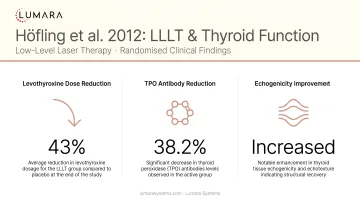
- Patients in the treated group showed significant reductions in levothyroxine (T4 replacement) dose requirements versus the placebo group
- Improvements in thyroid echogenicity (a measure of thyroid tissue quality on ultrasound) were observed in treated patients
- Anti-thyroid antibody levels (anti-TPO, anti-Tg) showed reductions in treated versus control groups
This is a meaningful clinical finding - a reduction in hormone replacement requirement is not a cosmetic outcome. The study used clinical-grade laser devices applied directly to the thyroid region, not consumer LED panels, which is an important distinction.
Anti-Inflammatory Mechanism
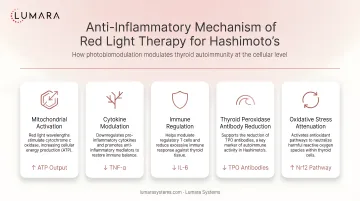
Hashimoto's thyroiditis is an autoimmune condition where the immune system attacks thyroid tissue, causing progressive destruction of functional cells. The anti-inflammatory effects of photobiomodulation - reducing pro-inflammatory cytokines and modulating autoimmune signaling - are mechanistically relevant to this process.
Research on photobiomodulation in autoimmune conditions more broadly shows reductions in inflammatory markers. For thyroid-specific application, the hypothesis is that reducing the local inflammatory environment allows remaining thyroid cells to function more effectively and reduces the rate of immune-mediated destruction.
What the Evidence Does Not Show
- Red light therapy has not been shown to reverse established hypothyroidism or replace medical treatment
- Evidence for hyperthyroidism (overactive thyroid) is much more limited and the mechanism less clear
- Consumer LED devices operate at lower irradiance and have less precise tissue targeting than the clinical laser devices used in research
- Replication of the Brazilian trial findings in larger, multi-center studies is still needed
Wavelength Considerations for Thyroid Application
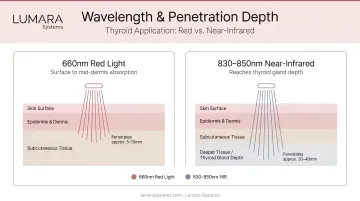
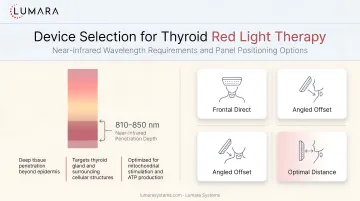
The thyroid gland is located in the anterior neck, beneath skin, subcutaneous fat, and muscle. For photobiomodulation to reach thyroid tissue, the wavelength needs sufficient penetration depth.
| Wavelength | Penetration depth | Relevance for thyroid |
|---|---|---|
| 660nm red | Up to 5-10mm (depending on wavelength, power, exposure time, and tissue type) | Limited for thyroid depth - primarily surface and dermal tissue |
| 830-850nm near-infrared | Deeper tissue penetration | More relevant for reaching thyroid tissue |
The Brazilian trial used laser devices operating at 830nm - the near-infrared range. For at-home use, devices that include near-infrared alongside red light are more appropriate for this application than red-light-only devices.
How to Use Red Light Therapy for Thyroid Support
Important prerequisite: Thyroid conditions require medical monitoring. Do not modify thyroid medication based on self-assessed results from light therapy. Any changes in thyroid function should be documented through blood tests and managed with your physician.
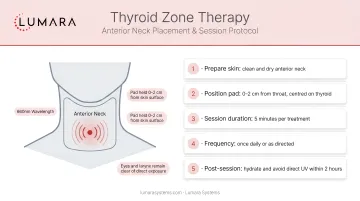
Device positioning: Apply to the anterior neck over the thyroid region. The thyroid sits below the Adam's apple in the midline of the neck.
Session protocol:
- 10-20 minutes per session
- 3-5 sessions per week
- Consistent use over several months before expecting assessable changes in thyroid markers
What to monitor: Thyroid function tests (TSH, Free T4, TPO antibodies) through your physician's standard monitoring protocol. Do not self-assess based on subjective symptoms alone. Protective eye safety during sessions should also be considered.
Device Selection for This Application
For thyroid-targeted application, a panel or targeted device with near-infrared capability is more relevant than a red-only device. The thyroid sits deeper than what 660nm red light can effectively reach.
A device that delivers both 660nm and near-infrared (830-850nm) in a format that can be positioned against the anterior neck covers more of the relevant tissue depth. Panel devices or flexible pads designed for body-contact use work well for this positioning.
Lumara's Illuminate V2 (660nm) can be used for neck area sessions, but the thyroid-specific evidence is more closely aligned with near-infrared wavelengths. For users building a broader red light wellness routine that includes thyroid support as one application, a panel that covers multiple body areas across different sessions is more versatile.
Frequently Asked Questions
Does red light therapy help with thyroid conditions?
A randomized controlled trial showed meaningful improvements in hypothyroid patients treated with LLLT, including reduced levothyroxine requirements. The strongest evidence is for Hashimoto's thyroiditis. Evidence for other thyroid conditions is more limited.
What wavelength is best for thyroid application?
Near-infrared at 830-850nm has more depth relevance for reaching thyroid tissue than 660nm red light. The Brazilian trial used 830nm laser. At-home devices with near-infrared output are more appropriate than red-only devices for this application.
Can red light therapy replace thyroid medication?
No. Thyroid conditions require medical management and monitoring. Red light therapy is a complementary approach used alongside medical treatment, not a replacement for it. Any medication adjustments should be made by your physician based on objective thyroid function testing.
How long does it take to see results?
The Brazilian trial assessed results over 9 months. Meaningful changes in thyroid antibody levels or medication requirements are not short-term outcomes. Assess through blood tests after 3-6 months of consistent use under physician monitoring.
Is red light therapy safe for the thyroid?
Consumer-level red and near-infrared light therapy applied to the neck region at recommended distances is generally considered safe. Anyone with thyroid cancer, nodules, or active disease progression should consult their endocrinologist before starting.
The Research Is Legitimate - But So Is the Specificity
Red light therapy for thyroid health has a genuine research foundation - more substantial than many wellness applications. The key variables that matter most are wavelength selection (near-infrared for tissue depth), a consistent protocol, and appropriate medical oversight.
The published thyroid research is primarily built around near-infrared wavelengths at 830nm and above - not 660nm red light. This distinction matters for anyone considering light therapy specifically for thyroid support: the clinical protocols that produced meaningful results used devices operating in the NIR range, not consumer red light panels.
For users interested in broader 660nm red light wellness routines - across skin, body areas, and general recovery - Lumara's Illuminate V2 offers a precise, high-output panel for consistent daily use. For thyroid-specific concerns, users should discuss any light therapy approach with their physician and understand that near-infrared protocols are more closely aligned with the published thyroid research.
Thyroid conditions require physician monitoring, regular blood testing, and any medication changes should only be made under medical supervision.
Explore Lumara Illuminate V2 for broader 660nm red light wellness routines.