Introduction
EMF (electromagnetic field) concerns around consumer electronics are legitimate enough to be worth addressing seriously, and the red light therapy panel market has responded with a proliferation of "low EMF" claims. The problem is that most of these claims are made without context - no measurement methodology, no reference standard, no meaningful comparison point.
This guide covers what EMF actually is in the context of red light panels, what levels are considered acceptable by independent standards, how EMF is properly measured, and what to look for when evaluating a panel's EMF claims.
Key Takeaways
- All electrical devices produce some level of electromagnetic field; the relevant question is at what level and at what distance
- Building Biology standards are the most commonly referenced independent benchmark for EMF in consumer wellness contexts: under 1 mG at treatment distance is a typical target
- Pulsed frequencies in some red light therapy panels can increase effective EMF readings; continuous output panels tend to measure lower
- Distance is the most practical EMF reduction tool - EMF drops with the square of the distance
- Claimed EMF specs are not always measured consistently; ask for third-party lab testing data with specified measurement methodology and distance
What EMF Is in the Context of Red Light Panels
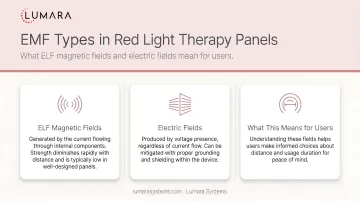
Electric and magnetic fields are produced by all devices that carry or consume electricity. Red light therapy panels are no exception - LEDs, drivers, control circuitry, and power supplies all generate EM fields at varying intensities and frequencies.
The type of EMF most often discussed in the wellness community is extremely low frequency (ELF) magnetic field, measured in milliGauss (mG) or microtesla (μT). This is separate from radio frequency (RF) EMF, which is produced by wireless devices like phones and WiFi routers.
For a wired red light therapy panel:
- ELF magnetic fields are the primary EMF type, generated by the AC current in drivers and wiring
- Near-field electric fields are present but typically less discussed
- RF EMF is negligible in non-wireless panels
What Level Is Considered Safe or Low
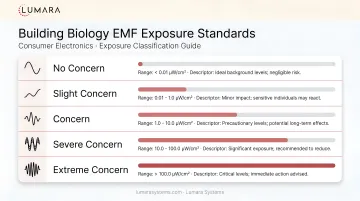
The most commonly referenced independent standard for EMF exposure in consumer wellness contexts is the Building Biology guidelines, which set the following ELF magnetic field benchmarks:
| Category | ELF Magnetic Field (mG) |
|---|---|
| No concern | Under 0.2 mG |
| Slight concern | 0.2 - 1.0 mG |
| Severe concern | 1.0 - 5.0 mG |
| Extreme concern | Above 5.0 mG |
For consumer electronics used at arm's length or greater, readings under 1 mG are the most commonly marketed as "low EMF." The key variable is measuring distance - EMF drops rapidly with distance, so a device that reads 3 mG at 1 inch will typically read well under 1 mG at 6 inches.
Most red light therapy use cases involve positioning the panel at 6-12 inches from the body. At this distance, many well-designed panels measure below 1 mG even without specific EMF-reduction design choices.
How EMF Is Properly Measured
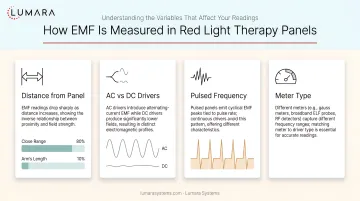
The "low EMF" claim on many panels is made using inconsistent methodology. Key factors that affect readings:
Measurement distance: A panel might read 5 mG at 1 inch and 0.5 mG at 6 inches. Claims should specify distance.
AC vs DC drivers: Panels using AC-driven LEDs produce more ELF magnetic field than those using DC drivers. The driver design significantly affects EMF output.
Pulsed vs continuous output: Some panels use pulsed LED frequencies for therapeutic effect. Pulsed operation can increase ELF magnetic field readings compared to continuous output at the same power level.
Meter type: Handheld gaussmeters vary significantly in accuracy. ISO-accredited lab testing with calibrated equipment is the only reliable standard for comparison across brands.
When evaluating EMF claims, ask:
- At what distance was this measured?
- What instrument was used?
- Is there third-party lab documentation?
Practical EMF Reduction During Sessions
Regardless of the panel you use, these practices reduce effective EMF exposure during sessions:
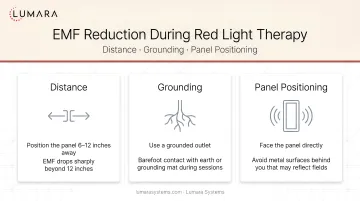
Maintain recommended treatment distance: Most panels specify 6-12 inches as the treatment distance. This already reduces EMF significantly from what it would be at 1-2 inches. If you are comparing a panel vs mat setup, note that treatment distance and EMF exposure differ between form factors.
Position grounding cables correctly: If your panel uses a grounding cable, connecting it to a properly grounded outlet reduces AC electric field significantly.
Use wired rather than wireless control: If your panel has WiFi or Bluetooth app control, the wireless feature adds RF EMF. Wired operation reduces this.
Avoid standing directly over or behind the panel power supply: Driver circuits produce the highest EMF concentration; the display face of most panels measures lower.
What to Look for in a Low-EMF Panel
When evaluating EMF claims:
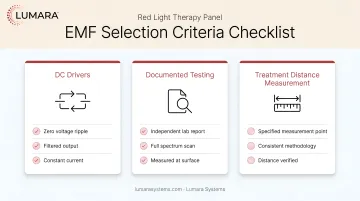
Documented testing at treatment distance: Any claim should include the distance at which EMF was measured - ideally 6 inches and 12 inches to reflect actual use.
DC driver design: Panels built with DC LED drivers produce lower ELF magnetic fields than AC-driven equivalents. This is also relevant when evaluating a DIY red light therapy panel, where driver choice is fully in the builder's control.
Third-party measurement documentation: Manufacturer self-reported EMF figures are less reliable than independent lab measurements. Ask for documentation.
Continuous vs pulsed output option: If you are concerned about EMF from pulsed frequencies, choose a panel that can run in continuous mode.
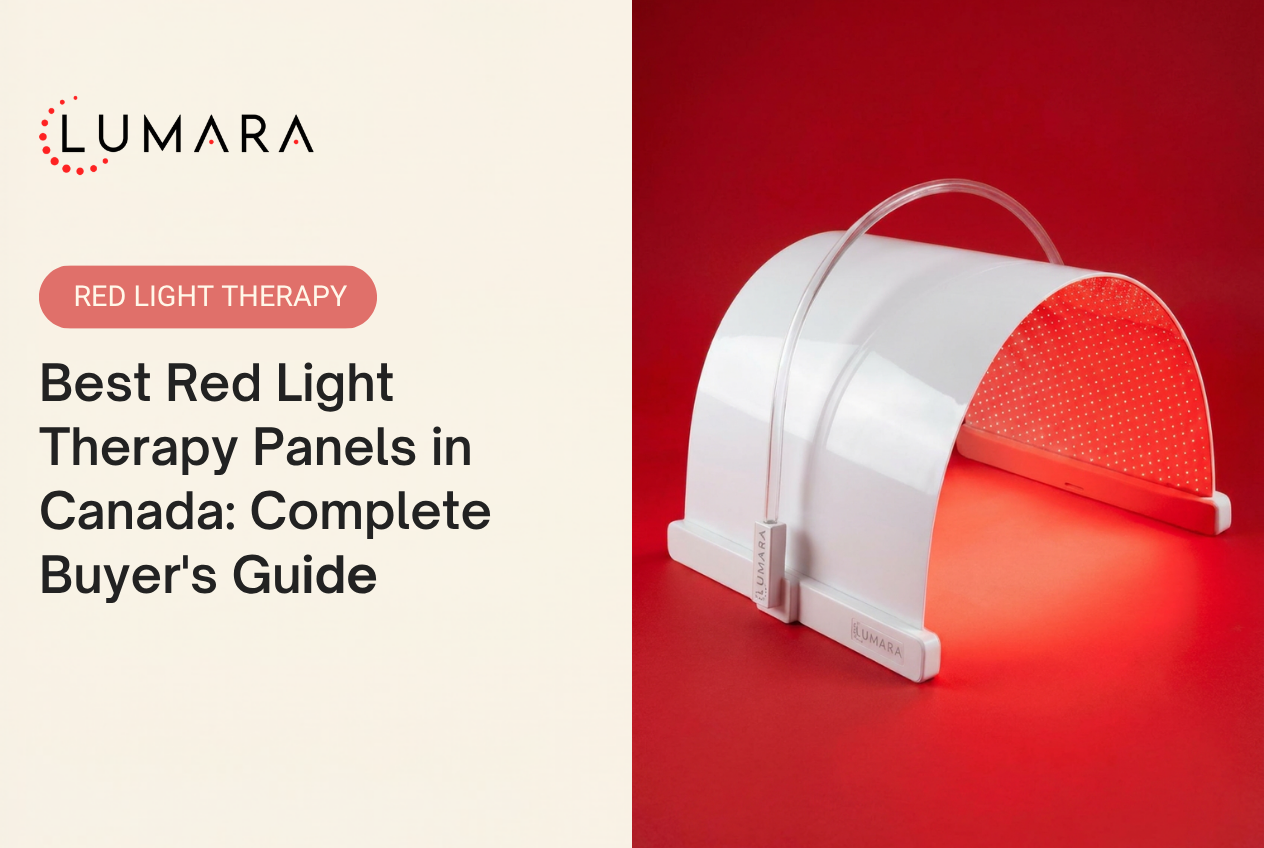
Lumara's Illuminate V2 is built with thermal management and driver design choices that minimize unnecessary EMF output, complementing its Targeted 660nm red light therapy designed for 5- to 20-minute sessions and FDA clearance.
Frequently Asked Questions
Are red light therapy panels safe in terms of EMF?
Consumer red light therapy panels used at recommended treatment distances (6-12 inches) typically produce ELF magnetic fields well below the 1 mG Building Biology benchmark at that distance. EMF concerns are legitimate but proportional - at the distances used during sessions, most well-designed panels are in the low-concern range.
What is a good EMF level for a red light therapy panel?
Under 1 mG at 6 inches (the typical treatment distance) is the most commonly referenced benchmark based on Building Biology standards. Under 0.2 mG falls into the "no concern" category.
Does distance from the panel affect EMF exposure?
Significantly. EMF drops with the square of the distance. At twice the distance, you receive approximately 25% of the EMF. Maintaining 6-12 inches from the panel during sessions is the single most effective EMF reduction practice. Distance also matters when managing back pain treatment, where panel placement varies by target area.
How are EMF levels measured for red light therapy panels?
ELF magnetic fields are measured in milliGauss (mG) using a gaussmeter. For comparison across panels, testing should be conducted at consistent distances using calibrated equipment. ISO-accredited lab measurement is the most reliable standard; manufacturer-reported figures vary in methodology.
What makes a panel "low EMF"?
DC driver design, accurate measurement at specified treatment distance, and documentation from third-party testing. "Low EMF" as a marketing claim without measurement methodology is not meaningful - ask for specifics.
Context Matters More Than Claims
EMF from red light therapy panels is a real consideration worth addressing - but the "low EMF" label requires context to be meaningful. What distance? What meter? What driver design? What documentation?
At proper treatment distances, most well-engineered panels are in an acceptable range. Lumara's Illuminate V2 - designed with driver efficiency and thermal management in mind, 660nm, FDA cleared - is built with the same engineering-first approach that makes EMF management a design consideration rather than a marketing claim.