Introduction
Low back pain is the leading cause of disability globally. For a condition this prevalent, non-invasive management tools are in high demand - and red light therapy is among the most studied non-pharmaceutical options for pain and inflammation in soft tissue.
This guide covers how red light therapy works for back pain, what the clinical evidence shows, which wavelengths are relevant, and which device format makes practical sense for this application.
Key Takeaways
- Near-infrared light (810-850nm) penetrates deep enough to reach paraspinal muscle and spinal structures - this is the more relevant wavelength for back pain
- 660nm red light addresses surface-level muscle inflammation and soft tissue; a device with both wavelengths covers more of the back pain picture
- Form factor matters: large panels cover the full back in one session; flexible pads allow direct-contact body positioning; wearable belts enable hands-free sessions
- Clinical protocols use 10-20 minutes per session, 3-5x per week over 4-8 weeks before assessing results
- Consistent use over weeks outperforms any individual session
How Red Light Therapy Applies to Back Pain
Anti-Inflammatory Effect
Red and near-infrared light therapy reduces pro-inflammatory cytokines (including TNF-α and IL-6) through photobiomodulation. For back pain driven by disc irritation, muscle strain, or facet joint inflammation, this anti-inflammatory effect addresses one of the key drivers.
Circulation and Muscle Relaxation
Near-infrared wavelengths trigger nitric oxide release from mitochondria, supporting vasodilation and improved blood flow to paraspinal muscles. Better circulation reduces muscle spasm and supports clearance of inflammatory byproducts.
Tissue Repair Support
A 2020 RCT using 660nm and 850nm LEDs three times per week for two weeks in nurses with low back pain showed significant reductions in pain scores versus control. Research on photobiomodulation for muscle recovery consistently shows reduced DOMS and faster recovery from tissue stress.
The Wavelength Question for Back Pain
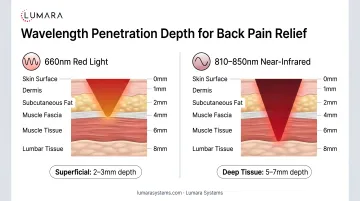
For back pain specifically, wavelength selection matters more than for surface skin applications because the relevant tissue is deeper.
| Wavelength | Practical relevance for back pain |
|---|---|
| 660nm red | Supports surface-level soft tissue, local circulation, and inflammation-related discomfort |
| 810-850nm near-infrared | More relevant for deeper muscle and joint-adjacent areas because near-infrared light generally reaches deeper than visible red light |
Red light can penetrate approximately 5-10 mm into the skin, depending on wavelength, power, exposure time, and tissue type. Near-infrared wavelengths generally reach deeper than visible red light, which is why they are usually more relevant for back pain applications.
660nm alone addresses surface inflammation and muscle tissue closest to the skin surface. For conditions involving deeper structures - chronic low back pain, disc-adjacent inflammation, paraspinal muscle issues - near-infrared at 810-850nm is the more relevant wavelength. A device with both wavelengths covers more of the clinical picture.
Device Formats for Back Pain
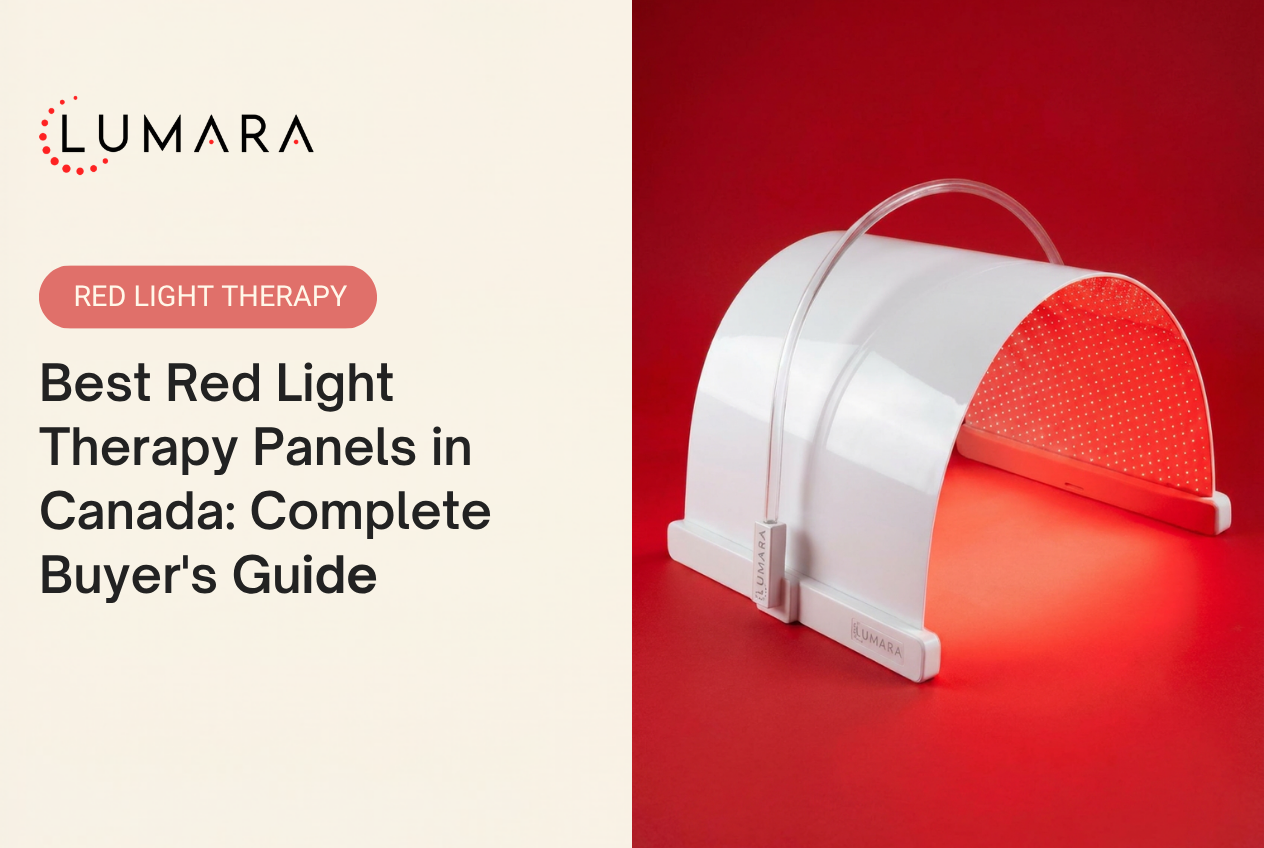
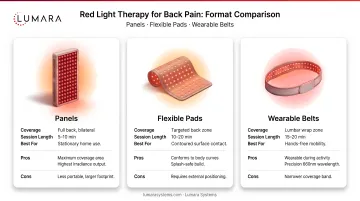
Large Panels - Maximum Coverage Per Session
Full back panels provide broad irradiance across the entire back in a single standing session. Best for users with diffuse back pain or who want comprehensive coverage without multiple repositioning steps.
Tradeoff: fixed setup, usually requires standing or sitting at a distance.
Flexible Pads - Direct Body Contact
Flexible pads placed directly against the back surface maintain consistent LED-to-tissue contact. The direct contact format can be more comfortable for lying-down sessions and covers the specific pain area reliably.
Lumara's Pad uses red, near-infrared, and far-infrared wavelengths in a flexible body-contact format.
Wearable Belts - Hands-Free Sessions
Wearable belt formats strap around the lower back for hands-free sessions during daily activity. Best for localized lower back pain where targeted coverage is more important than broad back coverage.
What to Look For in a Device
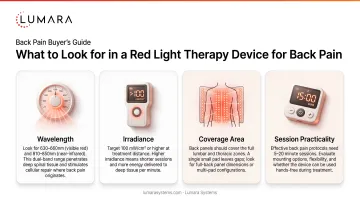
Wavelength: Near-infrared (810-850nm) must be present for meaningful depth in back tissue. Red-only devices at 660nm are insufficient for deep paraspinal applications.
Irradiance at treatment distance: Ask for irradiance figures at 6" and 12" (not 0"), measured with calibrated equipment. Most therapeutic protocols require 20+ mW/cm² at the treatment distance.
Coverage for your pain pattern: Diffuse low back pain needs broad coverage. Localized pain (single vertebral level, one side) can be managed with a smaller targeted device.
FDA clearance: Quality signal that the device has been through regulatory review.
Session time practicality: A device you will use 4x per week consistently outperforms a technically superior device you use irregularly.
How to Use Red Light Therapy for Back Pain
Prep: Clean the treatment area and remove any lotions or products. Bare skin is required for effective penetration.
Positioning: For panels, position at manufacturer-recommended distance (typically 6-12"). For pads, place directly against skin.
Session length: 10-20 minutes per session is the evidence-supported range. Follow manufacturer guidance for your specific device.
Frequency: 3-5 sessions per week. Daily use is safe for most users. Results build over 4-8 weeks - individual sessions do not produce overnight relief.
Safety: Wear eye protection if the device is near face level. Consult your doctor before starting if you are pregnant, on photosensitizing medications, or have open wounds in the treatment area.
Frequently Asked Questions
Does red light therapy help back pain?
Clinical evidence supports red light therapy as a complement to back pain management. Research shows reduced pain scores and inflammation markers with consistent use. It works best as part of a broader management approach.
What wavelength is best for back pain?
Near-infrared (810-850nm) for deeper tissue and muscle penetration. 660nm for surface tissue and inflammation. Devices with both wavelengths provide more comprehensive coverage for back pain applications.
How long does it take to see results?
Most research protocols run 4-8 weeks before meaningful assessment. Initial comfort improvements may appear within 1-2 weeks; sustained pain reduction requires consistent multi-week use.
Can I use red light therapy every day for back pain?
Yes. Daily use is safe and many protocols recommend it for acute back pain. Chronic pain management typically uses 3-5x/week. Following manufacturer session time guidance is more important than frequency limits.
What format is best for back pain?
Depends on pain pattern. Diffuse low back pain: a large panel or a 20x30" flexible pad. Localized pain: smaller targeted pad or wearable belt. Hands-free preference: wearable belt format.
The Right Wavelength and Consistent Sessions - In That Order
Red light therapy is a legitimate non-pharmaceutical option for back pain management, with the strongest relevance when near-infrared wavelengths are included and sessions are consistent over weeks.
For body-contact flexibility across back, lower back, and other recovery areas, Lumara's Pad - red, near-infrared, and far-infrared, flexible format, multiple sizes, 3-year warranty - is built for that use case.