Introduction
The red light therapy panel market in Canada has grown significantly, and so has the noise around it. Brands claim clinical-grade results, list impressive wattage numbers, and include test certificates that often do not reflect real-world performance. For Canadian buyers, there is also the added complexity of import duties, warranty support across borders, and shipping costs that can add hundreds to the total cost.
This guide covers what actually matters when choosing a panel, how to evaluate Canada-specific buying factors, and where Lumara's Illuminate V2 fits in this market.
Key Takeaways
- The most important specs are wavelength accuracy (verified, not claimed), irradiance at treatment distance, and coverage area - not raw wattage
- Canada-specific considerations: confirm whether the price includes duties and HST, whether warranty support is available domestically, and whether the shipping cost is included or added at checkout
- 660nm is the most studied red wavelength for skin and soft tissue applications; 850nm near-infrared is the relevant addition for deeper tissue and joint applications
- Consistency beats intensity: 5-20 minutes several times weekly produces better results than occasional long sessions
- Lumara's Illuminate V2 ships to Canada, is FDA cleared, and is built around verified targeted 660nm red light therapy designed for 5- to 20-minute sessions
Why Specs Are More Complex Than They Look
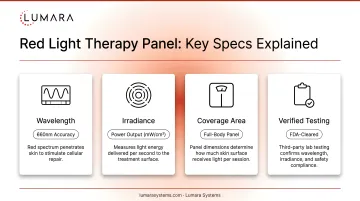
Wavelength: Claimed vs Verified
Most panels list wavelengths on the spec sheet. Fewer have them independently verified. The distinction matters because LED manufacturing tolerances mean actual output can shift from the stated wavelength by 10-20nm or more in lower-quality production runs.
For 660nm red light specifically, being 20nm off means the device is delivering less of the light that the clinical research supports. Ask whether the stated wavelength has been verified by a third-party lab using a calibrated spectroradiometer.
Lumara's Illuminate V2 is built around triple-tested, verified 660nm output.
Irradiance: How It Is Measured Matters
Irradiance (mW/cm²) tells you how much light energy reaches your skin at a given distance. The problem is that most brands measure irradiance with handheld solar meters, which read 40-70% higher than calibrated lab equipment because they detect broad-spectrum light rather than the specific LED output wavelength.
When comparing irradiance numbers across brands, the only fair comparison is numbers measured with the same equipment at the same distance. Third-party ISO-accredited lab testing is the most reliable standard.
Coverage Area vs Power Density
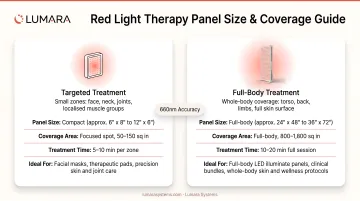
A panel with 1,200 cm² of coverage and 30 mW/cm² delivers more total energy per session to the treatment area than a smaller panel with higher listed irradiance, if the higher number was measured at a different distance. Always check what distance the irradiance figure was measured at.
Canada-Specific Buying Considerations
Import Duties and Taxes
Panels shipped from the US or internationally are subject to CBSA import duties and HST on the declared value. LED lamps (HS Code 8539.52.00.00) carry a 0% duty rate in Canada, but shipments over $20 CAD are subject to 5% GST or applicable provincial HST (up to 15%).
What this means practically: a $1,500 USD panel shipped from the US may have additional GST/HST, brokerage fees, and courier charges added on delivery, depending on province, declared value, and shipping terms. Always confirm the total landed cost before purchasing.
Some brands (particularly those with Canadian warehouse operations or with explicit duty-paid shipping programs) eliminate this. Lumara ships to Canada directly; confirm current shipping and tax treatment at lumarasystems.com.
Warranty and Support
After-sales service for a red light therapy panel worth hundreds of dollars should not require cross-border shipping. Before purchasing, confirm:
- Whether warranty claims are handled domestically or require international shipping
- Whether customer support is accessible in business hours relevant to Canadian time zones
- What the return policy covers if the panel arrives damaged
Canadian vs US Pricing
CAD/USD currency differences can make Canadian pricing look higher than US equivalents. When comparing prices, confirm whether CAD prices on Canadian-facing store fronts include duties and shipping, or whether those are added at checkout.
What You Are Actually Buying at Each Price Point
| Budget (CAD) | What You Typically Get |
|---|---|
| Under $300 | Handheld or small-area devices; limited coverage; basic wavelength specs |
| $500-$1,200 | Single-area panels with moderate LED count and irradiance; suitable for targeted facial or body use |
| $1,500-$3,000 | High-LED-count panels with verified irradiance; full-face and body use; better build quality |
| $3,000+ | Multi-panel systems, modular coverage, professional-grade output - see why red light panels are expensive for context on what drives pricing |
Lumara Illuminate V2: How It Fits the Canadian Market
Lumara's Illuminate V2 is a 660nm red light panel built around verified wavelength precision, 1,800 LEDs across a 1,200 cm² treatment area, and a 5-minute session format. It ships to Canada and is listed by Lumara as an FDA-cleared Class II medical device.
| Spec | Detail |
|---|---|
| Wavelength | 660nm red light (triple-tested) |
| LEDs | 1,800 |
| Treatment area | 1,200 cm² |
| Session time | 5 minutes |
| Energy delivery | 6,000 joules per session |
| Build | Splash-safe |
| FDA status | FDA cleared |
| Made in | USA |
| Warranty | 3 years |
| HSA/FSA eligible | Yes |
The 5-minute session format makes it practical for daily use without the time commitment of longer sessions. The splash-safe build means it can be used in bathroom settings - more practical for post-shower skin routines.
For users whose primary concern is facial skin wellness, Lumara also offers the VISO LED Mask - a 660nm dedicated facial mask with 470 micro-LEDs and full-face coverage in a mask format that maintains consistent LED-to-skin contact. The right choice between VISO and Illuminate V2 depends on whether you want a face-specific format or a panel that covers face and body areas.
What Makes a Good Red Light Therapy Panel Regardless of Brand
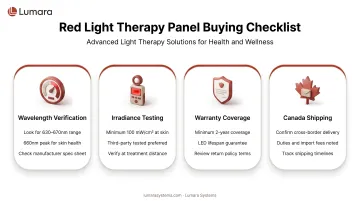
Before purchasing any panel (Lumara or otherwise), verify:
Non-negotiables:
- Exact wavelength specified (660nm for red, 830-850nm for near-infrared) - not just "red spectrum"
- Third-party irradiance measurement at your intended treatment distance
- FDA clearance or registration documentation
- Warranty terms that include Canadian buyers
Important-but-secondary:
- EMF levels at treatment distance (below 1 mG is the standard benchmark)
- Cooling/thermal management system
- Protective eyewear included
- Session time guidance matched to stated irradiance
Frequently Asked Questions
What wavelengths should a red light therapy panel have for Canada buyers?
The research-supported range is 630-670nm for red light (skin and soft tissue applications) and 810-850nm for near-infrared (deeper tissue, joint, and muscle applications). A panel that specifies exact wavelengths with third-party verification is more reliable than one that lists a broad range or vague claim.
Do I have to pay import duties on a red light therapy panel shipped to Canada?
Panels in the LED lamp category (HS Code 8539.52.00.00) carry 0% import duty in Canada, but GST or HST on the declared value still applies. Confirm with the seller whether this is included in the listed price or added at delivery.
How long should I use a red light therapy panel per session?
5-20 minutes per treatment area, 3-5 times per week, is the most commonly referenced protocol. Lumara's Illuminate V2 is designed around 5-minute sessions that deliver 6,000 joules - a full therapeutic dose without requiring extended daily commitment. For more on session protocols for physical recovery, see red light therapy for muscle recovery.
Is Lumara Illuminate V2 available in Canada?
Yes. Lumara ships to Canada. Visit lumarasystems.com to confirm current pricing, shipping costs, and tax treatment for Canadian orders.
What is the difference between a red light panel and an LED mask for skin?
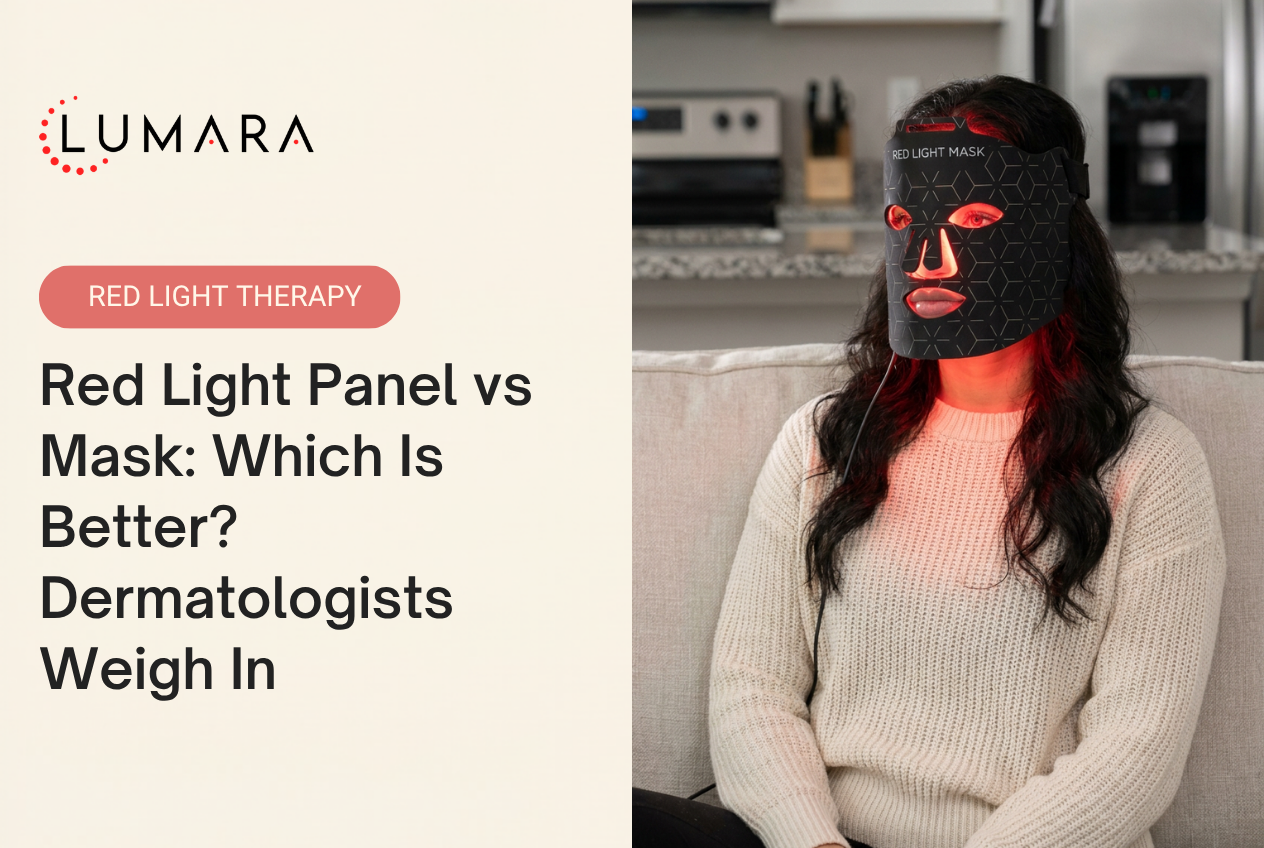
A panel is positioned at a distance and covers a broader area; an LED mask fits directly on the face and maintains consistent LED-to-skin contact. For facial-only skin routines, a mask (like Lumara's VISO) offers more precise facial coverage. For users who also want to treat body areas, a panel is more versatile.
Precision, Consistency, and Verified Specs - In That Order
The Canadian red light therapy panel market has good options and plenty of overstated ones. The buyers who get value from these devices are those who choose based on verified specs, use the device consistently, and match the format to their actual routine.
Lumara's Illuminate V2 is built around those fundamentals - 660nm, verified, 1,800 LEDs, 5-minute sessions, 3-year warranty, ships to Canada.