Green Tea and Red Light Therapy: A Complete Guide

Introduction

A claim keeps circulating across skincare forums and wellness communities: applying or drinking green tea before red light therapy accelerates results. Some users report seeing in one month what typically takes ten months with light therapy alone. But is this a legitimate science-backed synergy, or just another overhyped wellness trend fueled by anecdotal enthusiasm?

This guide covers how red light therapy and green tea each work at the cellular level, what the research actually says about combining them, and a practical protocol you can follow at home.

The evidence is preliminary — rooted largely in one compelling 2009 study — but the underlying biology holds up, the risks are low, and the combination is straightforward enough to test yourself.

Key Takeaways:

  • Red light at 660nm boosts cellular ATP and activates repair pathways through controlled oxidative stress
  • Green tea's EGCG neutralizes excess free radicals without blocking beneficial light-triggered signaling
  • A 2009 study linked green tea pre-treatment to 10-month results in just 1 month — large trials are still lacking
  • Apply lightweight green tea serum 15–20 minutes before sessions; skip heavy creams, retinoids, and acids
  • Drinking 1–2 cups 30–90 minutes before sessions adds systemic antioxidant support

How Red Light Therapy Works at the Cellular Level

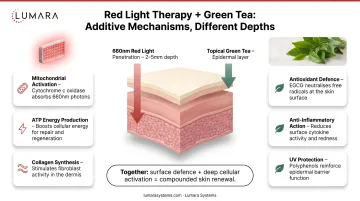
Red light therapy—also called photobiomodulation (PBM)—uses low-wavelength red light (primarily 630–660nm) to penetrate skin and stimulate mitochondria. When red photons hit cytochrome c oxidase (CCO), a key enzyme in the mitochondrial electron transport chain, they dissociate inhibitory nitric oxide molecules. The enzyme runs more efficiently, and the result is increased ATP (cellular energy) production.

This ATP surge triggers a cascade of benefits:

  • Faster cellular repair - More energy means cells can repair damage and regenerate more quickly
  • Collagen stimulation - ATP fuels fibroblasts to produce new collagen and elastin
  • Reduced inflammation - Enhanced mitochondrial function dampens inflammatory signaling pathways
  • Improved circulation - Better energy metabolism supports vascular function and nutrient delivery

Four red light therapy cellular benefits triggered by ATP surge infographic

The 660nm wavelength is particularly well-studied for skin rejuvenation. Clinical trials demonstrate significant wrinkle reduction and collagen density improvements at this specific wavelength. That's why wavelength accuracy matters for home protocols—Lumara Systems calibrates its 660nm panels to this exact therapeutic target.

The ROS Paradox: Why Dose Matters

Red light therapy produces a small, intentional amount of reactive oxygen species (ROS) as part of its mechanism. This is the hormesis effect—a beneficial stress response. That brief ROS burst activates NF-κB, a transcription factor that triggers cellular repair, anti-inflammatory responses, and tissue proliferation.

Red light therapy follows a biphasic dose-response curve, meaning more exposure isn't always better:

  • Low/optimal dose: Brief ROS spike → ATP increase → cellular repair activated
  • Excessive dose: Massive secondary ROS peak → ATP depletion → mitochondrial damage

Overdoing sessions doesn't just waste time—it actively reduces benefits and can damage cells. This is precisely why antioxidants become relevant: they help manage the "bad" excess ROS without interfering with the beneficial signaling pulse.

What Makes Green Tea a Skin Powerhouse

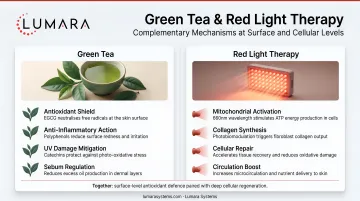
Green tea's most potent active compound is epigallocatechin gallate (EGCG), a polyphenol antioxidant that neutralizes free radicals, inhibits collagen-degrading enzymes called matrix metalloproteinases (MMPs), and calms skin inflammation.

What sets EGCG apart is its reach: it targets mitochondria directly, preventing mitochondrial degradation and even triggering mitochondrial biogenesis (the creation of new mitochondria).

Key Skin Benefits of Topical Green Tea

Research on green tea polyphenols as a standalone ingredient shows:

  • Neutralizes UV and pollution-induced free radicals that cause premature aging
  • Strengthens the skin's protective barrier function
  • Calms irritation and reduces redness through anti-inflammatory action
  • Inhibits MMP-1, MMP-8, and MMP-13, the enzymes responsible for collagen breakdown

Not All Green Tea Is Equal

"Green" tea refers to any tea prepared from unoxidized leaves, which preserves maximum polyphenol content. This means matcha and high-quality sencha both qualify, but black and oolong teas don't—fermentation destroys the vast majority of EGCG.

EGCG content varies dramatically:

Tea TypeProcessingEGCG Content
MatchaUnfermented, shaded, powderedHighest (81-84% flavanols)
SenchaUnfermented, steamedHigh (46-70 mg/g)
OolongSemi-fermentedSignificantly reduced
BlackFully fermentedLowest (48-51% flavanols)

Green tea EGCG content comparison table by processing type and fermentation level

For red light therapy synergy, stick with matcha or high-quality sencha—both topically and orally.

The Science Behind the Green Tea + Red Light Therapy Synergy

The foundational evidence comes from a 2009 study by researcher Andrei Sommer, published in Photomedicine and Laser Surgery. In this case study, pre-treatment with green tea-soaked pads showed dramatically improved skin rejuvenation outcomes compared to red light therapy alone—achieving in one month what typically took ten months.

Important context: This was a single-patient case study, not a large randomized controlled trial. The evidence is compelling but preliminary.

The Mitochondrial Mechanism

The mechanism centers on EGCG's role as a superoxide dismutase mimetic — it mimics the body's natural antioxidant enzymes. EGCG targets free radicals directly at the mitochondrial membrane (exactly where red light therapy produces them), rather than acting superficially on the skin surface.

The "Sticky Water" Theory

Sommer's research introduced a biophysical concept: excess free radical buildup increases the viscosity of interfacial water in the mitochondrial membrane. Think of ATP synthase (the enzyme that produces ATP) as a tiny motorboat — when free radicals accumulate, the surrounding water thickens, like rowing through molasses instead of open water.

The motor slows. ATP production drops.

Red light reduces this viscosity; green tea antioxidants help prevent the free radical buildup that causes it in the first place.

The Antioxidant Paradox: Won't EGCG Block ROS Benefits?

This is the most common objection: if red light therapy needs ROS to work, won't antioxidants neutralize that beneficial signal?

Here's the nuance: the beneficial ROS only needs to trigger the cellular signaling cascade — it doesn't need to persist. Research shows that even a brief, transient ROS pulse is sufficient to activate NF-κB repair pathways. Topical antioxidants scavenge the excess ROS that accumulates after that trigger occurs, functioning similarly to the body's own endogenous antioxidant defenses like superoxide dismutase and catalase.

Studies confirm that antioxidants don't block the ATP increase from photobiomodulation — they only prevent the secondary, damaging ROS peak that occurs with excessive dosing. That distinction is what makes the green tea combination mechanistically defensible.

Evidence Summary: Where We Stand

The current evidence supports biological plausibility, with one compelling clinical data point:

  • EGCG targets the exact cellular location where red light acts
  • Scavenges harmful ROS without blocking beneficial signaling
  • One clinical case study shows dramatic acceleration of results (1 month vs. 10)
  • The combination is low-risk and low-cost

What's missing: large-scale randomized controlled trials replicating these findings in diverse populations. Until those studies exist, this remains a promising but preliminary approach worth testing, not yet a proven protocol.

How to Use Green Tea with Red Light Therapy: A Step-by-Step Protocol

Green tea supports red light therapy from two angles: topically, where EGCG primes skin before treatment, and orally, where it provides systemic antioxidant support. Here's how to run both protocols effectively.

Drinking Green Tea

Timing: Drink 1-2 cups of quality green tea 30-90 minutes before your red light session.

Why the range? Oral EGCG reaches peak plasma concentration between 1.3 and 2.2 hours after ingestion, but bioavailability is up to 3.5 times higher on an empty stomach. If you're drinking tea fasted, 30-60 minutes is sufficient; with food, allow 90-120 minutes.

For best results:

  • Choose matcha or high-EGCG sencha — loose leaf, freshly brewed
  • Skip sugar and milk, both reduce catechin absorption
  • Avoid bottled green tea, black tea, and oolong — all have minimal to no active EGCG

Applying Green Tea Topically

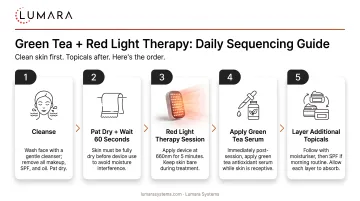
Timing: Apply a lightweight green tea serum or extract to clean, dry skin 15-20 minutes before your session.

The serum must be fully absorbed — not wet or occlusive — before you begin. Residual liquid or thick cream blocks light penetration and reduces effectiveness.

Lumara Systems' panels are built around 660nm precision and 5-minute treatments, which makes adding a pre-treatment serum step genuinely practical — it fits into a routine without reshaping your day.

Application steps:

  1. Cleanse skin thoroughly
  2. Apply 3-5 drops of green tea serum to face and neck
  3. Gently massage until fully absorbed
  4. Wait 15-20 minutes (serum should be completely dry)
  5. Begin red light therapy session

5-step green tea serum application protocol before red light therapy session

After Your Session

The post-session window is optimal for absorption. Cellular activity is elevated, and your skin is primed to take in targeted actives more effectively than at baseline.

Apply these immediately after treatment:

  • Vitamin C serum — supports collagen synthesis
  • Hyaluronic acid — replenishes hydration
  • Peptides — aids repair and regeneration

Drinking green tea after your session extends antioxidant support during the recovery window — so both timing slots work, just for different reasons.

What to Apply (and Avoid) Around Your Red Light Sessions

Best Serums to Use With Red Light Therapy

Before sessions (lightweight, non-occlusive formulas):

  • Green tea or EGCG serum
  • Niacinamide serum
  • Hyaluronic acid (if fully absorbed)

After sessions (potent actives for enhanced absorption):

  • Vitamin C serum
  • Retinol or retinoids
  • Peptide complexes
  • Growth factors

Serums to Avoid Before Red Light Therapy

Photosensitizing ingredients:

Physical light blockers:

  • Thick occlusive creams (petrolatum-based)
  • Heavy oils
  • Sunscreen (zinc oxide and titanium dioxide scatter visible light)

Apply these ingredients after your session, not before.

Clarifying "Green and Red Light Therapy Together"

If you've seen references to "green and red light therapy together," that phrase usually means green LED + red LED multi-wavelength therapy — not green tea. Green LED light operates at 520-540nm and targets hyperpigmentation and redness through different mechanisms than red light's 630-660nm wavelength.

Some multi-wavelength devices combine both. That's a separate approach from pairing green tea extract with red light therapy.

Frequently Asked Questions

Does green tea make red light therapy more effective?

Preliminary research from 2009 suggests green tea pre-treatment may dramatically accelerate results, likely because EGCG targets free radicals at the mitochondrial membrane where red light acts. However, large-scale clinical trials are still needed to confirm this definitively.

How should I use green tea serum with red light therapy?

Apply a lightweight green tea or EGCG serum to clean skin 15-20 minutes before your session, ensuring it's fully absorbed before your session starts. Apply other actives like vitamin C and peptides after the session when cellular absorption is heightened.

Should you drink green tea before or after red light therapy?

Drinking green tea 30-90 minutes before a session ensures EGCG is circulating systemically during treatment. Drinking it after supports antioxidant recovery and hydration. Both timing windows have merit, so either approach works.

What should I put on my face before red light therapy?

Clean, bare skin allows maximum light penetration. A lightweight antioxidant serum (green tea, niacinamide) is compatible if fully absorbed, but avoid heavy creams, oils, retinoids, and chemical exfoliants before sessions.

What serums should I avoid with red light therapy?

Avoid applying retinoids, AHAs/BHAs, benzoyl peroxide, and thick occlusive formulas directly before sessions. These ingredients cause photosensitivity or physically block light penetration. Apply them after treatment instead.

Can I use green and red light therapy together?

This question has two meanings. For green LED and red LED multi-wavelength devices, yes — compatible devices can run both wavelengths together for complementary benefits. For green tea extract combined with red light therapy, yes — this is the combination covered throughout this article and is safe with real potential benefit.