Introduction
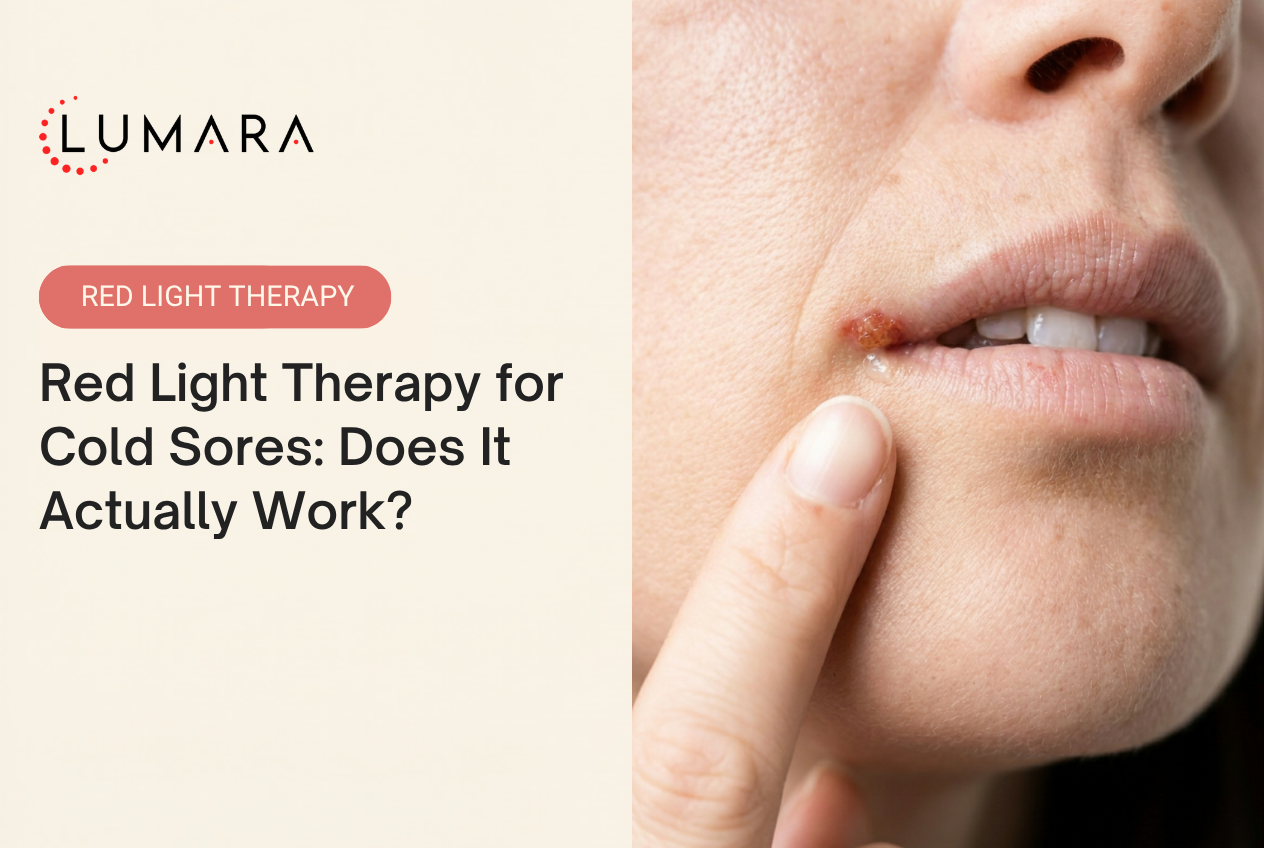
Cold sores caused by HSV-1 affect millions of people repeatedly. Standard treatments (antiviral creams, prescription antivirals) help, but results are modest - over-the-counter options reduce healing time by roughly 18-24 hours. Photobiomodulation has been studied as an adjunctive approach for herpes labialis, with some research suggesting it may support healing time and recurrence-related outcomes. However, cold sores are caused by HSV-1, so users should follow medical guidance and should not treat red light therapy as a replacement for antiviral care.
This guide covers the evidence, the protocol, and how to use a consumer device effectively.
Key Takeaways
- Some clinical studies suggest photobiomodulation in the 630-660nm range may help support healing in herpes labialis, but reported effects vary and should not be treated as guaranteed outcomes
- Some studies have explored whether ongoing photobiomodulation may help extend the interval between outbreaks, but recurrence prevention should be discussed with a healthcare professional
- Early intervention is critical: starting at prodrome (the tingling before blistering) produces the best outcomes
- The mechanism involves anti-inflammatory and immune-support effects at the outbreak site
- Some clinical protocols use sessions during outbreaks and maintenance-style sessions between outbreaks, but users should treat this as adjunctive support and follow medical guidance for HSV-1 care
The Evidence
Individual Outbreak Duration
Multiple randomized controlled trials and case series show red light therapy significantly reducing cold sore healing time. Some studies report shorter healing times with photobiomodulation, although effect sizes vary across protocols and study designs. Most protocols in these trials apply treatment 1-2 times daily for the first week of an outbreak.
Recurrence Reduction
This is the more compelling long-term finding. Several studies show that consistent ongoing red light therapy (not just during outbreaks) extends the interval between outbreaks. Some studies report longer intervals between outbreaks with ongoing photobiomodulation, but this should be presented as clinical research rather than a guaranteed consumer outcome.
The mechanism for recurrence reduction likely involves modulating the local immune environment at the site, making the tissue less permissive to viral reactivation and outbreak expression. At the cellular level, this works through mitochondrial stimulation that enhances local immune and repair signalling.
The Protocol
Before using red light therapy for cold sores, especially if outbreaks are frequent, severe, or medically managed, follow your clinician's guidance. Red light therapy should not replace topical or oral antiviral treatment when those are recommended.
Timing - Intervene at Prodrome
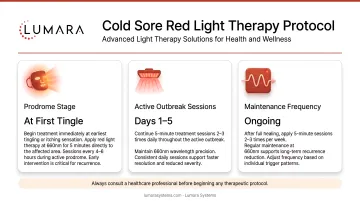
The most important protocol rule: start at the first sign of prodrome - the tingling, itching, or burning sensation that precedes visible blister formation. Research consistently shows better outcomes when treatment begins before visible lesion development.
During an outbreak:
- Session frequency: 1-2 sessions per day
- Session duration: 10-20 minutes per session on the affected area
- Total course: Continue daily until healed
Between outbreaks (maintenance):
- Session frequency: 1-2 sessions per week
- This is the protocol most associated with recurrence reduction
- Continue as an ongoing routine rather than only treating active outbreaks
Using Alongside Antivirals
For users with frequent or severe outbreaks who use prescription antivirals, red light therapy can be used concurrently - the mechanisms do not overlap and there are no known interaction risks.
Device Considerations for Cold Sore Treatment
Cold sores are predominantly perioral - at or around the lips and perioral skin. The key device requirements are:
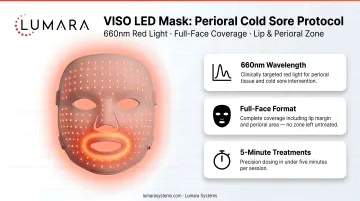
660nm wavelength: The most studied range for oral herpes photobiomodulation. The tissue depth of perioral cold sores (surface mucosal and skin tissue) is well within the reach of 660nm light. For a comparison of red and near-infrared wavelength differences, see our guide on infrared vs red light therapy.
Perioral coverage: A full-face mask that covers the perioral area, lips, and perinasal region provides consistent exposure to the areas where HSV-1 typically manifests.
Consistent session format: A device that fits comfortably into a daily routine makes the maintenance protocol achievable. Devices that require complex setup create friction that leads to skipped sessions. For best light absorption, sessions on bare skin are recommended.
Lumara's VISO LED Mask delivers triple-verified 660nm light across 470 micro-LEDs with a 10" x 7" oval format that includes full perioral and lip area coverage. Sessions run 5-20 minutes and the device includes eye inserts for protection. FDA cleared.
Frequently Asked Questions
Does red light therapy work for cold sores?
Photobiomodulation has been studied for herpes labialis, with some research suggesting it may support healing when used as an adjunct. However, cold sores are caused by HSV-1, so users should follow medical advice and should not treat red light therapy as a replacement for antiviral care.
When should I start red light therapy for a cold sore?
At the first sign of prodrome - tingling, itching, or burning before visible blistering. Early intervention consistently produces better outcomes than starting after the sore is fully formed.
How often should I use red light therapy for cold sores?
During an outbreak: 1-2 sessions per day until healed. Between outbreaks (maintenance): 1-2 sessions per week. The maintenance protocol is most associated with recurrence reduction.
Does red light therapy reduce cold sore recurrence?
Some research has explored whether ongoing photobiomodulation may extend the interval between outbreaks, but recurrence management should be discussed with a healthcare professional.
Can I use red light therapy alongside antiviral medication?
Yes. No known interaction exists between red light therapy and topical or oral antiviral medications for herpes labialis.
Consistency Is the Protocol
Cold sore management with red light therapy works best as an ongoing routine rather than a reactive-only approach. Daily sessions during outbreaks, weekly sessions between them - this is the protocol that produces both faster healing and reduced recurrence.
Lumara's VISO LED Mask delivers 660nm red light across 470 micro-LEDs for consistent facial skincare routines. For cold sores or recurrent HSV-1 symptoms, follow your clinician's guidance.