Red light therapy — also called photobiomodulation or low-level laser therapy — has emerged as a research-supported, non-invasive option that targets the cellular mechanisms behind nerve pain and damage, not just surface symptoms. Unlike medications that mask pain, this approach addresses inflammation, poor circulation, and cellular energy deficits that sustain nerve damage.
TL;DR
- Targets tissue with specific wavelengths — 630–660nm red and 810–850nm near-infrared — to stimulate cellular healing
- Clinical studies across diabetic, chemotherapy-induced, and idiopathic neuropathy show measurable symptom improvements
- Key benefits: pain reduction, nerve regeneration support, improved blood flow
- Results typically emerge after weeks to months of consistent use at 3–5 sessions per week
- Works best integrated into a broader treatment plan, not as a standalone cure
What Is Red Light Therapy for Neuropathy?
Red light therapy is a non-invasive treatment that uses LED panels to deliver specific wavelengths of light into skin and tissue, initiating photobiomodulation within cells.
The North American Association for Photobiomodulation Therapy defines it as the use of non-ionizing light in the visible and near-infrared spectrum to produce photochemical changes that alleviate pain, modulate immunity, and support tissue regeneration.
Wavelengths That Matter for Nerve Tissue
Two distinct wavelength ranges deliver therapeutic benefits for neuropathy:
- Red light (630–700nm): Penetrates approximately 0.5–1mm, promoting surface-level cellular energy production and blood flow in superficial nerve endings
- Near-infrared (810–850nm): Penetrates approximately 2mm before losing 37% of intensity, reaching deeper peripheral nerve tissue where damage often occurs
For neuropathy, both ranges are therapeutically relevant. Research shows that over 90% of near-infrared light energy is absorbed within the first 10 millimeters of tissue, making wavelength precision and adequate power density critical for reaching damaged nerve fibers.

Understanding these wavelength effects explains where red light therapy fits into neuropathy management. It addresses biological processes — inflammation, poor circulation, cellular energy deficit — that sustain nerve damage and that most conventional medications don't directly target. Used alongside treatment for underlying causes like diabetes, it works on the mechanisms driving nerve deterioration.
Key Benefits of Red Light Therapy for Neuropathy
Benefit 1: Pain Reduction Through Cellular Signaling
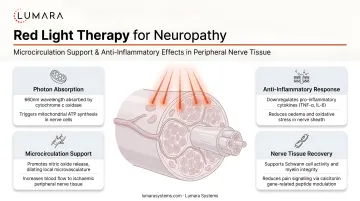
Red light triggers the release of nitric oxide from blood vessel walls and red blood cells. This molecule acts as a vasodilator and also modulates pain signal transmission — a distinct mechanism from simply masking pain.
How it works:
- Nitric oxide release: Photobiomodulation causes nitric oxide to dissociate from cytochrome c oxidase in mitochondria, restoring electron transport and ATP production
- Reduced nociceptor sensitivity: Research demonstrates that laser irradiation attenuates activation of TRPV1 (the capsaicin/heat receptor) on sensory neurons, leading to thermal antinociception
- Animal studies show that 830nm light enhances peripheral endogenous opioid analgesia by increasing beta-endorphin expression in inflamed tissues
Clinical evidence:
Multiple randomized controlled trials show significant pain score reductions:
| Study | Neuropathy Type | Protocol | Pain Outcome |
|---|---|---|---|
| Argenta et al. (2017) | Chemotherapy-induced | 800–970nm, 3x/week, 6 weeks | Significant mTNS reduction at 4, 8, and 16 weeks (p < 0.001) |
| Ebadi et al. (2023) | Diabetic | 630nm & 810nm, 32.08 J/cm², 3x/week, 4 weeks | Significant MNSI improvement and better monofilament sensation (p < 0.05) |
| Teng et al. (2022) | Chemotherapy-induced | 658nm, 1-2 J/point, 2x/week, 6 weeks | 48% response rate at 6 weeks (p < 0.001 vs sham) |

Symptoms most affected: Burning pain, hypersensitivity to touch, sharp or shooting sensations — particularly prevalent in diabetic and chemotherapy-induced peripheral neuropathy patients.
Benefit 2: Nerve Regeneration and Restored Function
Neuropathy often involves structural damage to nerve fibers: lost myelin sheath integrity, severed axons, or degenerated peripheral nerves. Red light therapy supports the cellular repair process that conventional pain medications do not address.
Two key cell types activated:
- Schwann cells: Rebuild the myelin sheath around peripheral nerves for faster signal transmission
- Fibroblasts: Bridge damaged nerve tissue and signal Schwann cells to regrow peripheral nerves
ATP production: Red light stimulates mitochondria in nerve cells to produce more ATP (cellular energy), which directly powers repair and regeneration. Studies in diabetic neuropathy patients show improvements in nerve conduction velocity and neural potential amplitudes following photobiomodulation treatment.
What the evidence shows:
Animal models provide the clearest structural data. In rodent sciatic nerve crush models, 808nm laser therapy at 3–8 J/cm² significantly improved functional recovery and increased myelin sheath thickness and expression of growth-associated protein 43 (GAP43).
Human trials tell a more nuanced story. A 2021 study found that 12 weeks of infrared treatment provided symptomatic relief, yet did not significantly increase intraepidermal nerve fiber density in the short term — a reminder that functional gains often precede measurable structural changes.
Realistic expectation: Nerve regeneration is a slow process. Functional improvements in sensation and motor control typically require months of consistent treatment.
Symptoms most affected: Numbness, persistent tingling, loss of sensation in feet or hands, motor weakness — conditions that medication alone often fails to resolve.
Benefit 3: Reduced Inflammation and Improved Peripheral Blood Flow
Chronic inflammation is both a cause and consequence of nerve damage in neuropathy. Inflammatory cytokines continue to injure nerve tissue in a feedback loop. Red light therapy breaks this cycle by triggering increased production of intracellular antioxidants and anti-inflammatory compounds.
The circulation mechanism:
By stimulating nitric oxide production, red light causes vasodilation in peripheral blood vessels, improving delivery of oxygen and nutrients to damaged nerve tissue. This is particularly relevant for diabetic neuropathy patients who already have compromised microvascular circulation.
Clinical evidence:
- Inflammatory biomarkers: A 2019 randomized trial of older adults with diabetic neuropathy using 810/980nm deep tissue laser therapy significantly reduced serum levels of Interleukin-6 (IL-6) and Monocyte Chemoattractant Protein-1 (MCP-1) compared to sham therapy
- Microcirculation improvements: Research using laser Doppler flowmetry demonstrated that 830nm near-infrared light induced a 27% increase in microcirculatory flow, rising to 54% during a 20-minute follow-up period
Chronic aching, swelling, cold extremities, and slow wound healing are all tied to poor circulation and inflammation in the feet and lower limbs — and represent the symptom cluster most responsive to this mechanism.
What Happens When Neuropathy Symptoms Are Left Unaddressed
Neuropathy is a progressive condition. Without active intervention, nerve damage tends to worsen over time, with symptoms spreading from localized tingling to widespread loss of sensation, balance problems, and increased fall risk.
The cascade of consequences:
- Persistent inflammation accelerates nerve fiber loss, compounding damage to surrounding tissue
- Poor circulation raises the risk of foot ulcers in diabetic patients — the lifetime risk of developing a diabetic foot ulcer is 19–34%, and approximately 20% of those cases require lower-extremity amputation
- Untreated pain drives reduced mobility, muscle atrophy, and steadily worsening functional limitations
- Peripheral neuropathy increases the odds of falling by over 16-fold in elderly patients, making injury a near-constant risk
These consequences compound over months and years. That's why evidence-supported, non-invasive options — including red light therapy — are worth examining early, before damage progresses further.
How to Get the Most from Red Light Therapy for Neuropathy
Consistency Is Critical
Nerve regeneration is a slow process. Research protocols typically involve treatment sessions 3–5 times per week over multiple months before significant improvement is observed. Early symptom changes may appear within a few weeks, but meaningful nerve-related improvements require sustained commitment.
Clinical trial protocols:
- Frequency: 2–3 sessions per week
- Duration: 4–6 weeks of continuous treatment (totaling 12–18 sessions)
- Long-term results: Studies tracking outcomes at 8–16 weeks show continued improvement beyond the initial treatment phase
Wavelength and Irradiance Matter
Not all red light devices deliver therapeutic doses. Effective devices must emit light in the clinically studied 630–660nm (red) and/or 810–850nm (near-infrared) range at sufficient power density to penetrate tissue.
Dosage guidelines:
The World Association for Laser Therapy advises an irradiance of 10–150 mW/cm² for transcutaneous devices to prevent thermal damage. Effective protocols vary based on the target — superficial anti-inflammatory effects may be achieved at 3–10 J/cm², while deeper nerve targets in clinical trials have used up to 32–48 J/cm².
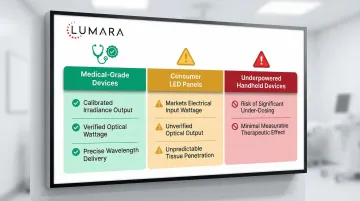
Device quality directly affects whether you reach those doses. Key differences between device tiers:
- Medical-grade devices use optical power meters to calibrate precise irradiance and wavelength delivery
- Consumer LED devices often market electrical input wattage rather than verified optical output, leading to unpredictable tissue penetration
- Underpowered handheld devices risk significant under-dosing with minimal measurable effect

At-Home Use Is Feasible with the Right Device
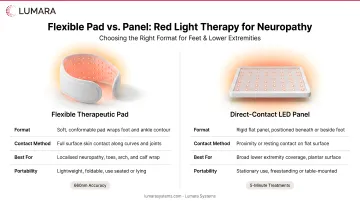
Given those device quality requirements, at-home use is realistic — but only with hardware built to clinical standards. Panels using medical-grade, high-output LEDs designed for targeted application to feet and lower limbs deliver consistent irradiance session after session. Lumara Systems' 660nm precision panels, for instance, combine 5-minute treatment sessions with a splash-safe build specifically suited for feet and lower extremities.
Pair Red Light Therapy with Complementary Practices
Red light therapy works best alongside:
- Medical management of the underlying cause (e.g., blood sugar control for diabetic neuropathy)
- Physical activity to support circulation
- Regular monitoring of symptom changes with a healthcare provider
This integrated approach offers the best chance of meaningful, lasting symptom improvement.
Conclusion
Red light therapy's value for neuropathy lies in addressing real biological mechanisms — cellular energy production, nerve repair, inflammation reduction, and blood flow — rather than offering temporary symptomatic relief alone. Applied consistently and correctly, those benefits build on each other over weeks and months.
For patients frustrated by medications with modest efficacy and significant side effects, integrating red light therapy into a structured neuropathy management plan offers a practical, low-risk alternative. Photobiomodulation is evidence-supported — and worth a direct conversation with your healthcare provider.
Frequently Asked Questions
How long does red LED phototherapy take to improve neuropathy symptoms?
Early changes may be noticed within a few weeks of consistent use, but meaningful nerve-related improvements typically require several months. Frequency of sessions (3–5x weekly) and device quality significantly influence the timeline.
Can red LED phototherapy reverse neuropathy?
Red light therapy supports nerve regeneration and reduces inflammation, but it is not a cure. In mild-to-moderate cases, consistent use may partially restore function — though severely damaged nerves are unlikely to fully recover.
Can red LED phototherapy help foot pain from neuropathy?
Yes — foot and lower extremity neuropathy is among the most studied applications. Targeted treatment can reduce burning pain, improve circulation, and support nerve repair with consistent use over several months.
Is red LED phototherapy safe for people with autoimmune conditions (e.g., lupus, Hashimoto's)?
Red light therapy is low-risk for most people. Those with photosensitive autoimmune conditions — particularly lupus — should consult their physician before use, as certain wavelengths may interact with disease activity or medications.
What are the risks and limitations of red LED phototherapy for neuropathy?
Red light therapy has minimal reported side effects when used correctly. Key limitations include its inability to address underlying causes, the time commitment required for results, and inconsistent device quality — underpowered panels may not deliver therapeutic benefit.