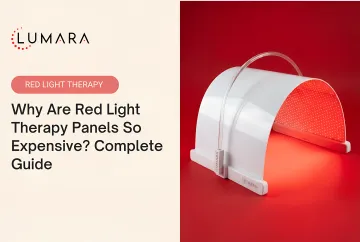
Why Are Red Light Therapy Panels So Expensive? Complete GuideYou open your browser, ready to buy a red light therapy panel, and the price tags stop you cold: $50 on one site, $5,000 on another. What could possibly justify that gap? Is the expensive panel really 100 times better, or are you just paying for branding?

The answer isn't what most buyers expect. The price difference reflects genuine engineering choices that determine whether your panel delivers therapeutic results or just glows red. Red light therapy works through photobiomodulation—a precise biological mechanism where specific light wavelengths stimulate cytochrome c oxidase in your mitochondria, triggering ATP production and cellular repair. But this process only happens when the wavelength, power density, and energy delivery match the parameters used in clinical research. Budget panels routinely miss these targets by substantial margins.

In this guide, you'll learn what actually drives the cost of quality panels, what cheap alternatives sacrifice (and what that costs you in results), and how to evaluate whether a panel's price is genuinely justified.

TLDR

  • Premium LEDs with tight wavelength tolerances (±5nm) are essential for the cellular benefits shown in photobiomodulation research
  • Irradiance (mW/cm² at your treatment distance) drives real results; budget panels often fall below effective thresholds
  • Safety certifications, third-party testing, thermal management, and solid warranties add real costs — and real protection
  • Cost-per-effective-session often favors a quality panel: subtherapeutic results from cheap alternatives make them no bargain

The Real Cost Drivers Behind Red Light Panel Prices

LED Quality and Wavelength Precision

Not all LEDs are created equal. Therapeutic-grade diodes from reputable manufacturers like Cree or Osram cost substantially more than generic alternatives—often 10-30% more per diode. The difference lies in a manufacturing process called "binning."

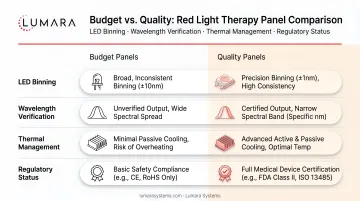
LED production inherently creates variations in color and brightness. Manufacturers sort these LEDs by their precise dominant wavelength and light output. Standard commodity bins allow wavelength variations of ±7.5nm or wider. But therapeutic-grade panels use "tight bins" (±5nm) or "ultra-tight bins" (±2.5nm) to ensure emitted light precisely hits biological absorption peaks.

LED binning process showing wavelength tolerance tiers from standard to ultra-tight bins

Here's why this matters: cytochrome c oxidase has peak absorption at specific wavelengths—approximately 650-670nm for red light and 810-850nm for near-infrared. When a cheap panel's "660nm" LED actually emits anywhere from 640nm to 680nm, it may straddle in and out of the therapeutic absorption range.

Wavelengths between 700nm and 770nm fall into an absorption trough and are significantly less effective for stimulating cellular respiration.

The manufacturing reality: To achieve ±2.5nm bins, manufacturers reject 50-70% of LEDs for that specific bin and sell them as standard grade. This precision testing and lower yield directly increases cost.

Lumara Systems' panels specify 660nm wavelength accuracy with ±5nm tolerance for their Illuminate Pro model—precision that ensures the light you're paying for actually triggers the mitochondrial response documented in research.

Thermal Management and Build Engineering

LEDs generate heat, and unmanaged heat degrades both performance and lifespan. Budget panels consistently cut costs here—and it shows.

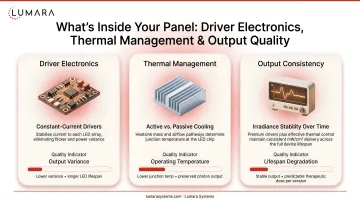
Quality panels invest in aluminum heat sinks, thermal interface paste, and sometimes active cooling fans to maintain stable output throughout a session. Junction temperature directly impacts both immediate light output and long-term LED lifespan. As temperature increases, light output decreases—a phenomenon called thermal droop.

Real-world impact: Independent testing reveals that irradiance drops 10-20% as panels reach thermal equilibrium (typically after 15-20 minutes of operation). A panel that delivers 100 mW/cm² when cold may only output 80-85 mW/cm² by minute 15.

Budget panels routinely skip adequate heat management, causing thermal throttling that makes consistent dosing impossible. Your first minute of treatment delivers measurably more light than your last—making it hard to know what dose you're actually receiving.

Elevated junction temperatures also accelerate non-recoverable LED degradation. Manufacturer testing demonstrates that maintaining lower operating temperatures is critical for achieving L70 lifetimes (the point when light output degrades to 70% of initial value) of 50,000 to 100,000+ hours. Budget panels with poor thermal management often experience noticeable degradation within 10,000-15,000 hours.

Research, Development, and Component Engineering

Reputable manufacturers invest in R&D to optimize optical design—lens angles, LED spacing, and beam uniformity—along with power driver circuitry. These engineering choices are invisible on a spec sheet but have major real-world effects.

Regulated vs. unregulated drivers: Quality panels use regulated power drivers that maintain consistent output regardless of temperature or input voltage fluctuations. Cheap panels often use unregulated drivers that allow output to drift as the panel heats up or as your home's electrical voltage varies.

Optical engineering: LED spacing, beam angles, and lens design determine how evenly light distributes across the treatment area. Poor optical design creates hot spots (areas of excessive irradiance) and cold spots (areas below therapeutic thresholds)—even when average irradiance looks fine on paper.

These design choices are what separate panels that replicate clinical study conditions from panels that merely resemble them.

Panel Size and LED Density

Larger panels cost more for straightforward reasons—every additional LED requires supporting hardware to match. A full-body panel with 1,000-2,000 LEDs demands significantly more than a facial device with 100-200:

  • More high-quality diodes across the treatment surface
  • Larger, more complex heat sink structures
  • Higher-capacity power supplies
  • More elaborate wiring and driver circuitry

Lumara's Illuminate V2 features 1,980 micro LEDs, enabling 5-minute treatment sessions by distributing energy across a large area at high irradiance. That LED density requires sophisticated thermal management and power distribution—engineering that adds to the price but makes the efficiency possible.

What Cheap Panels Sacrifice — and What That Costs You

The most critical sacrifice budget panels make is irradiance at realistic treatment distances.

Many budget panels advertise impressive wattage figures, but independent testing consistently shows their actual irradiance at 6-12 inches—the distance most users actually stand from panels—falls far below therapeutic thresholds. Peer-reviewed literature supports surface irradiances between 5 mW/cm² and 100 mW/cm² for optimal photobiomodulation outcomes. Budget panels often fail to reach even 20 mW/cm² at 12 inches.

The Specification Inflation Problem

Independent testing organizations have documented widespread specification inflation in the consumer red light therapy market:

Deceptive PracticeRealityImpact on You
Solar meter readingsSolar meters measure broad-spectrum light and heat, inflating narrow-band LED readings by 40-70% compared to calibrated spectroradiometersYou believe you're receiving 100 mW/cm² when you're actually getting 30-60 mW/cm²
0-inch measurementsBrands report irradiance at direct contact rather than 6-12 inch treatment distanceA panel claiming 150 mW/cm² at contact may deliver <40 mW/cm² at 12 inches
Cold-panel readingsMeasurements taken immediately upon power-on before thermal equilibriumReal-world output inflated by 10-20% as heat reduces efficiency during your session

The Treatment Time Consequence

Lower irradiance directly translates to longer sessions needed to accumulate a therapeutic dose. Dose is calculated using the formula: Time (seconds) = Dose (J/cm²) / Irradiance (W/cm²).

To deliver a target dose of 10 J/cm²:

  • At 30 mW/cm²: 10 / 0.03 = 333 seconds (~5.6 minutes)
  • At 100 mW/cm²: 10 / 0.10 = 100 seconds (~1.7 minutes)

Red light therapy dose calculation comparison at 30 mW versus 100 mW irradiance treatment time

A panel delivering 30 mW/cm² requires more than triple the treatment time of a 100 mW/cm² panel to achieve the same therapeutic effect. That difference adds up fast across daily sessions.

Durability and Longevity

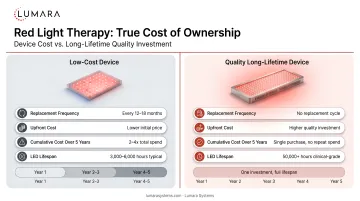
Performance degradation compounds the cost problem. Budget panels typically use substandard housing materials and inadequate electrical components — meaning the real cost isn't the $80 initial purchase, it's replacing that failed panel twice within two years.

The lifespan and warranty data make the gap concrete:

  • LED longevity: Quality panels with properly binned LEDs and thermal management are rated for 50,000+ hours of stable output; budget panels often degrade noticeably within 10,000–15,000 hours
  • Warranty terms: Premium brands back their panels with 2–3 year warranties; budget brands typically offer 6–12 months — a direct signal of how long they expect the device to last

Irradiance and Wavelength Accuracy: The Metrics That Matter Most

One metric predicts therapeutic outcomes above all others: irradiance in mW/cm², measured at your actual treatment distance. Wattage and LED count tell you almost nothing useful.

Wattage reflects electricity consumption. A 300-watt panel sounds powerful, but if those watts are lost as heat rather than delivered as light at skin level, they don't help you. LED count is equally misleading—1,000 low-efficiency LEDs can underperform 200 high-efficiency ones.

Understanding Therapeutic Dosing

Clinical photobiomodulation studies specify dosing parameters, typically 1-10 J/cm² for superficial targets (skin, wound healing) and 10-50 J/cm² for deeper tissues (muscle, joints, neurological). Devices that can't replicate these parameters cannot reliably replicate the outcomes.

The biphasic dose response: Too little light produces no effect; too much can inhibit target pathways. Low to moderate doses stimulate cellular processes and increase ATP production. But excessive doses generate harmful levels of reactive oxygen species (ROS), leading to cytotoxicity and worsened outcomes. In wound healing models, peak stimulation occurred at 2 J/cm², while doses of 50 J/cm² actively worsened wound expansion compared to untreated controls.

This is why knowing your device's true output matters. Underpowered panels may never reach therapeutic thresholds. Users with high-output panels who don't understand dosing may unknowingly exceed optimal ranges.

Wavelength Accuracy as Quality Control

Dosing only works if the wavelengths are accurate. Research on 630-660nm red light and 810-850nm near-infrared cannot be extrapolated to off-target wavelengths — even a 15-20nm drift from poor LED binning makes your treatments unpredictable.

Here's how premium and budget panels differ on this:

  • Premium panels publish spectral output graphs and specify tight wavelength tolerances
  • Budget panels rarely disclose spectral data, leaving you guessing whether advertised wavelengths are actually delivered
  • Wavelength drift causes results to stall — and most users blame the therapy rather than the device

If a panel can't prove its wavelength accuracy, you can't trust its results.

Certifications, Testing, and Warranties: The Price of Accountability

Safety certifications and third-party testing cost money—but they protect you from electrical, electromagnetic, and photobiological hazards.

Three certifications separate accountable manufacturers from the rest:

Red light therapy panel certification tiers comparing CE RoHS FDA registration versus 510k clearance

Warranty length is another reliable signal. Premium brands offer 2-3 year warranties—some extending to 5 years. Budget brands typically offer 6-12 months. That gap reflects how much confidence a manufacturer actually has in its own build quality. Lumara Systems, for example, offers a 3-year warranty on its panels, backed by its LED selection and thermal engineering standards.

How to Tell If a Panel's Price Is Actually Justified

Ask these questions before purchasing:

Does the brand publish third-party irradiance data at 6 and 12 inches? If irradiance is only measured at contact (0 inches) or isn't independently verified, approach with skepticism.

Do they specify wavelength tolerance (e.g., ±5nm)? If the brand doesn't publish tolerance specs, their LEDs likely use wide-bin sorting, sacrificing therapeutic precision.

Is there a meaningful warranty with accessible support? A warranty under 2 years suggests the manufacturer expects early failures. Look for responsive customer service that can answer technical questions.

Are certifications verifiable? Check that CE marks, FDA registrations, or RoHS compliance are legitimate third-party certifications, not self-declarations.

Long-Term Cost Comparison

Clinical photobiomodulation protocols require 2-5 treatments per week over several weeks or months to achieve significant outcomes. If clinic sessions cost £50-150 per visit, the cumulative cost over 6-12 months easily exceeds £2,000-5,000.

A quality home panel priced at £800-1,500 delivers unlimited sessions. Calculate cost-per-effective-session:

  • Clinic route: 50 sessions × £100 = £5,000
  • Quality panel: £1,200 ÷ 500 sessions (over 3 years) = £2.40 per session

The panel pays for itself within 12-15 clinic visits—typically 6-8 weeks of treatment.

What to Look For in a Quality Panel

The highest price doesn't automatically mean the best panel. But panels offering verified irradiance, precision wavelengths, durable construction, and safety certifications represent genuine value.

To see what those criteria look like in practice, Lumara Systems' Illuminate panels check each box: 660nm wavelength accuracy with ±5nm tolerance, splash-safe water-resistant construction, 1,980 micro LEDs delivering 6,000 joules in 5 minutes, and a 3-year warranty. Each spec maps directly to a question worth asking any brand before you buy.

Frequently Asked Questions

Why are red light therapy panels so expensive?

Quality panels require high-grade LED diodes sorted for tight wavelength tolerances (±5nm), precision thermal management to prevent performance degradation, regulated power drivers for consistent output, and third-party safety testing and certifications. These engineering requirements cannot be met cheaply without sacrificing therapeutic efficacy.

Do expensive red light therapy panels actually work better than cheap ones?

Yes, in most cases—but specifically because of measurable differences in irradiance at treatment distance, wavelength accuracy, and output consistency over time. Price should be evaluated against verified specs, not taken as a standalone quality indicator. A £300 panel with third-party irradiance data beats a £600 panel with inflated claims.

What is a good price to pay for a red light therapy panel?

Entry-level personal panels from reputable brands typically range £300-600, while full-body panels range £800-2,500. Anything significantly below these ranges warrants skepticism about LED quality, thermal management, and output claims—always verify certifications and third-party testing before purchasing.

What should I look for when buying a red light therapy panel?

Verify three critical specs: third-party irradiance data at 6-12 inch treatment distance, wavelength tolerance (±5nm or tighter), and warranty terms of at least 2 years with responsive support. Together, these predict therapeutic performance more reliably than price alone.

How long do red light therapy panels last?

Quality panels with properly binned LEDs and effective thermal management are rated for 50,000+ hours of stable output—equivalent to 13+ years of daily 10-minute sessions. Budget panels with poor heat management often experience noticeable degradation within 10,000-15,000 hours. Warranty length is a useful proxy for expected lifespan.

Is red light therapy safe and effective for autoimmune conditions such as lupus or Hashimoto's?

Emerging research suggests red light therapy may support immune regulation, with studies indicating benefits for Hashimoto's thyroiditis such as reduced antibodies and improved hormone levels. That said, individuals with autoimmune conditions—especially lupus patients with photosensitivity—should consult a healthcare provider before use, as responses vary.