Introduction
Bon Charge is an Australian-based wellness brand that has expanded into red light therapy panels with a strong direct-to-consumer presence. Their panels are frequently reviewed in the light therapy community, and a lot of buyers researching home vs clinic red light therapy ask how Bon Charge compares to other options before purchasing.
This guide gives an honest, spec-based assessment of the Bon Charge red light panel lineup - what they offer, what to verify, and how Lumara's Illuminate V2 compares on the criteria that matter most for therapeutic use.
Key Takeaways
- Bon Charge panels use 660nm and 850nm dual-wavelength output - the standard combination for skin and tissue applications
- Marketing claims around irradiance and LED count require scrutiny: specs should be measured at treatment distance, not at 0 inches
- Wavelength verification from Bon Charge is not as transparently documented as some competitors
- Lumara's Illuminate V2 leads with triple-tested 660nm wavelength verification, FDA clearance, Made in USA production, and 5-minute session design
- The right comparison is always specs-to-specs at the same measurement conditions, not marketing headlines
Bon Charge Red Light Panel: What the Specs Show
Bon Charge offers several panel sizes in their red light lineup. Their panels typically feature:
- Dual-wavelength output: 660nm (red) and 850nm (near-infrared)
- Multiple LED configurations depending on panel size
- Marketed irradiance figures that vary by measurement distance
- Australian brand with international shipping
The 660nm and 850nm combination is appropriate - these are the most studied wavelengths for surface skin and deeper tissue applications respectively.
What to Verify Before Purchasing
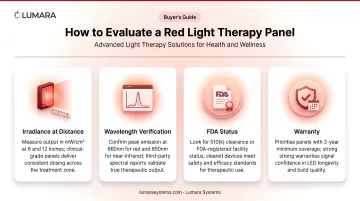
When evaluating any red light therapy panel - including Bon Charge - these are the questions that determine whether the device performs therapeutically:
1. At what distance is irradiance measured?
Irradiance figures measured at 0 inches are not relevant to any realistic use case. You should know the irradiance at 6 inches, 12 inches, and the recommended treatment distance. Some brands publish these; many only publish the most favorable number.
2. Is wavelength independently verified?
LED manufacturing bin tolerances mean stated wavelength and actual output can differ by 10-20nm. Independent spectroradiometer testing - ideally ISO-accredited - is the only reliable verification. Not all brands provide this level of documentation.
3. What is the FDA regulatory status?
FDA clearance (510k with clearance number) vs FDA registration (facility listing only) are meaningfully different quality signals. Verify which applies.
4. What does the warranty cover and for how long?
3-year warranties are the standard benchmark for quality devices. Shorter warranties suggest lower confidence in longevity.
How Lumara Illuminate V2 Compares
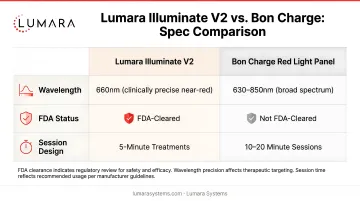
| Spec | Bon Charge | Lumara Illuminate V2 |
|---|---|---|
| Wavelength | 660nm + 850nm | 660nm (red only) |
| Wavelength verification | Not independently published | Triple-tested, verified |
| LEDs | Varies by model | 1,800 |
| Coverage area | Varies by model | 1,200 cm2 |
| Session time guidance | Varies | 5 minutes |
| Energy delivery | Not specified per session | 6,000 joules per 5-min session |
| FDA status | Bon Charge states that its red light therapy devices are FDA-registered; we did not find a clear FDA 510(k) clearance claim for the panels. | FDA cleared |
| Made in | Australia-based brand | USA |
| Warranty | Warranty varies by model/page; verify current warranty terms before purchase. | 3 years |
| HSA/FSA eligible | No | Yes |
The key differences:
Wavelength verification: Lumara's triple-tested process provides documented wavelength accuracy at 660nm. Bon Charge does not publish equivalent independent verification data.
Single vs dual wavelength: Bon Charge includes 850nm near-infrared alongside 660nm. Lumara's Illuminate V2 is 660nm only. For skin applications, 660nm wavelength is the primary relevant wavelength. For deep tissue and muscle recovery, 850nm adds depth. If both are needed, Lumara's Pad covers red, NIR, and FIR in a flexible body format.
FDA clearance: Illuminate V2 is listed by Lumara as an FDA-cleared Class II medical device. Bon Charge states that its red light therapy devices are FDA-registered; we did not find a clear FDA 510(k) clearance claim for the panels.
Session design: Illuminate V2's 5-minute session format is designed for consistent daily use. Bon Charge panel sessions are typically 10-20 minutes depending on the protocol.
Which One Is Right for Different Buyers
Choose Lumara Illuminate V2 if:
- You want verified 660nm wavelength output with documented testing
- FDA clearance and Made in USA production are priorities
- You want a 5-minute daily session format
- HSA/FSA eligibility matters
- You want the longest standard warranty (3 years)
Bon Charge may suit if:
- You want dual-wavelength (660nm + 850nm) coverage from a single device
- Australian shipping or brand familiarity are factors
- You are comfortable with the lower regulatory documentation level
For dual-wavelength needs (skin + deep tissue): Lumara's Pad covers red, near-infrared, and far-infrared in a flexible body format - addressing the multi-wavelength need with verified Lumara quality and the 3-year warranty.
Frequently Asked Questions
Is Bon Charge red light therapy good?
Bon Charge panels use appropriate wavelengths (660nm + 850nm) and have positive user feedback. The limitations relative to Lumara are wavelength verification documentation, FDA clearance status, and session design. For facial use cases, see the red light panel vs mask comparison for guidance on format selection.
How does Bon Charge compare to Lumara Illuminate V2?
Bon Charge offers dual-wavelength output. Lumara's Illuminate V2 leads on wavelength verification, FDA clearance, 5-minute session design, HSA/FSA eligibility, and 3-year warranty. Both are in the mid-to-premium consumer panel category.
What wavelengths does Bon Charge use?
660nm (red) and 850nm (near-infrared) - the standard dual-wavelength combination for photobiomodulation panels.
Is Lumara better than Bon Charge?
On the specs that matter most for therapeutic use - verified wavelength output, FDA clearance, session design, and warranty - Lumara's Illuminate V2 provides stronger documentation and regulatory quality. Which is "better" depends on your specific priorities, including whether keeping your eyes open or closed during sessions is a consideration for your use case.
Specs Determine Results - Not Brand Preference
The right red light therapy panel is the one with verified wavelength output, practical session design, appropriate regulatory status, and coverage that matches your treatment goals. Bon Charge is a legitimate option in the market; Lumara's Illuminate V2 leads on the documentation and regulatory metrics that matter most for therapeutic confidence.