Red Light Therapy for Retinitis Pigmentosa: What You Need to Know

Introduction

Retinitis pigmentosa is a progressive condition where night blindness gradually worsens, peripheral vision narrows, and central vision may eventually fade. There is no universal cure. The only FDA-approved gene therapy, Luxturna, targets just the RPE65 mutation, representing fewer than 6% of cases. This leaves the vast majority of RP patients searching for options beyond simply monitoring progression.

That's why patients and clinicians are increasingly asking about photobiomodulation—commonly known as red light therapy. Early research indicates that specific wavelengths of red and near-infrared light may protect surviving photoreceptors by targeting the mitochondrial dysfunction and oxidative stress that drive cell death in RP.

This article examines the science behind how red light interacts with retinal cells, what current research shows, and what RP patients should realistically expect.


TLDR:

  • Over 1.5 million people globally have RP — with mutations in 80+ genes and no cure for the majority
  • 660–670nm red light targets mitochondrial dysfunction in photoreceptors, a key driver of RP progression
  • Clinical pilots show statistically significant visual acuity improvements, but studies remain small and short-term
  • PBM is FDA-authorized for dry AMD only—its use in RP is off-label and requires medical supervision

What Is Retinitis Pigmentosa?

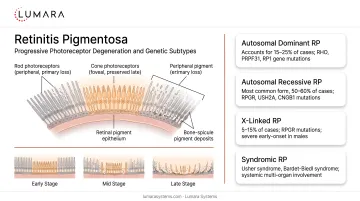
Retinitis pigmentosa is not a single disease but a group of inherited retinal dystrophies caused by mutations in over 80 different genes. These genetic defects lead to progressive photoreceptor degeneration, beginning with night blindness and peripheral vision loss, and potentially advancing to central vision impairment.

Prevalence varies by region:

  • Global: Approximately 1 in 3,000 to 1 in 4,000 individuals
  • United States and Europe: 1 in 3,500 to 1 in 4,000
  • Australia: Roughly 1 in 3,000 (about 8,900 people)

Why RP Is So Difficult to Treat

The genetic heterogeneity of RP means no single therapy works for all patients. Luxturna (voretigene neparvovec), the only approved gene therapy, targets only the RPE65 mutation—accounting for roughly 1%–6% of cases across studied populations. This leaves the overwhelming majority of patients without a disease-modifying option.

Shared Biological Pathways Across RP Types

Despite the genetic diversity, RP subtypes converge on common downstream mechanisms:

  • Mitochondrial dysfunction in photoreceptor cells
  • Oxidative stress from excessive reactive oxygen species (ROS)
  • Apoptosis, the programmed cell death that ultimately destroys photoreceptors

These shared pathways make RP collectively targetable by therapies that restore mitochondrial function and reduce oxidative damage. This is precisely why researchers have begun investigating photobiomodulation as a non-genetic approach that acts on these cellular mechanisms directly.

Three shared RP biological pathways targeted by red light therapy infographic

How Red Light Therapy Works on the Retina

What Is Photobiomodulation?

Photobiomodulation (PBM) uses specific wavelengths of red to near-infrared light—typically 600 to 1000nm—to stimulate cellular function through photochemical, not heat-based, mechanisms. Unlike harmful UV exposure or high-powered lasers, PBM operates at low intensities that trigger biological responses without damaging tissue.

The Primary Target: Cytochrome c Oxidase

The key cellular target is cytochrome c oxidase (CcO), a critical enzyme in the mitochondrial electron transport chain. CcO absorbs red and near-infrared light most efficiently at specific wavelengths:

  • Red light: ~660nm
  • Near-infrared: ~800–850nm

Research shows that over 50% of light absorption between 800 and 850nm in tissue is attributable to CcO. When CcO absorbs photons, it triggers:

  • Increased ATP production
  • Reduced reactive oxygen species (ROS)
  • Enhanced antioxidant protection in stressed or degenerating cells

Direct Connection to RP Pathology

Because RP photoreceptors suffer from mitochondrial dysfunction and oxidative stress, restoring mitochondrial energy metabolism through CcO activation could protect surviving photoreceptors from further programmed cell death. PBM addresses the downstream biological consequences of RP even when the underlying genetic mutation remains unchanged.

Secondary Cellular Effects

Those mitochondrial gains are only part of the picture. PBM also activates several downstream pathways that directly support photoreceptor survival in RP:

  • Upregulates BDNF and GDNF, neurotrophic factors that support neuronal survival and retinal structural integrity
  • Suppresses pro-inflammatory cytokines such as TNF-alpha and reduces Müller cell-mediated inflammatory activation
  • Increases anti-apoptotic Bcl-2 expression while decreasing pro-apoptotic Bax and Caspase-9

Why Wavelength Precision Matters

Research consistently points to the 660–670nm red light range as particularly effective for retinal applications. Precision matters here: studies using wavelengths that match the CcO absorption spectrum—670nm and 830nm—successfully restored enzyme activity, while off-target wavelengths such as 728nm failed to produce the same effect. Not all red light is equivalent, and the difference of even a few nanometers can determine whether a treatment reaches its biological target.

What the Research Shows

Foundational Preclinical Evidence

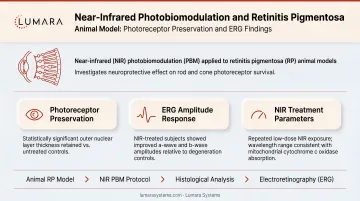
The earliest RP-specific PBM research used the P23H rat model, which mimics the most common rhodopsin mutation in human RP. In a 2006 study published in Investigative Ophthalmology & Visual Science and supported by the Foundation Fighting Blindness, 670nm LED treatment increased cytochrome oxidase activity and reduced photoreceptor apoptosis by nearly 50% compared to untreated controls.

A 2020 study by Gopalakrishnan and colleagues extended this work using 830nm PBM in P23H transgenic rats. Treatment preserved mitochondrial redox state, improved scotopic ERG responses, and maintained retinal structure and thickness, providing mechanistic evidence that PBM protects the retina during critical photoreceptor loss periods.

Clinical Pilot Studies in RP Patients

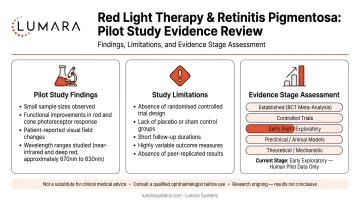
The most significant human data comes from a 2024 pilot study by Siqueira and colleagues, which enrolled 12 RP patients (24 eyes) for 9 sessions of multiwavelength PBM using the Valeda system (590nm, 660nm, 850nm). Results included:

  • Visual acuity: Statistically significant improvement from 0.62 to 0.53 logMAR (p=0.001)
  • Visual field: Mean deviation trended from -19.87 to -19.45 dB (p=0.366, not statistically significant)
  • Safety: No adverse effects observed on OCT or ERG

Additional supportive cases include:

  • Ivandic case study: Visual acuity improved from 20/50 to 20/20 with 780nm LLLT, maintained over 7 years with periodic retreatment
  • Carson Phase 1 trial: 12 advanced RP patients treated with 670nm laser PBM showed a mean improvement of 5.4 letters in visual acuity at 8 weeks
  • Alberta et al. 2024 systematic review: Analysis of 7 studies found consistent trends toward clinical improvements in visual acuity, visual fields, and outer nuclear layer preservation

Clinical PBM research results for retinitis pigmentosa studies comparison summary

Evidence Level, Regulatory Status, and Limitations

Despite the encouraging clinical signals above, PBM is not FDA-approved for RP. The LumiThera Valeda Light Delivery System received FDA authorization via the De Novo pathway (DEN230083) strictly for dry age-related macular degeneration (AMD), based on the LIGHTSITE I, II, and III randomized controlled trials — meaning any use of PBM for RP remains off-label.

Most RP-specific PBM studies are small, short-term, and non-randomized. Larger controlled trials are needed to confirm efficacy, establish optimal dosing, and verify long-term safety. Responses vary considerably based on disease stage, genetic mutation, and how much retinal damage has already occurred.

Active research is ongoing: Sight Research UK is currently running a pilot study examining red light for color contrast in RP patients (NCT06224114). Until those results are available, anyone considering PBM for RP should consult a retinal specialist to weigh the current evidence against their specific diagnosis.

What Red Light Therapy Can and Cannot Do for RP

Setting Clear Expectations

Red light therapy is not a cure for RP and does not reverse the underlying genetic mutation. It targets the downstream biological consequences—mitochondrial dysfunction, oxidative stress, and inflammation—that drive photoreceptor death. The goal is to preserve remaining vision—photoreceptors already lost cannot be recovered.

Heterogeneous Response Depending on Disease Stage

Research, including the Siqueira pilot study, notes that patient responses vary depending on:

  • Disease stage (earlier-stage RP may benefit more than advanced degeneration)
  • Genetic mutation type
  • Degree of retinal damage already sustained

Patients with advanced RP, where most photoreceptors are already lost, may see little benefit because there are fewer surviving cells to protect.

Safety Profile

Across preclinical and clinical studies, no significant adverse effects have been reported at therapeutic doses:

  • No phototoxicity
  • No structural damage on OCT
  • No ERG abnormalities

No studies have yet tracked safety across repeated long-term treatment cycles. In AMD studies, the FDA noted a potential risk of conversion to neovascular AMD in highly susceptible patients, though this has not been reported in RP trials.

Clinical Perspective on PBM for RP

This mixed safety picture partly explains why the ophthalmology community remains measured in its enthusiasm. The American Academy of Ophthalmology acknowledges the FDA authorization for AMD but notes that clinicians are still awaiting real-world data.

Most retinal specialists want larger, longer-term RCT data before making routine recommendations for RP. Patients should discuss PBM with their retinal specialist before starting any protocol.

Practical Guidance: Sessions, Wavelengths, and What to Ask

Typical PBM Protocol Based on Clinical Studies

The Siqueira RP study and the LIGHTSITE trials for AMD both used a consistent treatment regimen:

  • Session count: 9 treatments per series
  • Frequency: 3 sessions per week over 3 weeks (on alternate days)
  • Duration: Approximately 5 minutes per eye
  • Wavelengths: 660–670nm (red) and 830–850nm (near-infrared)

Importance of Wavelength Accuracy

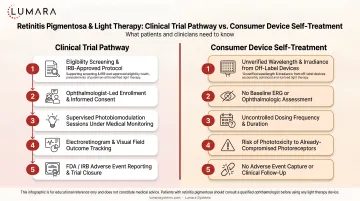
Clinical studies have consistently used 660–670nm for retinal benefit. Devices with imprecise wavelength output or broad-spectrum LEDs may not replicate study conditions.

For at-home use, verify the device before purchasing:

  • Confirmed output at 660nm (not just "red light" marketing claims)
  • Session capability of approximately 5 minutes per eye
  • FDA clearance or third-party wavelength verification

Practical Next Steps for RP Patients

If you're interested in red light therapy for RP:

  1. Consult a retinal ophthalmologist before starting and ask whether PBM research applies to your specific case
  2. Confirm that any device or protocol matches the wavelength (660–670nm) and dosing used in clinical studies
  3. Track visual acuity, visual field, and subjective symptoms throughout any treatment period
  4. Treat PBM as supportive therapy only — it should complement, not replace, standard care and any applicable gene therapy evaluation

Four-step practical guide for RP patients starting red light therapy protocol

Frequently Asked Questions

How to reverse retinitis pigmentosa?

RP cannot currently be reversed. The genetic mutations and photoreceptor loss are irreversible with existing treatments. The focus of current therapies, including red light therapy, is on slowing progression and preserving remaining vision rather than restoration.

What do ophthalmologists think of red light therapy?

Ophthalmologists find PBM promising, especially given its safety profile and FDA authorization for AMD, but most want to see larger, longer-term clinical trials in RP specifically before making routine recommendations. Patients should discuss it with their retinal specialist.

Is red light therapy safe for the eyes?

At therapeutic doses used in clinical studies, no significant adverse effects or phototoxicity have been observed. However, self-administering treatment without medical guidance or confirmed device specifications carries unknown risks.

What wavelength of red light is used for retinitis pigmentosa?

Research has primarily used 660nm to 670nm (red) and 830–850nm (near-infrared) wavelengths. Retinal mitochondria absorb most efficiently in this range, and 660nm in particular is well-supported by both preclinical and clinical RP studies.

How many sessions of red light therapy are needed for RP?

Most studies have used 9 sessions over 3 weeks, each approximately 5 minutes per eye. Whether repeat cycles provide sustained benefit is still being investigated.

Can red light therapy replace gene therapy for retinitis pigmentosa?

No, these are distinct interventions. Gene therapy targets specific genetic mutations in a small subset of RP patients; PBM addresses downstream mitochondrial and oxidative mechanisms. PBM may complement standard care but is not a replacement for any approved treatment.