Introduction
Red light therapy is not a replacement for every skincare approach - it is a specific tool that works at the cellular level to support collagen and skin quality in a way that topicals and procedures cannot fully replicate. Understanding how it compares to other treatments helps you place it correctly in a routine. Whether you use a panel or mask, the mechanism is the same - the format just determines coverage area.
This guide maps the most common skincare approaches against red light therapy by mechanism, evidence, and how they work together.
Key Takeaways
- Red light therapy at 660nm works through photobiomodulation - cellular collagen stimulation and anti-inflammatory effects - rather than chemical or mechanical intervention
- It is most additive to topical routines (retinoids, vitamin C) rather than competitive - different mechanisms working toward the same outcome
- For professional procedures (microneedling, chemical peels, laser), red light therapy is a supportive complement before or after
- The distinguishing advantage of red light therapy is daily at-home access without pharmaceutical side effects or downtime
- Device quality determines whether the mechanism works: verified 660nm wavelength and sufficient irradiance are the critical specs
How Red Light Therapy Differs Mechanistically
Most skincare approaches work through one of three pathways:
- Chemical delivery: Retinoids, vitamin C, AHAs - ingredients penetrating the skin barrier and interacting with cells
- Controlled injury: Microneedling, chemical peels, laser resurfacing - creating controlled damage that triggers repair response
- Physical protection: SPF - blocking UV damage before it occurs
Red light therapy works through a fourth pathway: photobiomodulation - light energy absorbed by cellular machinery (mitochondria) driving energy production, collagen synthesis, and anti-inflammatory responses without ingredient delivery or tissue injury.
Red Light Therapy vs Retinoids
Retinoids (retinol, tretinoin): Accelerate cell turnover and stimulate collagen via retinoid receptor activation. The most evidence-backed topical category for skin aging. Require tolerance-building; sun sensitivity is a side effect.
Red light therapy (660nm): Stimulates collagen via photobiomodulation in fibroblasts. No photosensitivity side effect. No peeling or purge phase.
How they work together: Retinoids drive surface cell turnover; red light therapy drives dermal collagen synthesis. Different layers, different mechanisms - genuinely additive. Use red light therapy on clean skin before applying retinoids in your evening routine.
Red Light Therapy vs Vitamin C
Vitamin C: Antioxidant protection against UV and pollution damage; collagen synthesis co-factor. Works at the surface through antioxidant chemistry.
Red light therapy: Drives collagen synthesis through cellular photobiomodulation in the dermis.
How they work together: Vitamin C protects against new oxidative damage; red light therapy drives structural rebuilding. Morning vitamin C, evening red light therapy (or vice versa) - natural pairing without interaction concerns.
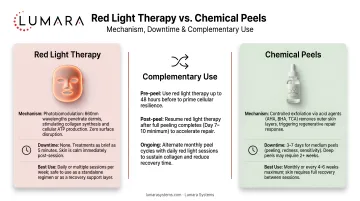
Red Light Therapy vs Chemical Peels
Chemical peels: Remove surface skin layers to trigger repair and resurface texture. Produce downtime (redness, peeling) proportional to peel depth. Results from controlled surface injury.
Red light therapy: No downtime, no surface injury. Slower cumulative results from cellular stimulation.
How they work together: After peels, microneedling, or laser procedures, red light therapy should only be resumed once the skin barrier has recovered and the treating professional has cleared it.
Red Light Therapy vs Microneedling
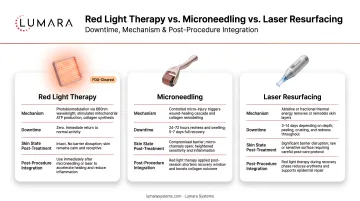
Microneedling: Creates micro-injuries that trigger robust collagen production. Produces significant results more quickly than light therapy alone. Requires professional treatment or careful at-home technique; some downtime.
Red light therapy: Non-invasive, no downtime. Less aggressive collagen stimulation but sustainable daily use.
How they work together: After microneedling, red light therapy should only be resumed once the skin barrier has recovered and the treating professional has cleared it. Some professional protocols incorporate LED as part of the in-office treatment.
Red Light Therapy vs Laser Resurfacing
Ablative laser resurfacing: Removes skin layers to produce dramatic collagen remodeling. Significant downtime; professional clinical procedure.
Red light therapy: No downtime, daily home use. Gentler, cumulative collagen support over months.
How they work together: After healing from ablative procedures, consistent red light therapy can help maintain skin quality. Resume red light therapy only once the skin barrier has recovered and the treating professional has cleared it.
Where Red Light Therapy Uniquely Wins
Red light therapy has a specific advantage profile that other approaches do not fully replicate:
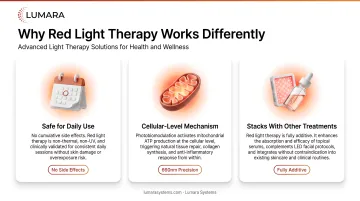
Daily consistent use without side effects: Retinoids cause sensitivity; chemical peels cause downtime; microneedling requires recovery. Red light therapy can be used daily, indefinitely, without these tradeoffs.
Cumulative collagen support as a foundation: Used consistently over months and years, red light therapy maintains elevated fibroblast activity that compounds skin quality improvements.
Works at the cellular level without topical delivery challenges: Ingredients face bioavailability and stability challenges; photobiomodulation bypasses the skin barrier entirely.
Additive to every other approach: Red light therapy does not conflict with retinoids, vitamin C, peels, or professional procedures - it supports all of them.
Building the Combined Routine
Foundation (daily):
- Morning: Vitamin C serum -> moisturizer -> SPF
- Evening: Red light therapy (clean skin) -> retinoid -> moisturizer
Enhancement (periodic):
- Chemical exfoliant 2-3x/week (alternate with retinoid nights)
- Professional peel or microneedling session as desired
Post-procedure:
- After peels, microneedling, or laser procedures, resume red light therapy only once the skin barrier has recovered and the treating professional has cleared it
Frequently Asked Questions
Is red light therapy better than retinol?
They are mechanistically different, not directly comparable. Retinol drives surface turnover via retinoid receptors. Red light therapy drives dermal collagen via photobiomodulation. Combined, they are more effective than either alone.
Can I use red light therapy with retinoids?
Yes - and it is a recommended combination. Apply red light therapy first on clean skin, then retinoid after your session. They work on different layers through different mechanisms.
Does red light therapy replace professional skincare treatments?
No. Professional procedures like microneedling and laser resurfacing produce more aggressive results in shorter timeframes. Red light therapy is a daily foundation that compounds over time and works well alongside professional treatments.
What is red light therapy best for in a skincare routine?
Consistent collagen support, skin quality improvement over time, anti-inflammatory effects, and daily use without side effects or downtime. It excels as the daily foundation that other treatments enhance.
The Daily Foundation That Makes Everything Else Work Better
Red light therapy does not compete with retinoids, chemical peels, or professional procedures - it supports all of them. Used daily as a consistent collagen and skin quality foundation, it can support a broader skincare routine when used consistently and appropriately.
Lumara's VISO LED Mask - 660nm, triple-tested wavelength, 470 micro-LEDs at 30 mW/cm2, FDA cleared, full-face coverage - is built for exactly this daily foundation role. For skin concerns including post-inflammatory hyperpigmentation, consistent daily light therapy is particularly relevant.