Introduction
Adding red light therapy to a clinic, med spa, esthetic practice, or wellness facility is a different decision than buying a consumer device. The requirements are different: higher throughput, regulatory compliance, multi-wavelength capability for diverse client needs, service menu integration, and ROI that justifies a capital investment.
This guide covers what to evaluate in a commercial red light therapy machine, the regulatory landscape, and how Lumara PRO fits into the professional context.
Key Takeaways
- Commercial devices require more rigorous regulatory status than consumer devices - FDA clearance (with a clearance number) is more meaningful than FDA registration for professional settings
- Multi-wavelength systems with preprogrammed treatment options are more versatile for diverse client needs than single-wavelength devices
- Format matters for throughput: standalone professional systems allow parallel client scheduling; wearable or panel formats add flexibility to service menus
- ROI calculation should factor in session pricing, session throughput per device, and consumable or maintenance costs
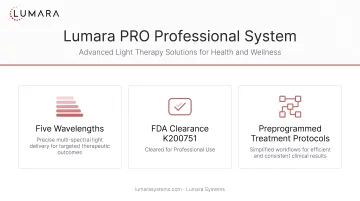
- Lumara PRO is a five-wavelength professional system (red, blue, green, IR, yellow) with FDA clearance K200751, preprogrammed treatments, TUV certification, and non-ablative, non-UV classification
What Commercial Means: Higher Standards Across Every Dimension
Consumer devices are designed for individual use at home. Commercial devices operate in a different context:
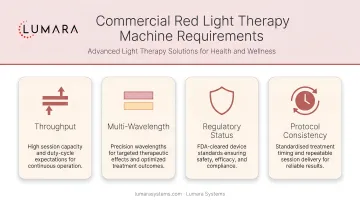
Throughput: A commercial device may run 6-10 client sessions per day. Build quality, component durability, and thermal management must support this.
Multi-wavelength capability: Consumer devices often optimize for one application (skin wellness at 660nm, acne management at 415nm). Commercial clients present diverse needs. A professional system covering multiple wavelengths allows one device to serve multiple service categories.
Regulatory positioning: FDA clearance with a clearance number (510k) is more meaningful for professional credibility than FDA registration (which only indicates facility listing). When clients and staff ask about the device's regulatory status, a clearance number is a credible answer.
Training and protocols: Preprogrammed treatments reduce operator variability and ensure consistent session delivery across different staff members.
Regulatory Landscape for Commercial Devices
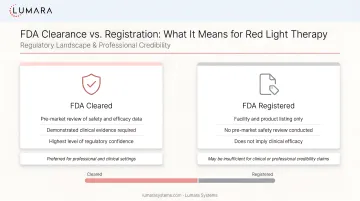
FDA Clearance vs Registration
| Status | What It Means | Commercial Significance |
|---|---|---|
| FDA cleared (510k) | Device has been reviewed and cleared for stated intended use | Strong credibility signal; includes a clearance number (e.g., K200751) |
| FDA registered | Facility registration only; does not indicate device review | Weaker signal; does not involve device safety/efficacy review |
| FDA approved | Higher standard, typically for pharmaceutical drugs and high-risk devices | Not typically applicable to LED light therapy devices |
For commercial and professional settings, FDA clearance with a clearance number is the relevant benchmark. It demonstrates the device has been through the FDA's 510k pathway for its stated device category.
Non-Ablative and Non-UV Classification
Professional light therapy devices in clinical and esthetic settings are typically categorized as non-ablative (they do not cut, burn, or break the skin surface) and non-UV (they do not produce ultraviolet wavelengths). These classifications define what the device can and cannot do and are relevant to scope-of-practice discussions in professional settings.
Device Formats for Commercial Use
Professional Treatment Systems
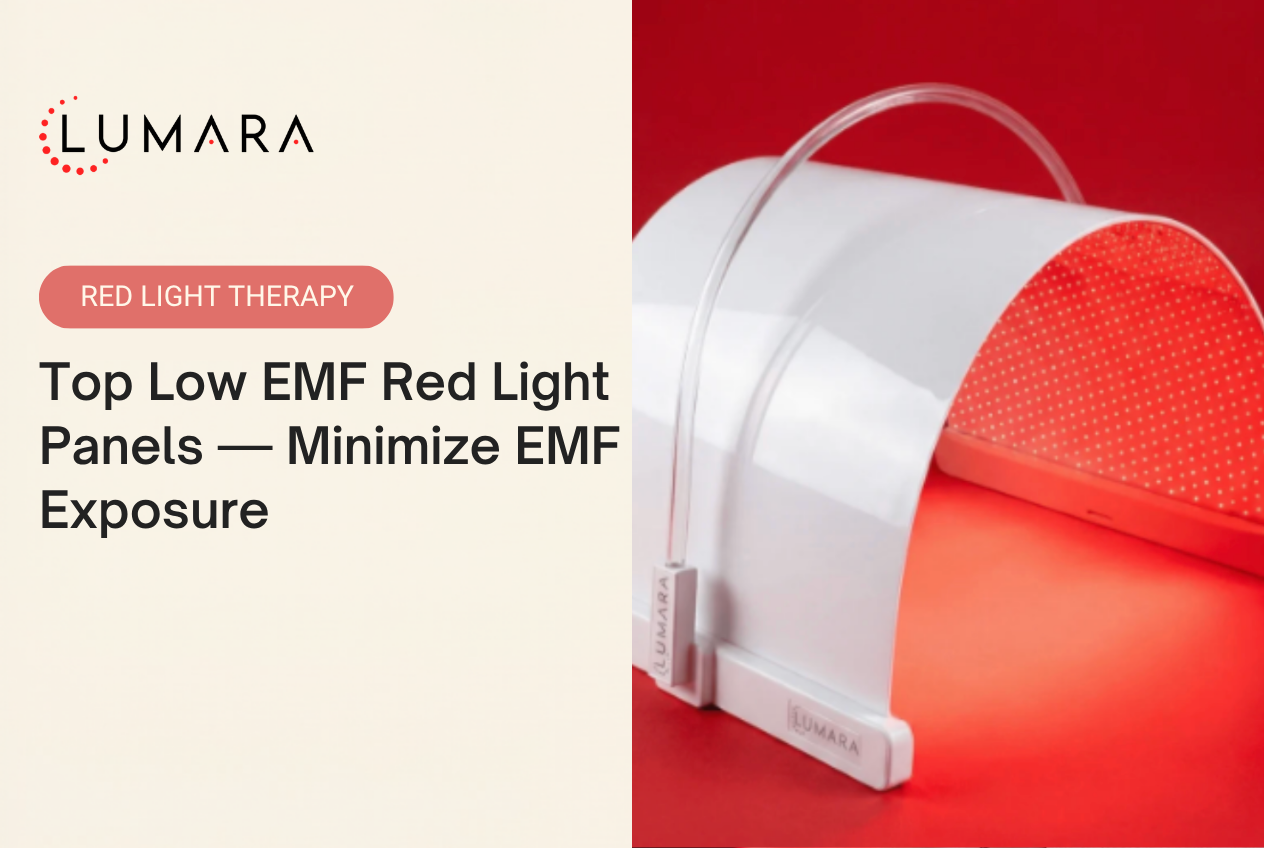
Standalone multi-wavelength professional systems are the most comprehensive commercial format. They support multiple service categories from one device, include preprogrammed treatment protocols, and are designed for the throughput demands of commercial use.
Advantages: Most versatile, consistent protocol delivery, professional credentialing Considerations: Higher upfront investment, requires dedicated treatment space
High-Output Panel Systems
Large panels with high LED counts and irradiance can serve multiple clients per day in a panel-based session format. More commonly found in wellness centers and fitness facilities alongside other recovery services.
Advantages: Faster sessions, can serve multiple users with minimal setup Considerations: Single or dual wavelength, less adaptable for diverse clinical applications
Device Integration with Service Menus
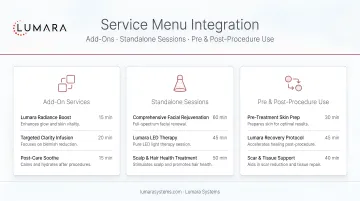
Commercial devices work best when integrated thoughtfully into service menus rather than offered as standalone single-session treatments. Common integration formats:
- Add-on to facial or skincare treatments (5-10 minutes of red or blue light post-procedure)
- Standalone wellness sessions (20-30 minutes of red or near-infrared light for recovery)
- Pre-treatment prep (red light before microneedling or other procedures to support skin readiness)
- Post-procedure support (reducing inflammation and supporting tissue recovery after ablative treatments)
ROI Considerations
Commercial device ROI depends on session pricing, capacity, and device lifecycle costs.
Session pricing range (industry benchmarks):
- Add-on to facial: $25-$75 per session (5-15 minutes)
- Standalone red light session: $50-$150 per 20-30 minute session
- Red light therapy pod or panel session (wellness/fitness): $30-$80 per session
Throughput calculation: A device running 6 sessions per day at $75 per session generates $450/day. At 5 days/week, that is $2,250/week or approximately $9,000/month at full capacity.
Device lifecycle: Commercial-grade devices designed for high throughput typically have claimed lifespans significantly higher than consumer devices. Evaluate warranty terms, LED lifespan claims, and what ongoing maintenance looks like.
Staff training: Devices with preprogrammed protocols reduce training time and operator variability. This directly affects service consistency and ROI per staff member.
Lumara PRO: Built for Professional and Clinical Settings
Lumara PRO is Lumara's professional system, designed for clinics, med spas, and esthetic businesses. It operates across five wavelengths - red, blue, green, IR, and yellow - with preprogrammed treatment options.
Key credentials:
- FDA clearance: K200751 (Class II medical device)
- TUV certified
- Non-ablative classification
- Non-UV output (does not produce ultraviolet wavelengths)
- Five wavelengths: covers skin wellness, acne management, inflammation, and multi-parameter treatments from a single system
- Preprogrammed treatments: consistent protocol delivery without operator variability
The five-wavelength capability is the key differentiator for commercial settings. Instead of buying separate devices for different service categories, Lumara PRO supports:
- Red light: skin wellness, collagen support, anti-inflammatory applications
- Blue light: acne management, bacterial photoinactivation
- Green light: skin tone and discoloration appearance support
- IR (infrared): deeper tissue applications
- Yellow: additional wavelength for multi-parameter skin protocols
What to Evaluate Before Purchasing
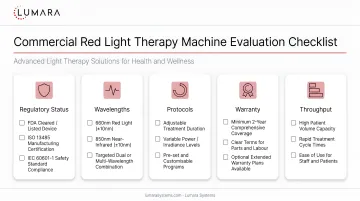
Regulatory documentation: Request the clearance number and verify it in the FDA 510k database. K200751 is verifiable for Lumara PRO.
Wavelength configuration: Does the system support the service categories you intend to offer? A red-only system limits your menu; a multi-wavelength system is more versatile.
Protocol support: Are preprogrammed treatments included? Is training provided? What is the process for protocol updates?
Warranty and service terms: Commercial use accelerates wear. Understand what the warranty covers, the service process, and replacement part availability.
Throughput capacity: How many sessions per day is the device designed for? Does this match your projected client volume? For a detailed comparison of home versus clinic devices, see our dedicated guide.
Frequently Asked Questions
What is the difference between a commercial and consumer red light therapy device?
Commercial devices are designed for multi-session daily throughput, multi-wavelength versatility, regulatory credibility in professional settings, and consistent protocol delivery. Consumer devices are optimized for individual home use at lower duty cycles.
What FDA status should a commercial red light therapy device have?
FDA clearance (510k) with a clearance number is the most credible regulatory status for professional settings. FDA registration (facility listing only) does not indicate device review. For Lumara PRO, the FDA clearance number is K200751.
How many wavelengths does a commercial system need?
More wavelengths increase service menu versatility. A single-wavelength device supports one primary application category. A five-wavelength system like Lumara PRO supports skin wellness, acne management, discoloration appearance, and multi-parameter protocols from one device.
What is a typical ROI timeline for a commercial red light therapy device?
Varies significantly by session volume and pricing. At $75/session with 6 daily sessions, a device generating $9,000/month would recover a $20,000-$30,000 investment in 3-4 months at full capacity. Conservative estimates at 3-4 sessions/day produce longer timelines.
Is Lumara PRO suitable for med spa use?
Yes. Lumara PRO is designed for professional and clinic use with FDA clearance K200751, TUV certification, five wavelengths, and preprogrammed treatments aligned with esthetic and clinical service menus. For clients focused on muscle recovery, the IR wavelength is particularly relevant.
Professional Performance Requires Professional-Grade Equipment
Commercial red light therapy adds real value to clinical, esthetic, and wellness service menus - but only if the device is built for commercial throughput and regulatory credibility.
Lumara PRO is built for that standard: five wavelengths, preprogrammed treatments, FDA clearance K200751, TUV certified, non-ablative, non-UV classification.