Introduction
The most common question people have after buying a red light therapy mask is not about wavelength or LED count. It is about consistency: how often should I actually use this?
The answer matters because red light therapy is dose-dependent. Too little use produces minimal effect. Too much can produce diminishing returns or skin sensitivity. And the right frequency depends on where you are in your routine - whether you are just starting, targeting a specific concern, or maintaining results you have already built.
This guide covers session frequency, treatment phases, session length, what overuse looks like, and what to look for in a mask that is built to support a sustainable routine.
Key Takeaways
- Red light therapy is dose-dependent: consistency and correct frequency matter more than intensity
- Most effective protocols follow a phased approach: a higher-frequency loading phase, a goal-based active phase, and a lower-frequency maintenance phase
- Session length for a well-designed mask at correct irradiance is typically 5-20 minutes
- Signs of overuse include increased redness, dryness, or sensitivity - not normal results of a well-calibrated routine
- Device quality determines whether a protocol is effective: wavelength accuracy, irradiance, LED count, and coverage consistency are the specs that matter
How Red Light Therapy Actually Works
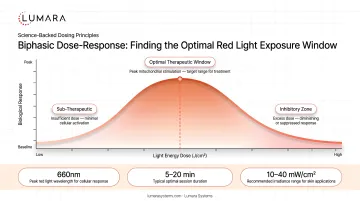
Red light therapy works because specific wavelengths of light are absorbed by cells in ways that support normal cellular activity. At the facial skin level, 660nm is the most researched wavelength for skin wellness applications - supporting cellular energy, local circulation, and skin recovery responses. This cellular mechanism is known as photobiomodulation, and it underlies all of the protocol guidance in this article.
The key insight for users is that these effects are cumulative and build over time. A single session produces a transient cellular response. Sustained, consistent sessions over weeks and months produce the lasting changes that buyers are looking for.
This is why frequency matters more than any single session length or intensity level. The device you use has to be accurate enough at the wavelength level and consistent enough in coverage to make that cumulative effect possible.
The Three-Phase Protocol: How Frequency Should Change Over Time
Red light therapy for facial skincare generally follows three phases. Understanding these helps set realistic expectations and avoid both under-use and overuse.
Phase 1: Loading Phase (Weeks 1-6)
Recommended frequency: 3-5 sessions per week
The loading phase is about building cellular baseline. In the first 4-6 weeks, more frequent sessions give your skin more opportunity to respond to the light exposure before the routine settles into maintenance.
Users often notice early improvements in skin texture, tone, or radiance during this phase, though significant structural changes take longer.
Phase 2: Active Phase (Weeks 6-16+)
Recommended frequency: 3-4 sessions per week (skincare/anti-aging goals); 4-5 sessions per week (clarity-focused routines)
During the active phase, you have established a baseline and are targeting specific outcomes. The right frequency depends on your goal:
- For skin appearance support (fine lines, firmness, tone): 3-4 sessions per week is the most commonly referenced protocol
- For skin clarity routines where blue light is also in use: 4-5 sessions per week of each wavelength, sequenced appropriately
Lumara's VISO LED Mask is designed around this active-phase use case. With 470 micro-LEDs at 660nm, 30 mW/cm² optical peak power, and a 10" x 7" oval form factor, it is built for full-face coverage in a session format that fits daily or near-daily use. Treatment guidance runs 5-20 minutes, making it practical to sustain the active-phase frequency without disrupting your routine.
Phase 3: Maintenance Phase (After Week 16+)
Recommended frequency: 1-2 sessions per week
Once you have completed an active protocol, maintenance sessions preserve the results you have built. Most users drop to 1-2 sessions per week and find this sufficient to sustain skin condition improvements.
This is also where device quality becomes a long-term investment. A mask you can use for years without wavelength drift, LED failure, or comfort issues is more valuable than a cheaper device that requires replacement every 6-12 months. For a detailed look at what results to expect at each stage of a sustained protocol, see the dedicated results guide.
How Long Should Each Session Be
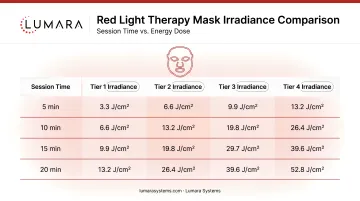
Session length depends on the device's irradiance - the power density of light delivered to the skin surface. A higher-irradiance device reaches a clinically relevant dose more quickly; a lower-irradiance device requires longer sessions to deliver the same dose.
| Device Irradiance | Typical Session Length |
|---|---|
| 10 mW/cm² | 30-40 minutes |
| 20 mW/cm² | 15-20 minutes |
| 30 mW/cm² | 5-20 minutes |
| 50 mW/cm² | 5-10 minutes |
Lumara's VISO LED Mask operates at 30 mW/cm² optical peak power, with treatment guidance of 5-20 minutes. At this irradiance, a 10-20 minute session delivers a meaningful dose without requiring extended session times.
Session length guidance from the device manufacturer is the most reliable starting point. If your device does not specify irradiance, the stated treatment time range is the next best reference. Always use your mask on bare skin that is clean and free of heavy creams or physical sunscreens, which can reduce light penetration at the skin surface.
What Overuse Actually Looks Like
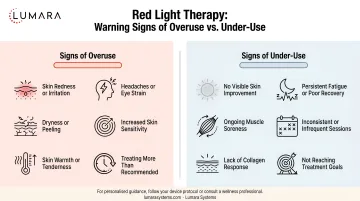
Red light therapy masks are generally well-tolerated, but overuse is possible and has observable signs. Knowing what to look for helps you calibrate your routine accurately.
Signs of overuse:
- Increased skin redness lasting more than a few hours after a session
- Dryness or tight-feeling skin that was not present before starting
- Sensitivity to other skincare products that were previously tolerated well
- Breakouts in users who have not experienced them on this routine before
Signs of under-use:
- No visible or tactile changes after consistent use over time, especially when session frequency is irregular or the device is underpowered.
- Irregular session frequency that does not match the phase recommendations above
If you are experiencing overuse signs, reduce session frequency or session length by 25-50% for 1-2 weeks and reassess. Most users find that recalibrating the routine resolves sensitivity without needing to stop entirely.
What to Look for in a Red Light Therapy Mask
The protocol only works if the device is capable of delivering a consistent, accurate dose. Most consumer masks on the market vary significantly in wavelength accuracy, irradiance, LED count, and build quality.
Wavelength Accuracy
660nm is the most researched wavelength for facial skincare applications. A device that claims "red light" but does not specify a precise wavelength may be delivering light at a range that includes wavelengths with less skin-level relevance. Verify that your device specifies 660nm and ideally has the wavelength independently tested rather than self-reported.
Lumara's VISO LED Mask has its wavelength triple tested and verified for precision at 660nm.
Irradiance and LED Count
A mask with too few LEDs or too low irradiance may not deliver enough dose per session to produce meaningful cumulative effects, even with correct frequency. 470 micro-LEDs at 30 mW/cm² gives VISO the output density to support consistent dosing across the 10" x 7" treatment area.
Full-Face Coverage
LED spacing and mask geometry determine whether every part of your face receives even coverage. Gaps in LED density or poor mask contact on the chin, temples, or forehead reduce the effective treatment area even if session time is correct.
FDA Clearance
FDA clearance is a useful quality signal that the device has gone through the FDA's clearance pathway for its stated device category. It does not guarantee individual results but separates devices that have been through formal regulatory review from those that have not. VISO is FDA cleared as a Class II medical device under product code ILY.
Build for Daily Use
A mask you intend to use 3-5 times per week needs to be comfortable, easy to put on and take off, and durable enough for daily handling. VISO includes eye inserts for protection and a travel bag, with a design focused on secure fit and even illumination across the full face. The mitochondrial effects of near-infrared light are complementary if you incorporate NIR wavelengths into your broader routine alongside a 660nm facial mask.
Building a Sustainable Routine
The most important variable in red light therapy is not session intensity - it is consistency. A user who completes 3 sessions per week for 16 weeks will see better results than a user who does 7 sessions one week and then gaps to once a week for the next two months.
A few practical notes:
- Anchor sessions to an existing routine: directly before or after your morning or evening skincare routine reduces the chance of skipping
- Use on clean skin: clean skin without heavy serums or physical blockers allows better light penetration
- Track your baseline: photos taken in the same lighting conditions every 4 weeks give you a reliable progress reference that prevents premature abandonment of the routine
- Maintain eye protection: VISO includes eye inserts; use them in every session
Frequently Asked Questions
How often should I use a red light therapy mask?
The recommended frequency depends on your phase. For the first 4-6 weeks (loading phase), 3-5 sessions per week. For weeks 6 through 16 (active phase), 3-4 sessions per week for skin appearance goals. After completing an active protocol, 1-2 sessions per week for maintenance. Follow manufacturer guidance for your specific device.
How long should each session be?
Session length depends on your device's irradiance. At 30 mW/cm² - the irradiance of Lumara's VISO LED Mask - 5-20 minutes per session is the guidance. Lower-irradiance devices require longer sessions to deliver an equivalent dose.
Can I use a red light therapy mask every day?
Daily use is within the loading-phase recommendation for most protocols. That said, a rest day or two per week is commonly included in most structured protocols to allow skin recovery time. Daily use is generally tolerated well by healthy skin, but monitor for any sensitivity signals.
How long does it take to see results?
Many users begin noticing improved radiance and overall skin appearance within 1–2 weeks of consistent use. Changes associated with firmness and fine line appearance typically require 6-8 weeks or longer to become visible. Structural skin changes require sustained use over multiple months.
What happens if I use a red light therapy mask too much?
Signs of overuse include prolonged redness, increased skin dryness, or sensitivity to products that were previously well-tolerated. If these appear, reduce session frequency or length and reassess after 1-2 weeks. Overuse at reasonable power levels is not dangerous but can temporarily disrupt skin barrier function.
Does the wavelength of a red light mask matter?
Yes. 660nm is the most researched wavelength for facial skin applications. Devices that do not specify a precise wavelength or use a broad range claim may not be delivering light at the most relevant wavelength. Wavelength accuracy is one of the most important specs to verify before purchasing.
Is a red light therapy mask worth it?
A well-built mask with verified wavelength accuracy, sufficient irradiance, and full-face coverage used consistently over 3-6 months is the basis for meaningful results. A low-cost mask with unverified wavelength specs and low LED density used inconsistently is not. The device quality and the routine quality are both part of the answer.
Consistency Is the Protocol
Red light therapy for facial skincare is not complicated. Use the right wavelength, at the right frequency, for long enough to let the cumulative effect build. The device has to be capable of delivering a consistent dose across the full face, and the routine has to be sustainable enough to maintain for months, not weeks.
Lumara's VISO LED Mask is built around those fundamentals: 660nm wavelength triple tested for precision, 470 micro-LEDs at 30 mW/cm², full-face 10" x 7" coverage, FDA cleared, with treatment guidance of 5-20 minutes that fits any morning or evening routine.